
Discover the role of AI analytics in enhancing sensor tech security. Learn how to reduce downtime and false positives with human oversight.

AI analytics for sensor tech security leaders

TL;DR:
- AI augments human analysts, reducing false positives and enabling faster anomaly response.
- Technical methods like edge AI, hybrid models, and multi-sensor fusion optimize security outcomes.
- Human-AI collaboration is essential, with human oversight critical to managing risks and ensuring accountability.
Most security leaders expect AI to eventually run their operations hands-free. The reality is more nuanced and more powerful. AI augments rather than replaces human analysts, and the organizations achieving the biggest operational gains are those that combine AI analytics with structured human oversight. We're talking about 70% reductions in false positives, 42% cuts in unplanned downtime, and sub-5-second anomaly-to-alert speeds across sensor-driven environments. This guide breaks down exactly how AI analytics creates those gains, what technical approaches work best, and how security leaders can deploy these capabilities without the pitfalls.
Table of Contents
- What is AI analytics in the context of sensor technologies?
- How AI analytics transforms security operations
- Key methodologies: Edge AI, hybrid models, and multi-sensor fusion
- Crucial challenges: Edge cases, adversarial attacks, and the human factor
- Best practices for actionable AI analytics deployment
- Why the real edge is hybrid human-AI collaboration, not total automation
- Connect with advanced AI analytics tailored to your security needs
- Frequently asked questions
Key Takeaways
| Point | Details |
|---|---|
| Collaborative edge | AI analytics works best when combined with experienced human oversight in security operations. |
| Real-world outcomes | Reduced false positives and operational downtime translate to measurable cost savings and improved facility protection. |
| Robustness matters | Training for edge cases and testing models against adversarial inputs are essential for reliable AI performance. |
| Tailored approaches | Matching method—edge AI, hybrid, or multi-sensor fusion—to operational realities yields optimal results. |
| Continuous improvement | Setting clear KPIs and iteratively refining processes ensures that AI analytics delivers growing value over time. |
What is AI analytics in the context of sensor technologies?
AI analytics, in the context of sensor-rich security environments, refers to the automated interpretation, pattern recognition, and continuous learning applied to data streams from physical sensors. These sensors include cameras, motion detectors, thermal imagers, vibration monitors, access control readers, and environmental sensors. AI analytics processes that raw data and converts it into actionable intelligence, often in real time.
This is fundamentally different from traditional monitoring. Conventional systems rely on static thresholds: if a value exceeds a preset limit, an alert fires. AI analytics learns what "normal" looks like for a specific environment and flags deviations from that baseline, which is far more accurate and far less prone to alert fatigue.
AI's role in modern sensor security has evolved rapidly, and the technical methods driving this evolution include several distinct approaches:
- Edge AI: Machine learning models deployed directly on local devices, enabling real-time processing without routing data to a central server. This dramatically cuts latency.
- Anomaly detection: Algorithms trained to identify unusual patterns in sensor data, such as unexpected motion at 3 a.m. in a restricted zone or abnormal vibration signatures in industrial equipment.
- Deep learning fusion: Combining convolutional neural networks (CNNs) for spatial data, recurrent neural networks (RNNs) for temporal sequences, and Transformer architectures for contextual understanding across multiple sensor streams.
- Hybrid models: Pairing classical statistical methods like Isolation Forest with large language models (LLMs) to improve both detection precision and contextual reasoning.
Real-time sensor AI methodologies now include multi-sensor fusion using CNNs, RNNs, and Transformers, alongside edge AI for low-latency processing and hybrid models combining Isolation Forest with LLMs.
"AI analytics doesn't just process more data faster. It changes what questions security teams can ask and how quickly they can act on the answers."
The shift from reactive to predictive security posture is the defining benefit. Instead of responding to incidents after they occur, AI analytics enables security teams to identify precursors and intervene before damage happens.
How AI analytics transforms security operations
With definitions in place, it's crucial to see how AI analytics delivers results on the ground, particularly when integrated with sensor-driven infrastructure.
The most immediate operational benefit is false positive reduction. Alert fatigue is a real and costly problem in sensor-heavy environments. When analysts spend hours chasing false alarms, genuine threats get delayed responses. AI analytics addresses this by learning contextual patterns, distinguishing between a delivery truck triggering a perimeter sensor at 9 a.m. and an unauthorized vehicle at 2 a.m. The result is a 70% reduction in false positives, which directly restores analyst confidence and focus.

Predictive maintenance is the second major gain. Sensor data from industrial and infrastructure environments contains early warning signals for equipment failure. AI analytics reads those signals continuously and flags anomalies before they become breakdowns. Predictive maintenance with edge AI has cut unplanned downtime by 42% and generated $28 million in annual savings in documented deployments.
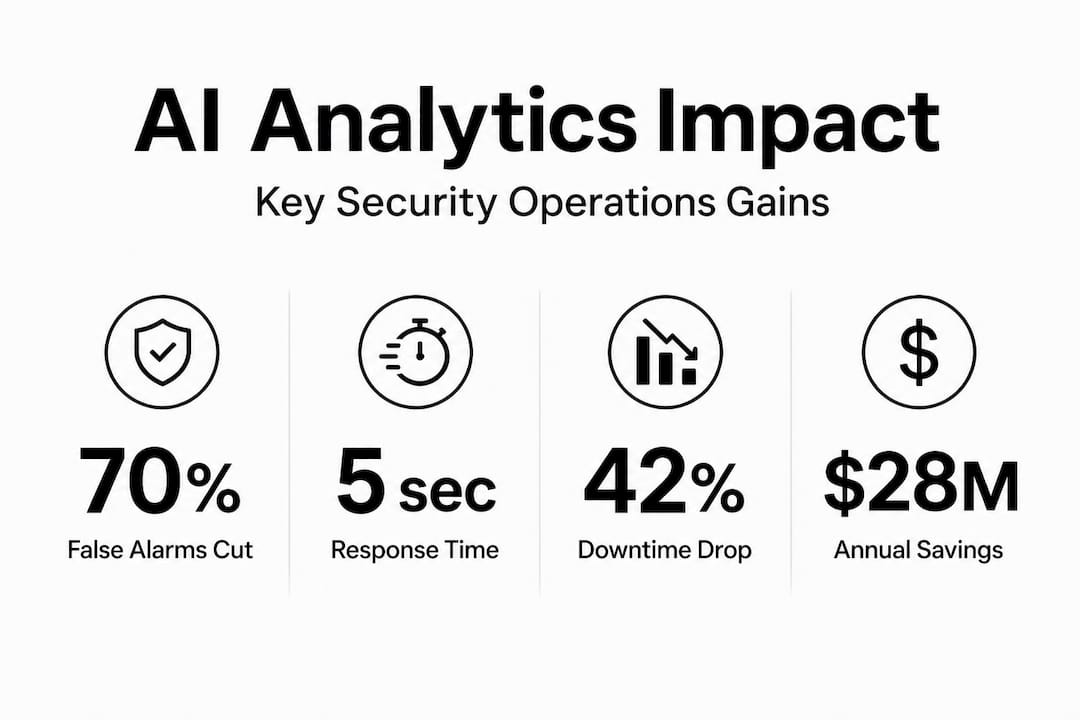
| Operational Metric | Without AI Analytics | With AI Analytics |
|---|---|---|
| False positive rate | High (60-80% of alerts) | Reduced by up to 70% |
| Anomaly-to-alert speed | Minutes to hours | Under 5 seconds |
| Unplanned downtime | Baseline | Reduced by 42% |
| Analyst fatigue | Severe | Significantly reduced |
| Annual cost savings | Baseline | Up to $28M documented |
Speed is the third pillar. Sub-5-second anomaly-to-alert response times mean security teams can intervene during an incident rather than after it. For environments like data centers, critical infrastructure, or manufacturing floors, that speed difference is the gap between containment and catastrophe.
For improving security efficiency, the human factor matters as much as the technology. AI handles the volume and velocity of sensor data that no human team can manage alone. Analysts are freed to apply judgment, context, and decision-making where it counts most.
Pro Tip: Set a baseline measurement of your current false positive rate and mean time to respond (MTTR) before deploying AI analytics. This gives you a concrete benchmark to measure real operational improvement within the first 90 days of deployment.
Key methodologies: Edge AI, hybrid models, and multi-sensor fusion
Understanding outcomes is key, but to apply AI analytics you need to know the main technical pathways and when to choose each.
Edge AI is the foundation for time-critical security applications. By running inference models directly on local hardware, edge AI eliminates the round-trip delay of sending data to a cloud server for processing. Edge AI achieves 23ms latency with detection accuracy in the 95 to 98% range and an AUC (area under the curve) of 0.96, which is a strong performance benchmark for binary classification tasks like threat detection. For perimeter security, access control, and real-time surveillance, edge AI is the right choice when speed is non-negotiable.
Hybrid models combine statistical anomaly detection with AI reasoning. Isolation Forest, a classical machine learning algorithm, excels at identifying outliers in high-dimensional sensor data without requiring labeled training examples. Paired with an LLM, the system can then reason about why something is anomalous and generate a human-readable alert summary. This combination is particularly effective for advanced sensing strategies in environments with complex, multi-variable sensor streams where pure statistical methods generate too much noise.
Multi-sensor fusion is where the real power of AI analytics becomes visible. Individual sensors have blind spots. A camera can be obscured. A motion sensor can be triggered by environmental factors. When you fuse data from multiple sensor modalities, such as thermal, acoustic, visual, and vibration, using deep learning architectures, the system builds a richer situational picture that is far harder to defeat or misinterpret.
Here's how the three methodologies compare across key operational criteria:
| Methodology | Latency | Best Use Case | Complexity | Infrastructure Need |
|---|---|---|---|---|
| Edge AI | ~23ms | Real-time perimeter, access control | Medium | Local compute hardware |
| Hybrid models | Low to medium | Complex anomaly detection | High | Cloud or on-premise ML platform |
| Multi-sensor fusion | Variable | Comprehensive situational awareness | Very high | Multi-sensor infrastructure |
To implement these effectively, security leaders should follow a structured approach:
- Assess your sensor infrastructure. Catalog existing sensor types, data formats, and network topology before selecting a methodology.
- Match methodology to use case. Use edge AI for latency-critical applications, hybrid models for nuanced anomaly detection, and fusion for full situational awareness.
- Pilot in a controlled zone. Run the chosen methodology in one area before scaling, using measurable KPIs to validate performance.
- Integrate with existing platforms. Ensure AI analytics outputs feed into your existing security information and event management (SIEM) or video management system (VMS).
- Plan for model updates. Environments change. Schedule regular retraining cycles to keep detection accuracy high.
Real-time sensing applications across industrial and infrastructure sectors are already proving these methodologies at scale. Staying current on emerging tech trends ensures your methodology choices remain competitive as the field evolves.
Pro Tip: When evaluating edge AI vendors, request AUC scores and latency benchmarks from real-world deployments, not just lab conditions. Field performance often differs significantly from controlled test environments.
Crucial challenges: Edge cases, adversarial attacks, and the human factor
State-of-the-art methodologies offer clear advantages, but implementation comes with specific challenges, both technical and human, that leaders must address to realize full value.
The first challenge is edge case handling. AI models trained on clean, representative data often struggle when they encounter noisy inputs, unusual environmental conditions, or deliberate manipulation. A sensor obscured by fog, a camera blinded by a strobe light, or an adversarial input designed to fool an image classifier can all produce dangerous blind spots. Edge case training improves detection performance by 35%, which is a significant gain that requires deliberate effort to capture diverse, challenging training scenarios.
Adversarial attacks are a growing concern in physical security AI. Bad actors who understand how AI models work can craft inputs specifically designed to evade detection. This requires security teams to treat their AI systems as potential attack surfaces and conduct regular robustness testing.
The human factor is equally important. Full AI autonomy introduces risk due to context gaps and model hallucinations. An AI system might flag a legitimate maintenance worker as a threat, or miss a coordinated intrusion because the pattern falls outside its training distribution. Human-on-the-loop models, where analysts review and validate AI decisions rather than simply executing them, provide the accountability layer that pure automation cannot.
Intelligent sensing technologies work best when paired with clear escalation protocols. Here are the organizational practices that make the biggest difference:
- Establish a dedicated AI validation role. Someone on the security team should own model performance monitoring, reviewing flagged events and tracking accuracy trends over time.
- Run adversarial testing quarterly. Simulate edge cases and adversarial scenarios to identify model weaknesses before real attackers do.
- Maintain a human review threshold. Define which alert categories always require human review before action is taken.
- Document model drift incidents. When performance degrades, log the conditions and feed corrected examples back into training data.
- Invest in tailored security systems rather than generic deployments. Custom-trained models for your specific environment outperform off-the-shelf solutions in edge case handling.
"The question isn't whether AI can handle security operations. It's whether your AI system has been tested against the conditions it will actually face."
Best practices for actionable AI analytics deployment
By meeting the challenges head-on, security leaders can make AI analytics a genuinely transformative tool. Here's how to put that into practice.
Effective deployment starts with a clear needs assessment. Before selecting any technology, map your current security gaps, identify which sensor streams generate the most noise, and define what "success" looks like in measurable terms. Vague goals produce vague results.
- Define measurable KPIs upfront. Target specific metrics: false positive rate, MTTR, anomaly detection accuracy, and uptime. These give you objective criteria to evaluate AI performance.
- Select methodology based on environment. High-speed perimeter needs edge AI. Complex multi-variable environments need hybrid models. Full situational awareness needs fusion.
- Train with diverse, edge case-rich data. Include unusual lighting, weather conditions, equipment anomalies, and simulated adversarial inputs in your training datasets.
- Implement human-on-the-loop oversight. Analysts should validate AI decisions, not just execute them. This catches errors and continuously improves model accuracy through feedback.
- Schedule performance reviews every 90 days. Model drift is real. Environments change, and AI models need to adapt. Regular reviews catch degradation before it becomes a security gap.
- Integrate lessons from adverse events. Every false negative or missed detection is a training opportunity. Build a formal process for capturing and incorporating these cases.
AI in SOC operations shows that false positive reduction of 70% and faster MTTR are achievable, but only when augmentation rather than full autonomy is the design principle. Model drift and poor context handling are the two most common failure modes in autonomous deployments.
For smarter industrial automation environments, integrating AI analytics into existing operational technology (OT) workflows requires careful change management. Operators who understand why the AI is flagging something are more likely to respond appropriately than those who simply see an alert.
Pro Tip: Create a "model health dashboard" that tracks false positive rate, detection accuracy, and alert volume week over week. A sudden spike in false positives is often the first sign of model drift or a new environmental variable the AI hasn't encountered before.
Why the real edge is hybrid human-AI collaboration, not total automation
There's a persistent narrative in the security industry that the end goal is full AI autonomy. Remove the human from the loop, eliminate the delay, and let the machine decide. We think that framing is not just wrong, it's operationally dangerous.
The organizations we see achieving the best outcomes are not the ones with the most autonomous AI. They're the ones that have designed deliberate collaboration between human expertise and AI capability. AI never blinks. It processes thousands of sensor events per second without fatigue. But it also lacks the contextual judgment that an experienced security director applies when something "feels off" in a way that doesn't fit any training pattern.
Full autonomy remains risky because AI systems can hallucinate, miss context, and drift from their training distribution without any visible warning sign. The consequences in a security environment are not just operational, they're reputational and potentially legal.
The better model is one where AI handles volume and speed, and humans handle judgment and accountability. Security leaders who invest in building that collaborative culture, training analysts to work with AI rather than behind it, consistently outperform those chasing full automation. The goal is not to remove the human. It's to make the human dramatically more effective. Staying ahead of security technology trends means recognizing that the most advanced organizations are doubling down on human-AI teaming, not eliminating the human element.
Connect with advanced AI analytics tailored to your security needs
The gap between knowing what AI analytics can do and actually deploying it effectively is where most security programs stall. BeyondSensor bridges that gap with purpose-built sensor intelligence platforms designed for the specific demands of industrial, infrastructure, and physical security environments.

Whether you're a security agency looking to modernize your operations or a system integrator building out a client's sensor ecosystem, BeyondSensor provides the hardware-software integration, regional expertise, and validation support to make AI analytics work in practice, not just in theory. Explore AI solutions for security agencies and solutions for system integrators to find the right fit for your operational context. For a broader view of what's possible, our AI-powered innovations showcase the latest sensing and analytics capabilities available today.
Frequently asked questions
What is edge AI and why does it matter for security?
Edge AI processes sensor data locally on the device itself, enabling 23ms latency and 95-98% detection accuracy without relying on network connectivity, making it ideal for rapid-response security environments where every second counts.
How does AI reduce false alarms in sensor-based security?
Advanced AI analytics learns contextual patterns in normal and abnormal activity, achieving a 70% reduction in false positives by distinguishing genuine threats from benign sensor triggers that would overwhelm a rule-based system.
Are there risks with fully autonomous AI in security?
Yes. Full autonomy is risky because AI systems can miss critical context, hallucinate, or drift from their training distribution, which is why human-on-the-loop oversight remains the best practice for accountable security operations.
How much can AI analytics reduce downtime for security operations?
Predictive maintenance using AI has reduced unplanned downtime by 42% and generated $28 million in annual savings in documented real-world deployments, making it one of the highest-ROI applications of sensor analytics.
What should be included in AI model training for robust security operations?
Training must include edge cases such as noisy sensor data, unusual lighting, adversarial inputs, and rare event scenarios. Edge case training improves detection performance by 35%, which is a meaningful accuracy gain that directly reduces security gaps in production environments.
Recommended
- Explore emerging security technology trends for 2026 | News | BeyondSensor
- Top intelligent sensing technologies to boost facility security | News | BeyondSensor
- Understanding advanced sensing: boost security and efficiency | News | BeyondSensor
- Top sensor security tips for safety & compliance 2026 | News | BeyondSensor
Read More Articles
RTSP Security Risks: Integrators Must Block Exposed Ports 554 and 8554
See how integrators can reduce RTSP security risks: close exposed ports 554 and 8554, secure camera access, and verify each deployment with practical checks.
Require MAEpp and X Accuracy Before You Buy People Counting Systems
Verify people counting accuracy by demanding MAEpp, X Accuracy, and directional-bias reports. Validate on-site with at least 100 events per direction...
30–90 Day Pilot Validates Redundant Camera Networks for Engineers
Standards led, practical steps for engineers to deploy redundant camera networks: MRP, dual homing, and aggregation patterns, commissioning checks, and...
30 Day Pilot Proves Video Analytics Accuracy for Security Teams
Validate video analytics accuracy with scenario tests, camera tuning, transfer learning and a 30 day edge first pilot for security teams.
Let's Build YourSecurity Ecosystem.
Whether you're a System Integrator, Solution Provider, or an End-User looking for trusted advisory, our team is ready to help you navigate the BeyondSensor landscape.
Direct Advisory
Connect with our regional experts for tailored solutioning.