
Discover the top security technology trends for 2026, including autonomous sensor management and AI analytics with AUC 0.96 and 23ms latency for industrial and government sectors.

Explore emerging security technology trends for 2026

TL;DR:
- Next-generation security systems use AI-powered edge analytics for faster, more accurate threat detection.
- Autonomous sensor management counters deception attempts and enables real-time validation across multiple feeds.
- Successful adoption relies on defining requirements, assessing infrastructure, and rigorous, environment-specific testing.
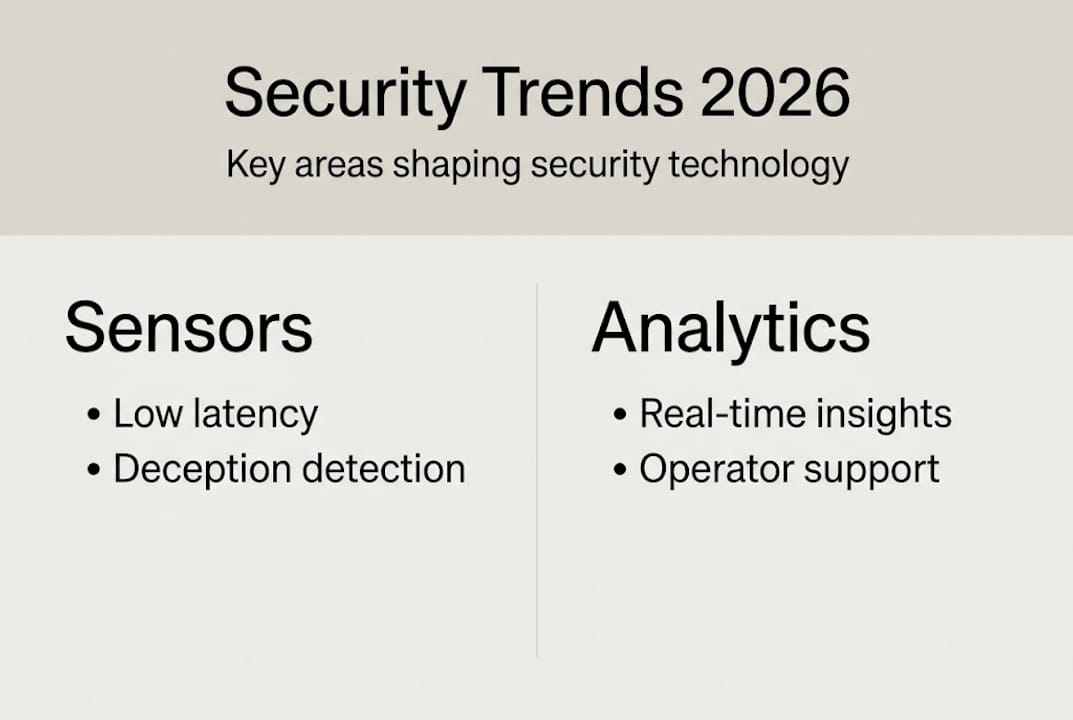
Traditional security systems were built for a different threat environment. Today, adversaries move faster, use deception more effectively, and exploit gaps that static cameras and rule-based alarms simply cannot close. AI-powered analytics on edge devices now achieve benchmarks that legacy systems cannot match, processing threats in real time with accuracy that manual oversight cannot replicate. This article breaks down the most critical security technology trends shaping industrial and government operations in 2026, covering autonomous sensor management, AI-driven analytics, and a practical roadmap for adoption. If you are responsible for securing critical infrastructure, these are the developments you cannot afford to ignore.
Table of Contents
- Understanding the new landscape of security technology
- Autonomous sensor management: Detecting deception and improving ISR
- AI-powered analytics: Achieving real-time, actionable security insights
- Practical implementation: Steps and pitfalls for adopting new sensor tech
- A fresh perspective: Why real-world deployment matters more than shiny features
- Next steps: Connect with advanced security solutions
- Frequently asked questions
Key Takeaways
| Point | Details |
|---|---|
| AI analytics boost accuracy | Edge AI delivers up to 0.96 AUC and rapid threat detection for security teams. |
| Autonomous sensors counter deception | Proactive sensor management strengthens Intelligence, Surveillance, and Reconnaissance in government and industrial settings. |
| Successful adoption demands planning | Security managers must follow stepwise implementation and prioritize compliance and vendor selection. |
| Deploy for real results | Prioritizing tech that has been demonstrated under real-world conditions ensures resilient, effective security. |
Understanding the new landscape of security technology
Security technology is no longer a passive discipline. The shift from reactive, human-monitored systems to proactive, sensor-driven platforms is accelerating across every major sector. Industrial facilities, government installations, and critical infrastructure operators are all facing the same reality: the threat landscape has outpaced the tools most organizations still rely on.
The core change is integration. Sensors are no longer standalone devices that record and transmit raw data. They now operate within layered architectures that combine edge computing, machine learning, and real-time analytics. This means a single sensor node can detect anomalies, classify threats, and trigger responses without waiting for a human to review footage or interpret an alarm.
Key capabilities defining the new generation of intelligent sensing technologies include:
- Spatial-temporal fusion: Combining data from multiple sensors across time to identify behavioral patterns, not just isolated events
- Edge inference: Running AI models directly on hardware at the point of collection, reducing latency and bandwidth demands
- Multimodal sensing: Integrating video, acoustic, thermal, and environmental data into a single decision framework
- Adaptive thresholds: Systems that learn baseline behavior and flag genuine deviations rather than generating constant false alarms
These capabilities translate directly into measurable performance gains. The table below compares legacy and next-generation sensor systems across key operational metrics:
| Metric | Legacy systems | Next-gen sensor systems |
|---|---|---|
| Threat detection latency | 2 to 10 seconds | Under 50ms |
| False positive rate | High (15 to 30%) | Low (under 5%) |
| Human oversight required | Constant | Exception-based |
| Scalability | Limited | Modular and cloud-ready |
| Deception resistance | Minimal | Built-in counter-deception |
For advanced sensing for efficiency, the performance gap between old and new is not marginal. It is operational. Organizations that continue relying on legacy infrastructure are not just missing features. They are accepting measurable risk. Autonomous sensor management detects and counters deception in ISR (Intelligence, Surveillance, and Reconnaissance) operations, making it a critical capability for government sectors in particular. Reviewing sensor security tips as part of your technology refresh is a practical starting point.
Autonomous sensor management: Detecting deception and improving ISR
Autonomous sensor management is one of the most significant advances in security operations today. In ISR contexts, the ability to detect and counter deception is not a nice-to-have feature. It is a core operational requirement. Adversaries actively attempt to spoof, jam, or manipulate sensor feeds to create blind spots and false confidence.

Manual sensor management cannot keep pace with these tactics. A human operator monitoring dozens of feeds cannot simultaneously verify data integrity, cross-reference sensor outputs, and identify coordinated deception attempts. Autonomous systems can.
Here is how autonomous sensor management compares to traditional manual approaches:
| Capability | Manual sensor management | Autonomous sensor management |
|---|---|---|
| Response time to deception | Minutes | Milliseconds |
| Cross-sensor validation | Operator-dependent | Automated and continuous |
| Adaptive tasking | Static schedules | Dynamic, threat-driven |
| Scalability | Constrained by staffing | Unlimited sensor nodes |
| Fatigue risk | High over long shifts | None |
"Autonomous sensor management is not just about speed. It is about maintaining decision advantage when adversaries are actively trying to degrade your situational awareness."
For government sector users, the funding landscape reflects this urgency. Autonomous sensor networks are funded to reach demonstration stage in 2026, signaling that governments are moving from research to real-world deployment. This is not a future technology. It is arriving now.
Core benefits of autonomous sensor management for security operations include:
- Real-time cross-sensor data validation to flag inconsistencies that indicate spoofing
- Dynamic reallocation of sensor resources based on evolving threat priorities
- Automated logging and audit trails that support security compliance in sensors and regulatory reporting
- Reduced operator workload, allowing security teams to focus on decision-making rather than data monitoring
- Continuous learning from past incidents to improve future threat classification
For industrial operators, the same principles apply. Production environments with large perimeters and multiple access points benefit enormously from systems that can autonomously coordinate sensor coverage without requiring constant human direction.
AI-powered analytics: Achieving real-time, actionable security insights
Performance numbers matter in security. When evaluating AI-powered analytics platforms, three metrics define operational fitness: AUC (Area Under the Curve, a measure of classification accuracy), F1 score (the balance between precision and recall), and inference latency. AI-powered analytics deliver AUC 0.96, F1 0.94, and 23ms latency on edge hardware. These are not laboratory figures. They represent what security managers can expect from production-grade deployments.
Twenty-three milliseconds is faster than a human blink. At that speed, AI analytics can identify a threat, validate it against historical patterns, and trigger a response before a human operator has finished reading the alert.
Spatial-temporal fusion is the technique driving much of this performance. By analyzing how objects and individuals move across sensor coverage zones over time, AI systems distinguish genuine threats from routine activity with far greater precision than single-frame analysis allows.
For operational efficiency insights, here is a practical deployment sequence for integrating AI analytics into existing security infrastructure:
- Audit your current sensor coverage to identify gaps, overlapping zones, and hardware that cannot support edge inference
- Define threat scenarios specific to your environment, whether that is perimeter intrusion, access control violations, or behavioral anomalies
- Select an AI analytics platform with published benchmark metrics (AUC, F1, latency) validated on hardware similar to yours
- Run a phased pilot on a defined zone before full deployment, using real incident data to calibrate detection thresholds
- Integrate with your existing SIEM or command platform to ensure alerts flow into your established response workflows
- Establish ongoing model retraining cycles using new incident data to maintain accuracy as threat patterns evolve
Pro Tip: Do not evaluate AI analytics platforms on demo footage alone. Request benchmark results from deployments in environments comparable to yours, specifically industrial or government settings with similar sensor densities and lighting conditions.
For security agency solutions, AI analytics also reduce the cognitive load on operators by filtering noise and surfacing only high-confidence alerts. Exception-based monitoring replaces the exhausting practice of watching every feed continuously.
Practical implementation: Steps and pitfalls for adopting new sensor tech
Knowing the technology is one thing. Deploying it successfully is another. Most failed security technology projects share the same root causes: poor requirements definition, vendor lock-in, and underestimating integration complexity.
Autonomous sensor management and edge AI frameworks are demonstration-ready, which means the technology is mature enough for serious organizational adoption. The challenge is execution.
Follow this roadmap to reduce adoption risk:
- Define operational requirements first. Identify the specific threats you need to detect, the environments involved, and the response workflows you need to support. Technology selection follows requirements, not the other way around.
- Assess existing infrastructure compatibility. Determine which sensors, networks, and command systems can integrate with new platforms and which need replacement.
- Prioritize open standards. Avoid proprietary ecosystems that limit your ability to swap vendors or add capabilities later.
- Validate compliance requirements early. Different sectors carry different regulatory obligations. Confirm that your chosen platform meets applicable standards before procurement.
- Plan for maintenance from day one. Sensor networks degrade over time. Build maintenance schedules, firmware update cycles, and hardware refresh timelines into your project plan.
- Train your operators. Even autonomous systems require skilled human oversight for exception handling, escalation, and post-incident analysis.
Pro Tip: Treat vendor selection as a long-term partnership, not a transaction. Evaluate vendors on their post-deployment support capability, regional presence, and track record with organizations similar to yours.
Common pitfalls to avoid:
- Skipping the pilot phase and deploying at full scale before validating performance in your specific environment
- Underestimating integration complexity between new sensor platforms and legacy command systems
- Selecting vendors based on features alone without verifying real-world deployment references
- Neglecting cybersecurity for sensor networks, which are increasingly targeted as entry points into broader operational technology environments
For tailored security solutions, the difference between a successful deployment and a costly failure often comes down to how rigorously the implementation phase is managed.
A fresh perspective: Why real-world deployment matters more than shiny features
Here is something most technology articles will not tell you: the gap between a feature list and a functioning deployment is where most security technology investments fail. We see it repeatedly across government and industrial projects. A platform performs brilliantly in a controlled demonstration and then struggles under the unpredictable conditions of a real operational environment.
Resilience and adaptability are the metrics that matter most, yet they rarely appear in vendor datasheets. A system that achieves AUC 0.96 in ideal conditions but degrades significantly under sensor noise, adverse weather, or deliberate interference is not a reliable security asset.
For security agency expertise, the lesson from major government and industrial deployments is consistent: prioritize vendors who can demonstrate performance under stress, not just in optimized scenarios. Ask for case studies from environments that match your own. Demand transparency about failure modes. The organizations that get the most from advanced sensor technology are the ones that treat deployment rigor as seriously as technology selection.
Next steps: Connect with advanced security solutions
The trends covered here represent a genuine shift in what security technology can deliver for industrial and government operations. Putting them to work requires more than awareness. It requires the right partners.

At BeyondSensor, we work directly with solutions for security agencies and government user solutions to design, validate, and deploy sensor-based security systems built for real-world conditions. Our regional presence across Singapore, Malaysia, and the Philippines means we bring localized expertise, not just global catalogs. Whether you are evaluating autonomous sensor platforms, AI analytics integration, or compliance-ready infrastructure, explore BeyondSensor to connect with specialists who understand your sector's specific demands.
Frequently asked questions
What makes autonomous sensor management better than manual systems?
Autonomous sensor management detects and counters deception in real time across multiple sensor feeds simultaneously, a task that exceeds the practical limits of human operators, especially over extended shifts.
How fast are AI-powered analytics for security threat detection?
AI-powered analytics achieve 23ms latency on edge hardware, meaning threats are identified and flagged faster than any manual monitoring process can match.
What are the main steps to adopt new sensor technologies?
Start with requirements definition, assess infrastructure compatibility, select compliant vendors, run a phased pilot, and build ongoing maintenance into your plan from the start. Demonstration-ready frameworks mean the technology is available for serious organizational adoption today.
Why is real-world deployment important for new security technologies?
Real-world deployment exposes performance gaps that controlled demonstrations conceal, ensuring your security investment holds up under the unpredictable and adversarial conditions of actual operations.
Recommended
Read More Articles

97% Takeover Success Demoed: Sensor Fusion Security for Practitioners
For security teams and system integrators: harden sensor fusion security with ETSI hardware controls, documented attack evidence, and a practical...

Stop False Dispatches: 5 SOP Steps for Singapore Alarm Triage
SOP first, verification led alarm triage workflow for Singapore facilities. Five SOP steps aligned to PDPC, SGPolice and ABS guidance.

Singapore Procurement: Live Pilot for Intrusion Detection Analytics
Procurement-first checklist for Singapore teams: require live pilots, add PDPA checks to RFPs, and judge intrusion detection analytics by pilot results...

Avoid Outages: IMDA/JST Camera Firmware Management for Administrators
Practical operations-first guidance for security administrators to run staged, auditable firmware updates across multi-site camera fleets, aligned to IMDA...
Let's Build YourSecurity Ecosystem.
Whether you're a System Integrator, Solution Provider, or an End-User looking for trusted advisory, our team is ready to help you navigate the BeyondSensor landscape.
Direct Advisory
Connect with our regional experts for tailored solutioning.