
Unlock safety with strategies for defining physical security ecosystems. Discover how integration enhances operational efficiency for security leaders.

Integrated physical security ecosystems: strategies for protection

TL;DR:
- A physical security ecosystem integrates people, technology, and protocols for coordinated security responses.
- Layered defense models use concentric zones with increasing controls to prevent unauthorized access.
- Effective security relies on technology, procedures, and ongoing training, not just visible measures.
Security managers who deploy more systems without connecting them often end up with more gaps, not fewer. Separate access control platforms, standalone camera feeds, and isolated alarm panels each generate their own data streams, but none of them talk to each other. The result is fragmented alerts, delayed responses, and operators who spend more time reconciling contradictory information than acting on it. This article cuts through that confusion by defining what a genuine physical security ecosystem looks like, how layered defense models work in practice, and which integration methodologies deliver real operational gains for security leaders across Southeast Asia.
Table of Contents
- What is a physical security ecosystem?
- Layered security models and defense in depth
- Integration methodologies for efficient security management
- The impact of cyber-physical convergence and operational realities
- Real-world outcomes: Lessons from integrated and gated systems
- Beyond conventional wisdom: Why integration isn't a silver bullet
- Connecting your security vision with BeyondSensor
- Frequently asked questions
Key Takeaways
| Point | Details |
|---|---|
| Ecosystem approach | Combining technologies and procedures creates a resilient security environment. |
| Layered defense | Using multiple, escalating protection zones greatly deters and delays threats. |
| Integrated response | Centralized systems enable faster, smarter decisions and reduce alert fatigue. |
| Avoid false security | Visible measures are only effective if backed by real procedures and ongoing review. |
What is a physical security ecosystem?
A physical security ecosystem is not simply a collection of cameras and locks. It is a coordinated architecture where people, technologies, and response protocols operate as a unified whole. Every component, from perimeter sensors to control room software, shares data and triggers coordinated actions rather than generating isolated alerts.
The core elements of a well-built ecosystem include:
- Access control systems: Credential-based or biometric solutions that govern who enters which zones and when.
- Video surveillance: Networked cameras with intelligent analytics that flag anomalies in real time.
- Physical barriers: Fencing, bollards, reinforced entry points, and security glazing that slow or stop unauthorized access.
- Alarm and detection systems: Motion sensors, glass-break detectors, and environmental monitors that feed into a central platform.
- Centralized management platforms: Software layers that aggregate, normalize, and present all incoming data to security operators.
The management layer is where the ecosystem either succeeds or fails. Without it, each component remains a silo. With it, a door forced open at a restricted zone can automatically trigger camera focus, alert a response team, and lock adjacent access points, all within seconds.
Modern ecosystems leverage three principal integration platforms. PSIM (Physical Security Information Management) collects and normalizes events from disparate subsystems into a single operational view. SIEM (Security Information and Event Management) correlates security events across physical and cyber domains to identify patterns. SOAR (Security Orchestration, Automation, and Response) takes that correlation further by automating predefined response workflows. As SOC integration methodology makes clear, these platforms represent a layered model moving from event collection to normalization to orchestration, each layer adding intelligence and speed.
"A physical security ecosystem that lacks a unifying management layer is like a hospital with no emergency dispatch. Every department may be excellent, but without coordination, patients fall through the cracks."
Reviewing physical security best practices for Southeast Asian facilities confirms that the shift from piecemeal installation to genuine ecosystem thinking is the single most impactful operational decision a security director can make. It changes security from a reactive cost center into a proactive, intelligence-driven function.
Layered security models and defense in depth
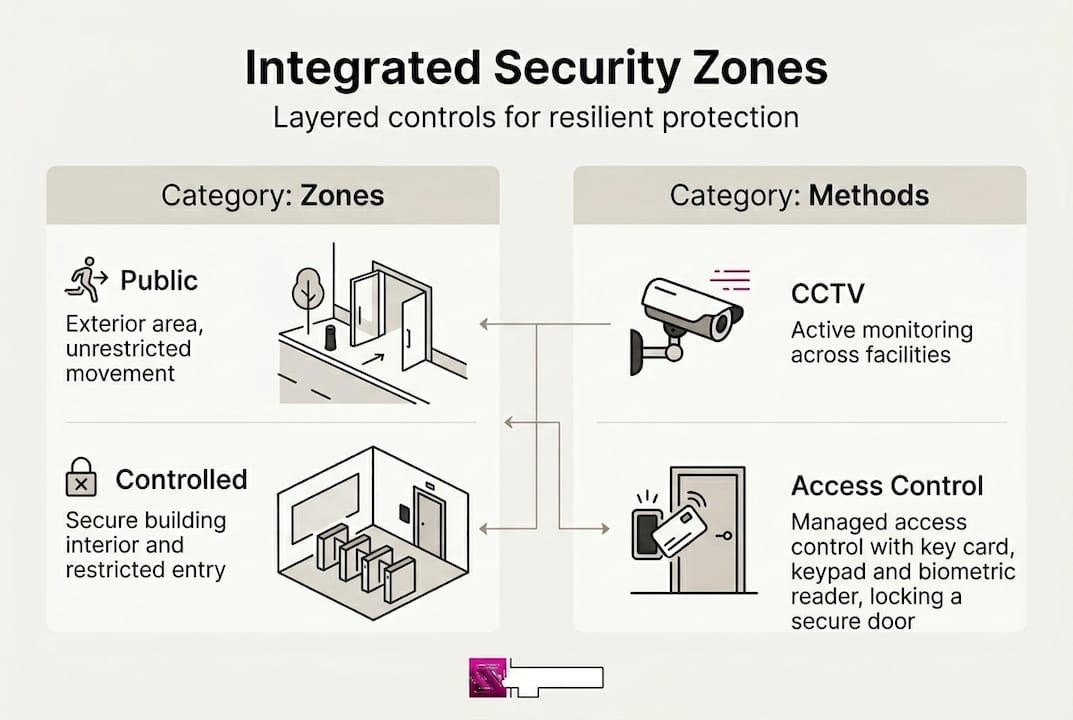
With the ecosystem defined, the next question is how to structure protection so that no single failure point exposes critical assets. The answer is defense in depth, a model that builds security through concentric zones, each with progressively stricter controls.
Defense in depth establishes four primary zones arranged from outermost to innermost:
| Zone | Label | Primary control method |
|---|---|---|
| 1 | Public | Signage, CCTV, open-area patrol |
| 2 | Controlled | Badge access, visitor management |
| 3 | Restricted | Biometric authentication, mantrap entry |
| 4 | Critical | Dual control, armed oversight, vault-grade barriers |
The logic is straightforward. An intruder who breaches the public zone still faces controlled-zone barriers. Defeating those still leaves restricted-zone biometrics intact. Each layer buys time for detection and response, and that time is operationally decisive.
Here is how security teams can apply this model in practice:
- Map your asset criticality. Identify which assets require the highest protection (server rooms, evidence storage, executive areas) and work outward from there to define zone boundaries.
- Match controls to zone risk. Do not apply biometric-level cost to low-risk public areas. Calibrate investment to the threat level at each boundary.
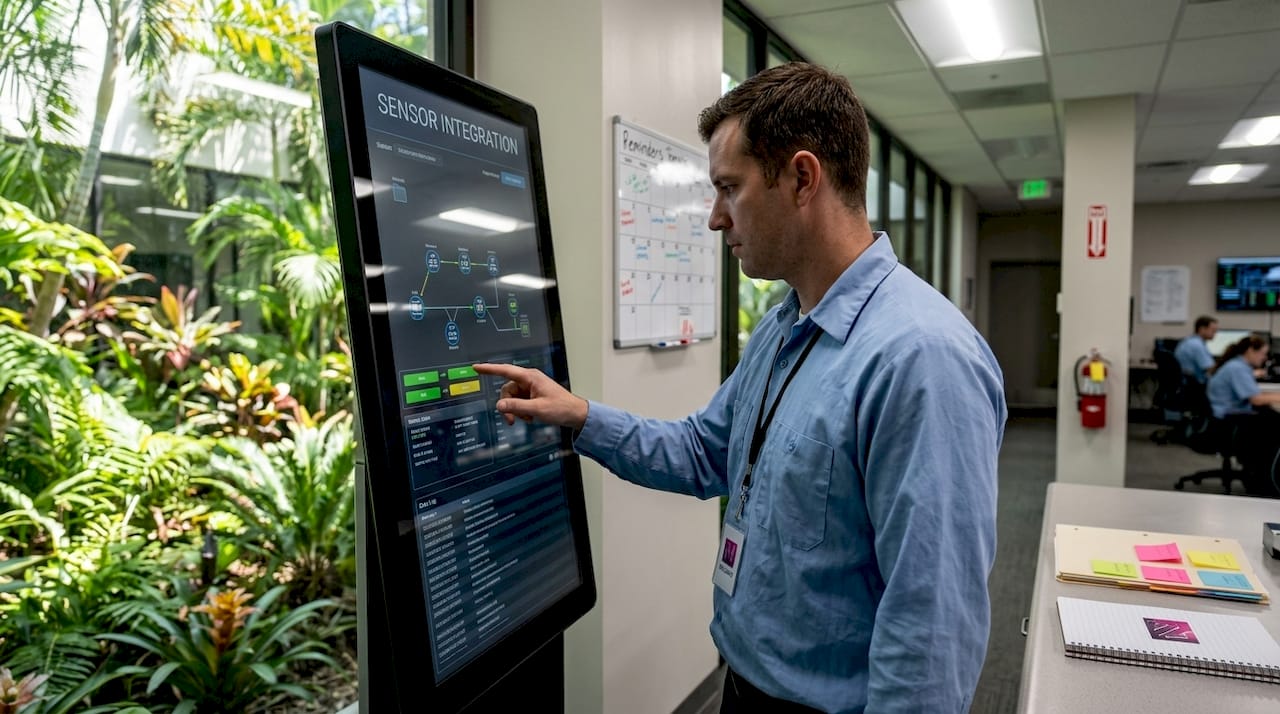
- Integrate sensor coverage across zones. Use advanced sensor technology to ensure that any boundary event is detected and logged, not just alerted to a standalone panel.
- Define escalation triggers. When a controlled-zone event occurs, what automatically happens at the restricted zone? These protocols must be built into the management platform, not left to operator discretion.
- Test transitions, not just components. Most incidents exploit the gaps between zones, not the controls within a single zone.
Pro Tip: When designing zone boundaries in facilities with high foot traffic, such as commercial towers or mixed-use developments common in Singapore and Kuala Lumpur, consider time-based zone reclassification. A lobby may function as a public zone during business hours and automatically shift to a controlled zone after hours, with corresponding access rules activated automatically.
The defense in depth best practices that apply to Southeast Asian facilities must also account for local realities. Tropical climates affect sensor and barrier durability. High-density urban environments create overlapping fields of coverage that need careful calibration to avoid false positives. Zone boundaries in a high-rise are vertical as well as horizontal.
Integration methodologies for efficient security management
Now that we've explored the importance of layers, it's critical to see how integration ties these elements into a cohesive, actionable ecosystem. There are four dominant integration methodologies in use today, each with distinct tradeoffs.
| Methodology | Strengths | Limitations |
|---|---|---|
| Unified PSIM | Single operational view, vendor-neutral | High upfront cost, complex to configure |
| Direct SIEM integration | Strong cyber-physical correlation | Requires dedicated security analysts |
| Hybrid SOC | Flexible, scalable, cost-effective | Needs clear governance between teams |
| Federated model | Distributed resilience, no single point of failure | Coordination overhead, latency risk |
SOC integration frameworks confirm that PSIM handles event normalization across physical subsystems, while SIEM and SOAR handle cross-domain correlation and automated response. Organizations choosing between these models should evaluate three factors: existing technology footprint, analyst capacity, and bandwidth availability.
Bandwidth is particularly relevant in Southeast Asia. Facilities in secondary cities across Malaysia, the Philippines, and Thailand often face variable connectivity. A closed, AI-driven platform that depends on cloud processing can become unreliable or completely non-functional when connectivity drops. Hybrid and open architectures address this by maintaining edge-based processing locally and syncing to central systems when bandwidth allows.
The efficiency gains from well-executed integration are significant:
- Reduced alert fatigue: Correlated events replace isolated alerts, so operators receive fewer but higher-confidence notifications.
- Faster mean time to detect (MTTD): Automated event normalization means threats are identified in seconds, not minutes.
- Reduced mean time to respond (MTTR): SOAR-triggered workflows dispatch response teams and adjust access controls automatically.
- Better audit trails: Integrated systems produce synchronized logs across all subsystems, critical for post-incident analysis and regulatory compliance.
Exploring step-by-step integration resources shows that organizations which approach integration in structured phases, starting with normalization, then adding correlation, then enabling automation, consistently outperform those that attempt full automation from day one. Equally, optimizing security workflows through sensor-driven data reduces the manual reconciliation burden that consumes so much operator time in fragmented environments.
The role of intelligent sensing technologies is central here. Sensors that provide structured, calibrated data reduce the normalization burden on the integration platform, accelerating the entire detection-to-response chain.
The impact of cyber-physical convergence and operational realities
With the technical methods of integration clear, let's look at cyber-physical realities and emerging risks that often get overlooked in standard planning. The boundary between physical and digital security is eroding. An access control system is now also a networked device. A surveillance platform is also a data processor. A building management system is also a potential attack vector.
This convergence creates risks that purely physical or purely cyber frameworks cannot address alone:
- Credential theft enabling physical access: Stolen digital credentials can unlock physical barriers, bypassing all traditional perimeter controls.
- Network-based manipulation of physical devices: Compromised firmware in a camera or sensor can disable detection at a critical zone boundary.
- Subscription lapse disabling AI modules: Proprietary AI-based security modules tied to cloud subscription models can become non-functional if licensing lapses, a real operational risk for budget-constrained teams.
- Fragmented alerts from disconnected systems: Without PSIM or SIEM integration, a cyber intrusion that simultaneously triggers physical alarms produces competing notifications with no unified context.
"Cyber-physical convergence means that a network packet and a door being forced open may be the same attack, just seen from different angles. Your security ecosystem must be capable of connecting those angles in real time."
Southeast Asian deployments face an additional challenge: variable bandwidth across geographically dispersed facilities. Open, hybrid deployments that process events locally and transmit only normalized alerts centrally are better suited to these conditions than fully cloud-dependent architectures.
Pro Tip: Before selecting any AI-driven security module, verify whether its core detection functions operate on-premises or require continuous cloud connectivity. For facilities in areas with unreliable internet infrastructure, on-premises or edge-based AI processing is not optional—it is mission-critical.
Staying current with security compliance strategies and understanding physical security compliance standards becomes increasingly important as regulatory frameworks across Southeast Asia begin to address cyber-physical integration requirements explicitly. Facilities that build compliance into their ecosystem architecture from the start avoid costly retrofit work later.
Real-world outcomes: Lessons from integrated and gated systems
To bring these principles to life, let's look at the real-world effectiveness and limitations of integrated security deployments. Empirical evidence provides both encouragement and important caution for security managers planning major ecosystem investments.
Research on gated community security offers useful data. Studies on gated community crime patterns show property crime reductions of 22 to 24 percent following comprehensive physical security implementation. However, the same research found no statistically significant impact on violent crime, and identified a measurable risk of complacency, sometimes called "false security," among residents and operators who over-rely on visible security measures.
| Security outcome | Observed result | Risk factor |
|---|---|---|
| Property crime reduction | 22-24% decrease | Complacency after visible measures deployed |
| Violent crime impact | No significant reduction | Behavioral risks require different interventions |
| Operator alertness | Declines with routine | Rotation, training, and incident drills required |
| System effectiveness over time | Degrades without review | Requires scheduled assessments and updates |
The practical lessons from these findings are direct:
- Visible deterrence has real value, but limited scope. Cameras, barriers, and signage reduce opportunistic property crime effectively. They do not address determined, organized, or violent threat actors.
- Complacency is a documented operational risk. Teams that see no incidents begin to assume their systems are working perfectly, when in fact systems may be degrading without detection.
- Regular drills and incident simulations matter. Security ecosystems that are never tested under realistic conditions produce operators who lack the muscle memory to respond effectively when real events occur.
- Continuous improvement cycles are non-negotiable. Technology capabilities, threat patterns, and facility operations all change. A security ecosystem that was optimally configured two years ago may have significant gaps today.
"The greatest threat to a well-integrated security ecosystem is not the next attack. It is the assumption that the system is working because nothing has gone wrong recently."
Strategies to avoid false security include scheduled penetration testing of physical zones, regular review of sensor coverage maps, and quarterly calibration checks across detection subsystems. Security managers who build these reviews into their operational calendar, rather than treating them as reactive responses to incidents, consistently maintain more effective ecosystems over time.
Beyond conventional wisdom: Why integration isn't a silver bullet
The empirical evidence and integration frameworks presented here are genuinely useful. But there is a perspective that rarely appears in vendor documentation: technical integration alone does not produce security.
We have seen facilities with fully unified PSIM platforms, complete zone coverage, and automated SOAR workflows that still experienced serious security failures. The common factor in each case was not a technology gap. It was a human one. Operators who did not understand the alerts they were receiving, managers who had not reviewed response protocols in over a year, and organizations where security culture had quietly eroded while the dashboard looked green.
Physical security context matters more than any individual technology. A solution optimized for a high-security government facility in Singapore will perform poorly if deployed without adaptation in a mid-rise commercial building in Cebu or a manufacturing campus in Johor Bahru. Local threat profiles, staffing models, and operational rhythms are not footnotes to the integration strategy. They are the integration strategy.
Integration is a force multiplier for a security organization that is already functioning well. It is not a corrective for a security organization that lacks discipline, training, or clear accountability. Security managers who recognize this distinction will allocate investment across technology and people, not instead of people.
Connecting your security vision with BeyondSensor
Building a genuinely integrated physical security ecosystem requires more than selecting the right platforms. It requires a partner with regional expertise, validated hardware-software solutions, and the ability to match your operational needs to the right sensing technologies.

BeyondSensor works with system integrators and security agencies across Singapore, Malaysia, and the Philippines to design and deploy sensor-based ecosystems built for real Southeast Asian conditions, including variable bandwidth environments, high-density facilities, and complex compliance requirements. Our advanced security tools are engineered to accelerate integration, reduce deployment risk, and deliver measurable operational gains from day one. Explore how BeyondSensor can help you move from fragmented systems to a cohesive, high-performance security ecosystem.
Frequently asked questions
What is the main benefit of an integrated physical security ecosystem?
Integration enables seamless event detection, faster response, and reduces missed or duplicate alerts by centralizing management through PSIM and SIEM/SOAR platforms, giving operators a single, correlated operational picture instead of competing data streams.
How do layered security models improve facility protection?
Defense in depth adds increasing levels of control from the public perimeter to critical inner zones, making unauthorized access progressively harder and buying response time at each boundary.
Can technology alone prevent all security incidents?
No. Technology enhances detection and response capabilities, but strong procedures, regular staff training, and a proactive security culture are what convert those capabilities into actual protection outcomes.
How can organizations avoid "false security" from visible measures?
Regular assessments, penetration testing, operator training, and continuous system calibration reduce the gap between perceived and real protection, based on evidence showing that visible measures alone address only a subset of security risks.
Recommended
Read More Articles
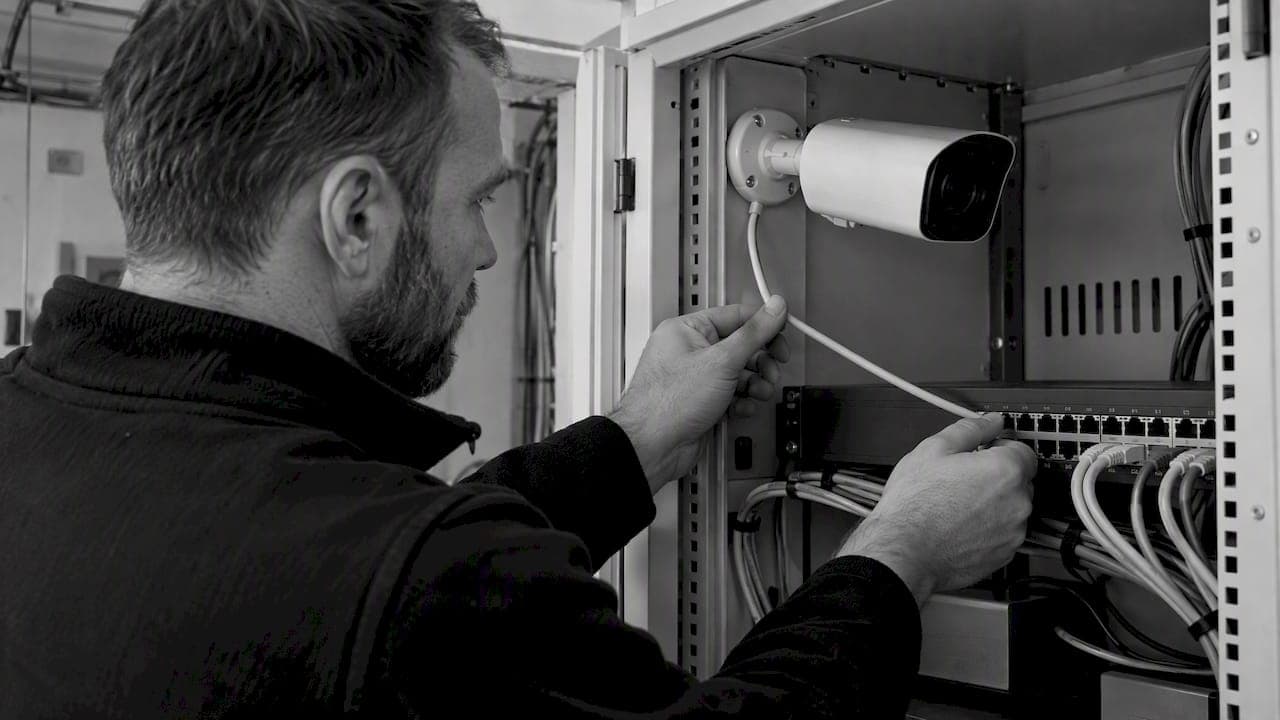
RTSP Security Risks: Integrators Must Block Exposed Ports 554 and 8554
See how integrators can reduce RTSP security risks: close exposed ports 554 and 8554, secure camera access, and verify each deployment with practical checks.

Require MAEpp and X Accuracy Before You Buy People Counting Systems
Verify people counting accuracy by demanding MAEpp, X Accuracy, and directional-bias reports. Validate on-site with at least 100 events per direction...
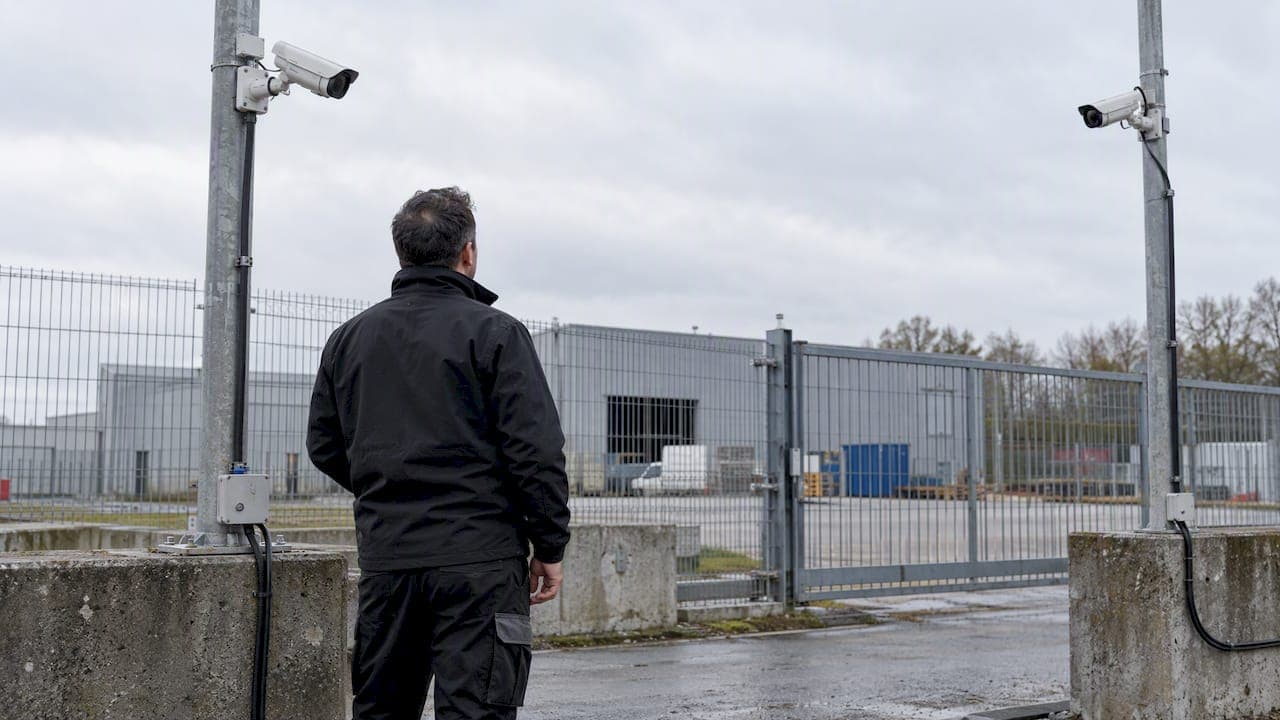
30–90 Day Pilot Validates Redundant Camera Networks for Engineers
Standards led, practical steps for engineers to deploy redundant camera networks: MRP, dual homing, and aggregation patterns, commissioning checks, and...
30 Day Pilot Proves Video Analytics Accuracy for Security Teams
Validate video analytics accuracy with scenario tests, camera tuning, transfer learning and a 30 day edge first pilot for security teams.
Let's Build YourSecurity Ecosystem.
Whether you're a System Integrator, Solution Provider, or an End-User looking for trusted advisory, our team is ready to help you navigate the BeyondSensor landscape.
Direct Advisory
Connect with our regional experts for tailored solutioning.