
Learn how secure sensing defends industrial and environmental operations beyond encryption, covering RF attacks, layered defenses, and future-proof strategies.

Secure Sensing Explained: Defend Industrial & Environmental Ops

TL;DR:
- Secure sensing protects wireless hardware, signals, and software layers beyond encryption alone.
- Attacks include jamming, spoofing, eavesdropping, model poisoning, and adversarial perturbations.
- Layered defenses, including physical-layer security and trust-aware learning, are essential for resilience.
Encryption is the first line of defense most organizations think of, but it is far from the only one that matters. In high-stakes environments like industrial automation plants and environmental monitoring networks, attackers do not just target your data in transit. They target your sensors, your wireless signals, and the decisions those signals drive. Secure sensing refers specifically to protecting wireless and RF-based sensing technologies against jamming, eavesdropping, spoofing, and adversarial perturbations while keeping sensing functionality intact. For security managers overseeing critical operations, understanding this distinction is not optional. It is the foundation of every resilient defense strategy.
Table of Contents
- Defining secure sensing: Beyond encryption
- Common attacks and vulnerabilities in wireless and RF sensing
- Layered defense strategies: Technology and process
- Challenges, best practices, and the future of secure sensing
- Why physical-layer security is the next leap in secure sensing
- Find your secure sensing solution with BeyondSensor
- Frequently asked questions
Key Takeaways
| Point | Details |
|---|---|
| Physical threats matter | Secure sensing defends against not just hackers but also signal jamming, spoofing, and device-level attacks. |
| Layered security is vital | Combining physical, network, and application-layer protections makes sensing far more resilient. |
| Best practices outpace older models | Modern frameworks using federated learning and physical-layer security outperform legacy approaches by up to 32%. |
| Future is spectrum-centric | Protecting the radio spectrum and hardware is essential for 6G and advanced industrial systems. |
Defining secure sensing: Beyond encryption
With the misconception addressed, let's pinpoint exactly what secure sensing protects against and why it matters so much for industrial and environmental operations.
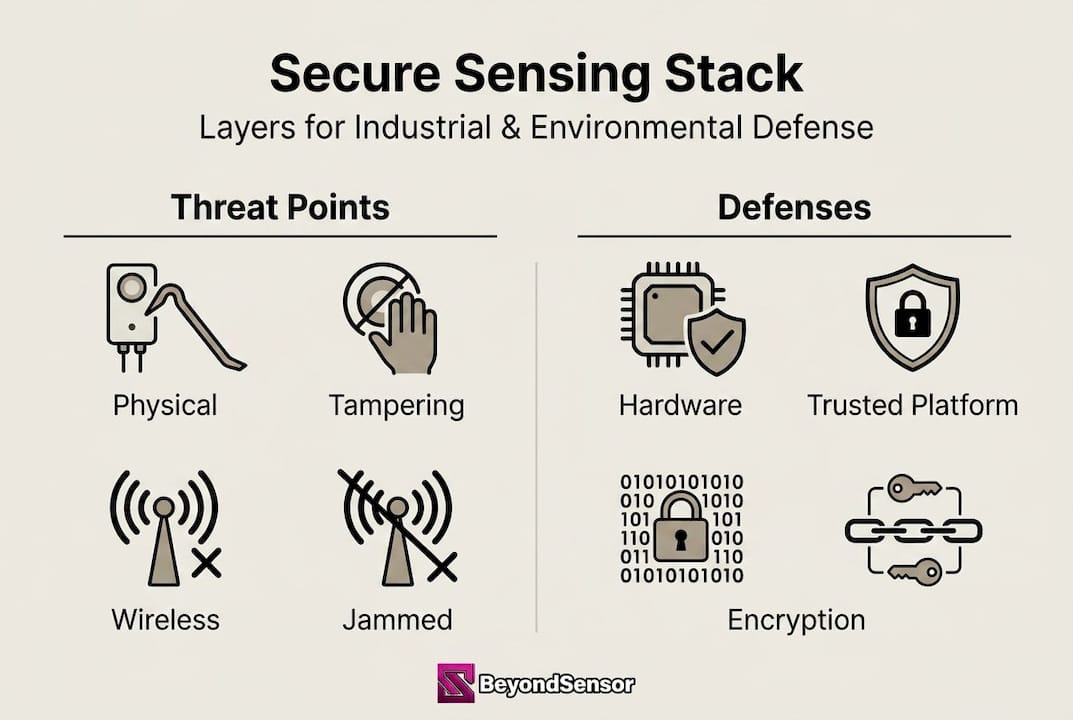
Secure sensing is not simply about encrypting the data a sensor transmits. It covers the entire stack: the physical hardware, the wireless communication channel, the data aggregation process, and the software models that act on that data. If any one of these layers is compromised, your operational decisions become unreliable, even dangerous.
Secure sensing in industrial automation environments faces a particularly complex threat surface. Sensors in these settings are often embedded in machinery, distributed across wide areas, and connected over wireless networks that are inherently exposed. A single compromised node can cascade failures across an entire operation.
The primary threats you need to account for include:
- Jamming: Flooding the wireless channel to prevent sensor data from reaching its destination.
- Spoofing: Injecting false signals that mimic legitimate sensor readings, causing systems to act on fabricated data.
- Eavesdropping: Intercepting sensitive data from sensor channels, especially in cross-boundary surveillance scenarios.
- Model poisoning: Corrupting the machine learning models that interpret sensor data, skewing outputs at scale.
- Adversarial perturbations: Subtle manipulations to input data designed to fool AI-driven sensing systems without triggering alarms.
As one key insight from recent research captures it:
"RF sensing vulnerabilities include signal spoofing, model poisoning, and cross-boundary surveillance; defenses span physical layer, network layer, and application layer strategies."
This layered threat picture makes it clear that defending only the network layer leaves significant gaps. Securing wireless sensors requires synchronized defenses at every level of the sensing stack, not just the data layer that traditional IT security focuses on.
Common attacks and vulnerabilities in wireless and RF sensing
Having defined secure sensing, understanding the threat landscape is critical for anyone planning a defense. The attack surface in wireless and RF sensing environments is broader than most security managers initially expect.
Each attack type has a distinct profile and preferred target:
- Jamming attacks overwhelm wireless channels using radio frequency noise, effectively blinding a sensor network for minutes or longer. In environmental monitoring deployments covering large geographic areas, this can leave entire zones without data coverage.
- Spoofing attacks are particularly insidious because the system keeps operating, but on false data. UAV swarm networks and wireless sensor networks (WSNs) face sensor spoofing risks that are especially difficult to detect without anomaly detection layers in place.
- Eavesdropping exploits unprotected channel state information (CSI), a byproduct of WiFi and RF sensing that leaks behavioral and environmental data even when payload encryption is active.
- Model poisoning targets the AI models trained on sensor data. An attacker who can corrupt training data gradually shifts the model's behavior without tripping conventional alarms.
- Adversarial perturbations are engineered inputs designed to fool neural networks. In dynamic industrial environments, these are a growing concern as AI-driven sensing expands.
| Attack type | Primary target | Operational impact |
|---|---|---|
| Jamming | Wireless channel | Loss of sensor data coverage |
| Spoofing | Signal or device identity | False operational decisions |
| Eavesdropping | Channel state information | Privacy breaches, intelligence loss |
| Model poisoning | ML model training data | Corrupted sensing outputs |
| Adversarial perturbation | AI inference layer | Undetected accuracy degradation |
Vulnerable points in your network include data aggregation gateways, edge devices with limited processing power, and any wireless channel that lacks physical-layer protection. The challenge is compounded by device constraints. Many sensors in the field prioritize energy efficiency and low latency, which limits the cryptographic overhead they can handle.

Pro Tip: Audit every wireless node in your network for its attack surface. Edge devices with no anomaly detection or signal validation are your most exposed points, and attackers know it.
For a practical starting point, sensor security tips specific to industrial and environmental deployments can help security teams close the most common gaps first.
Layered defense strategies: Technology and process
Knowing the risks, practical layered defense strategies can turn theory into operational security. The concept of layered defense, or defense in depth, applies to sensing environments just as it does to traditional IT infrastructure, but the layers look different.
Here is a structured approach to building secure sensing defenses:
- Physical layer: Deploy artificial noise injection, cooperative jamming, and constructive interference techniques. ISAC physical-layer security (Integrated Sensing and Communication, or ISAC) designs protect both communication channels and raw sensing data simultaneously, which is critical as next-generation wireless systems converge these functions.
- Network layer: Use network segmentation to isolate sensor subnetworks. Limit lateral movement so that a compromised edge device cannot reach critical aggregation points. Intrusion detection systems (IDS) tuned for sensor traffic patterns add an essential monitoring layer.
- Application layer: Implement trust-aware federated learning (FL), a machine learning method where models are trained across distributed sensor nodes without centralizing raw data. This protects against poisoning while preserving model accuracy across the fleet.
For industrial control systems (ICS) and operational technology (OT) environments, trust-aware federated learning, lightweight cryptography, and network segmentation work together to block data manipulation attacks. Lightweight cryptography is specifically designed for resource-constrained devices, trading minimal processing overhead for strong integrity guarantees.
| Defense technique | Layer | Primary benefit |
|---|---|---|
| Artificial noise injection | Physical | Disrupts eavesdropping and spoofing |
| Trust-aware federated learning | Application | Blocks model poisoning |
| Network segmentation | Network | Limits attack propagation |
| Lightweight cryptography | Application | Secures data on constrained devices |
| Intrusion detection systems | Network | Detects anomalous sensor traffic |
Pro Tip: Do not deploy physical-layer defenses and network controls as separate projects. They must be designed together to avoid gaps at layer boundaries where attackers find the easiest entry points.
For organizations evaluating sensing solutions for secure facilities, combining these layers is not a luxury. It is the baseline for any deployment that handles operationally sensitive data. Exploring the full range of sensor tools and uses available helps teams match the right controls to each environment's risk profile.
Challenges, best practices, and the future of secure sensing
With strategies in place, it is essential to recognize real-world challenges and anticipate what comes next. Implementing secure sensing is not a one-time configuration task. It is an ongoing operational discipline.
Key challenges your teams will face:
- Energy constraints: Many deployed sensors run on batteries or harvest ambient power. Adding cryptographic processing or advanced anomaly detection drains resources fast, forcing tradeoffs between security depth and device longevity.
- Latency sensitivity: Industrial automation processes often require sub-millisecond sensor response times. Heavy encryption or complex authentication protocols can introduce delays that disrupt process control.
- Attacker adaptation: Adversaries targeting industrial and environmental networks are becoming more sophisticated. Static defenses become ineffective against adaptive attackers who probe for gaps over time.
- Scale complexity: Large WSN deployments across environmental monitoring zones can include thousands of nodes, making centralized management and uniform policy enforcement genuinely difficult.
Best practices that experienced teams rely on:
- Prioritize physical-layer defenses in ISAC and RF sensing environments because physical-layer security outperforms traditional encryption when the spectrum itself is under attack.
- Integrate trust-aware learning frameworks from the start, not as an afterthought during a security review.
- Implement real-time monitoring with anomaly thresholds specific to each sensor type and deployment context.
- Follow physical security best practices alongside digital controls to prevent hardware-level tampering.
- Build security compliance for sensors into procurement and deployment standards, not retrofitted after deployment.
A telling statistic: Synergized WSN frameworks outperform legacy protocols like LEAP and SPINS by 17 to 32% in throughput, demonstrating that well-designed secure sensing architectures do not just improve security. They improve operational efficiency too.
Looking forward, 6G wireless networks and the maturation of ISAC technology will fundamentally reshape the secure sensing landscape. As sensing and communication converge on the same spectrum, defending that shared medium becomes the defining security challenge of the next decade. Organizations that build physical-layer resilience into their sensor infrastructure today will be positioned to adapt rather than scramble when that shift arrives.
Why physical-layer security is the next leap in secure sensing
Stepping back, here is what the current wave of secure sensing innovation means for decision-makers: most organizations are still fighting yesterday's battle. They invest heavily in network-layer encryption and firewall controls, then wonder why their sensor networks remain vulnerable to jamming and spoofing.
The problem is structural. Traditional network encryption assumes that the signal reaching your gateway is legitimate. Physical-layer attacks corrupt that signal before encryption even enters the picture. No amount of AES-256 protects a sensor whose wireless channel has been jammed into silence or whose signal has been replaced by a spoof.
Physical-layer security addresses this by embedding defenses at the hardware and signal level, adapting dynamically as threats evolve. This approach is built for the dual-use spectrum reality of ISAC, which is particularly critical for 6G industrial applications where sensing and communication share the same channel.
For security managers, the implication is direct: future-proof strategies must reach down to the lowest hardware levels. Encryption remains necessary, but it is not sufficient. The organizations that recognize this shift now will be building secure facilities with advanced sensor technology that remain defensible as both threats and network generations evolve. Those that don't will find themselves patching gaps that should have been designed out from the start.
Find your secure sensing solution with BeyondSensor
Translating these defense layers into a working operational deployment requires tools and expertise calibrated for industrial and environmental contexts. That is exactly where BeyondSensor's platform delivers.

BeyondSensor offers purpose-built secure sensing tools designed to match the specific risk profiles of industrial automation, environmental monitoring, and critical infrastructure environments. Whether you are a system integrator building out a multi-site sensing network or a facility owner seeking a scalable and compliant sensing architecture, the platform provides validated hardware-software combinations, ecosystem matchmaking, and regional expertise across Singapore, Malaysia, and the Philippines. Take the next step toward a genuinely resilient sensing deployment.
Frequently asked questions
What makes secure sensing different from traditional IT security?
Secure sensing goes beyond data encryption by protecting sensor hardware, wireless signals, and every layer of the sensing process from targeted attacks. Traditional IT security focuses on network and data protection, but physical-layer defenses are essential when the spectrum itself is under attack.
Which attacks are most common in wireless sensing environments?
Jamming, spoofing, eavesdropping, and model poisoning are the most frequent threats in wireless and RF-based sensor networks. RF sensing vulnerabilities span all layers, from the physical signal to the application model, requiring coordinated defenses at each level.
How does secure sensing protect critical infrastructure operations?
By combining trust-aware federated learning, lightweight cryptography, and network segmentation, secure sensing blocks both data manipulation and signal-level attacks. These ICS and OT defenses protect sensors and communication channels that critical infrastructure processes depend on.
What challenges should organizations expect with secure sensing systems?
The primary challenges involve balancing energy use, response latency, and security depth, particularly across large or resource-limited deployments. Adversarial attacks in dynamic environments and privacy leaks in environmental monitoring add further complexity that static defenses cannot address alone.
Recommended
Read More Articles
RTSP Security Risks: Integrators Must Block Exposed Ports 554 and 8554
See how integrators can reduce RTSP security risks: close exposed ports 554 and 8554, secure camera access, and verify each deployment with practical checks.

Require MAEpp and X Accuracy Before You Buy People Counting Systems
Verify people counting accuracy by demanding MAEpp, X Accuracy, and directional-bias reports. Validate on-site with at least 100 events per direction...
30–90 Day Pilot Validates Redundant Camera Networks for Engineers
Standards led, practical steps for engineers to deploy redundant camera networks: MRP, dual homing, and aggregation patterns, commissioning checks, and...

30 Day Pilot Proves Video Analytics Accuracy for Security Teams
Validate video analytics accuracy with scenario tests, camera tuning, transfer learning and a 30 day edge first pilot for security teams.
Let's Build YourSecurity Ecosystem.
Whether you're a System Integrator, Solution Provider, or an End-User looking for trusted advisory, our team is ready to help you navigate the BeyondSensor landscape.
Direct Advisory
Connect with our regional experts for tailored solutioning.