
Learn how sensor types, layered strategies, and AI integration strengthen physical security for government agencies and corporate facilities in 2026.

How sensors transform physical security for government

TL;DR:
- Sensors provide proactive detection and automated responses, unlike cameras that only record events.
- Effective security relies on layered, zone-specific sensor deployment integrated with access control and video systems.
- Proper assessment, calibration, and continuous review are essential for reliable, intelligent sensor-based security.
A single missed intrusion can expose multi-million dollar government operations or corporate assets within minutes. Security cameras record events, but they rarely stop them. Sensors serve as the primary detection layer in physical security systems, triggering real-time responses before threats escalate. Yet many security managers still treat sensors as afterthoughts, bolted onto CCTV infrastructure rather than engineered as a foundation. This article breaks down the sensor types, strategic deployment principles, and operational challenges you need to understand to build a genuinely resilient physical security ecosystem.
Table of Contents
- The fundamental role of sensors in modern security
- Types of physical security sensors and their core mechanics
- Designing a layered security sensor strategy
- Balancing effectiveness, reliability, and challenges in advanced security sensing
- From assessment to application: Best practices for sensor deployment
- A smarter approach: Rethinking sensors beyond the basics
- Enhance your facility's security with next-generation sensor solutions
- Frequently asked questions
Key Takeaways
| Point | Details |
|---|---|
| Sensors enable proactive security | Modern sensors detect threats early, giving responders time to act and prevent incidents. |
| Layered strategies increase reliability | Combining different sensors for perimeter, interior, and sensitive zones greatly reduces vulnerabilities. |
| Advanced sensors reduce false alarms | Using AI and sensor fusion improves detection accuracy and limits nuisance alerts. |
| Tailored solutions outperform one-size-fits-all | Assessing risks by facility zone ensures you select and deploy the best sensors for every application. |
The fundamental role of sensors in modern security
Sensors do something cameras cannot: they detect and respond, not just record. While video surveillance captures what happened, a well-calibrated sensor network identifies when and where a threat is developing, often triggering alerts before any camera operator notices. That distinction separates reactive security from proactive defense.
"Detection is the cornerstone of any effective security posture. Without accurate, timely sensing, response and mitigation have no trigger."
Sensors enable early identification of unauthorized access, intrusion, and environmental threats across all facility types. For government agencies and corporate campuses, this capability is foundational, not optional. The stakes involve classified data, critical infrastructure, and public safety.
Here is what sensors bring to a modern security architecture:
- Proactive threat detection: Sensors identify anomalies in motion, vibration, temperature, or access attempts before they escalate into incidents.
- Automated response triggering: Integrated systems activate alarms, lock access points, or alert response teams without requiring manual oversight.
- Compliance support: Many regulatory frameworks require sensor-based monitoring as part of physical security standards, making sensors a legal necessity in several sectors.
- Environmental awareness: Beyond intrusion, sensors monitor for fire, chemical leaks, or flooding, expanding protection beyond perimeter defense.
For a deeper look at how advanced sensing explained principles translate into operational advantages, the gap between sensor-aware and sensor-first security postures becomes clear quickly.
Types of physical security sensors and their core mechanics
Not all sensors work the same way, and choosing the wrong type for a given environment is a costly mistake. Each technology has a specific detection principle, a range of strengths, and real limitations depending on deployment conditions.
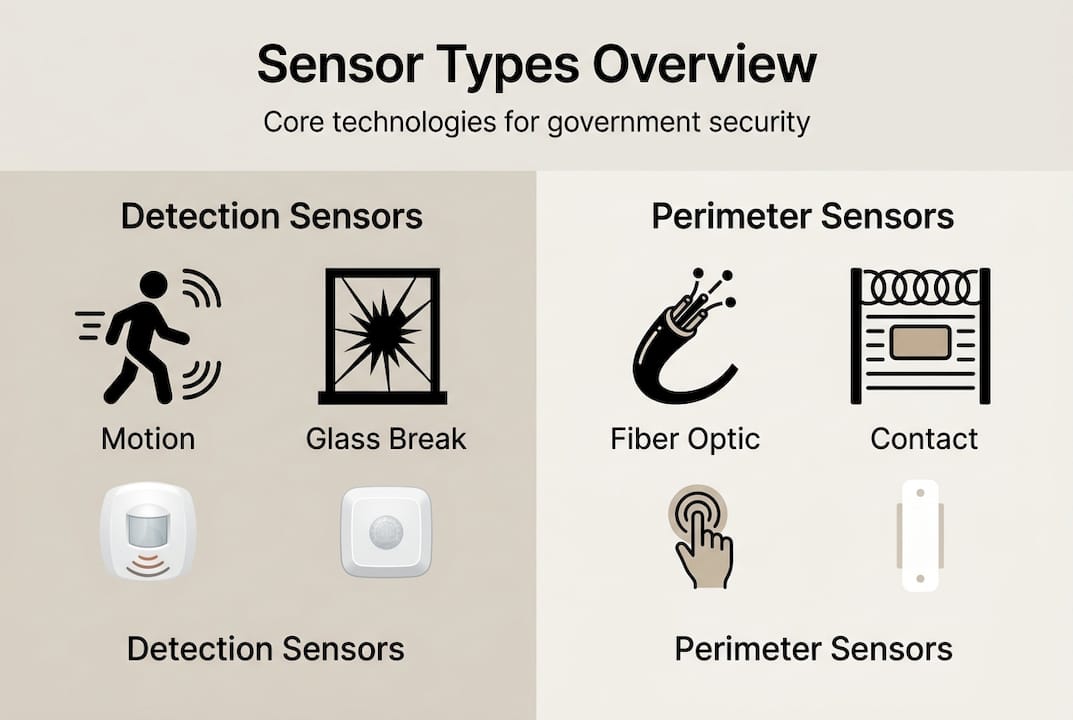
Diverse sensor types including motion (PIR), microwave, ultrasonic, contact, glass break, photoelectric, tomographic, fiber optic, and seismic exist, each with unique detection mechanics suited to different environments and threat profiles.
| Sensor type | Detection principle | Best deployment environment |
|---|---|---|
| PIR (Passive Infrared) | Heat signature change | Indoor corridors, offices |
| Microwave | Reflected microwave signal | Large open areas, warehouses |
| Ultrasonic | Sound wave reflection | Enclosed indoor spaces |
| Glass break | Acoustic frequency analysis | Windows, glass partitions |
| Fiber optic | Light signal disruption | Perimeter fencing, pipelines |
| Seismic | Ground vibration | Vaults, critical infrastructure |
| Tomographic | Radio wave mesh | Outdoor perimeters, parking areas |
Several factors determine which sensor fits a specific zone:
- Environmental conditions: Outdoor sensors must handle weather, animals, and vegetation interference.
- Detection range and coverage angle: A single PIR may cover a corridor; a tomographic mesh can cover acres.
- Integration capability: Sensors must communicate with your existing access control and alarm management platforms.
Pro Tip: Sensor fusion, combining two or more sensor types to validate an event, dramatically reduces false positives. For example, pairing a PIR with a microwave sensor confirms human presence before triggering a high-priority alert.
For a structured overview of intelligent sensing technologies and how they map to specific facility environments, matching technology to zone characteristics is the first step toward precision security.
Designing a layered security sensor strategy
Deploying sensors without a structured plan is like building a fence with gaps. Defense-in-depth means layering detection across perimeter, interior, and point-specific zones so that a failure or bypass at one layer triggers compensating sensors at another.
Layered sensors across perimeter, interior, and point zones improve reliability and enable swift response by eliminating single-point detection failures.
Here is a proven deployment workflow:
- Map facility zones by risk level. Classify areas from public access to restricted, using asset value and threat exposure as criteria.
- Assign sensor types per zone. Perimeter zones benefit from fiber optic or tomographic sensors. Interior spaces use PIR or ultrasonic. High-value points use seismic or contact sensors.
- Integrate with access control and alarms. Sensors must feed into a unified security management platform, not operate as isolated devices.
- Cross-validate with CCTV. Camera feeds should be triggered by sensor alerts, not monitored continuously, enabling exception-based monitoring that reduces operator fatigue.
- Test and calibrate. Conduct zone-by-zone testing under realistic conditions before going live.
| Security zone | Recommended sensor layer | Integration priority |
|---|---|---|
| Outer perimeter | Fiber optic, tomographic | High |
| Building entry points | PIR, microwave, contact | Critical |
| Interior corridors | PIR, ultrasonic | Medium |
| Server rooms, vaults | Seismic, contact, glass break | Critical |
Pro Tip: Avoid over-relying on any single vendor's sensor ecosystem. Open-protocol platforms give you flexibility to swap or upgrade individual sensor types without rebuilding the entire architecture.
Reviewing layered sensor strategies alongside physical security best practices gives security directors a clearer framework for aligning sensor deployment with compliance and operational goals.
Balancing effectiveness, reliability, and challenges in advanced security sensing
Sensors are not infallible. Traditional technologies carry well-documented limitations that can erode confidence in the entire security program if left unaddressed.
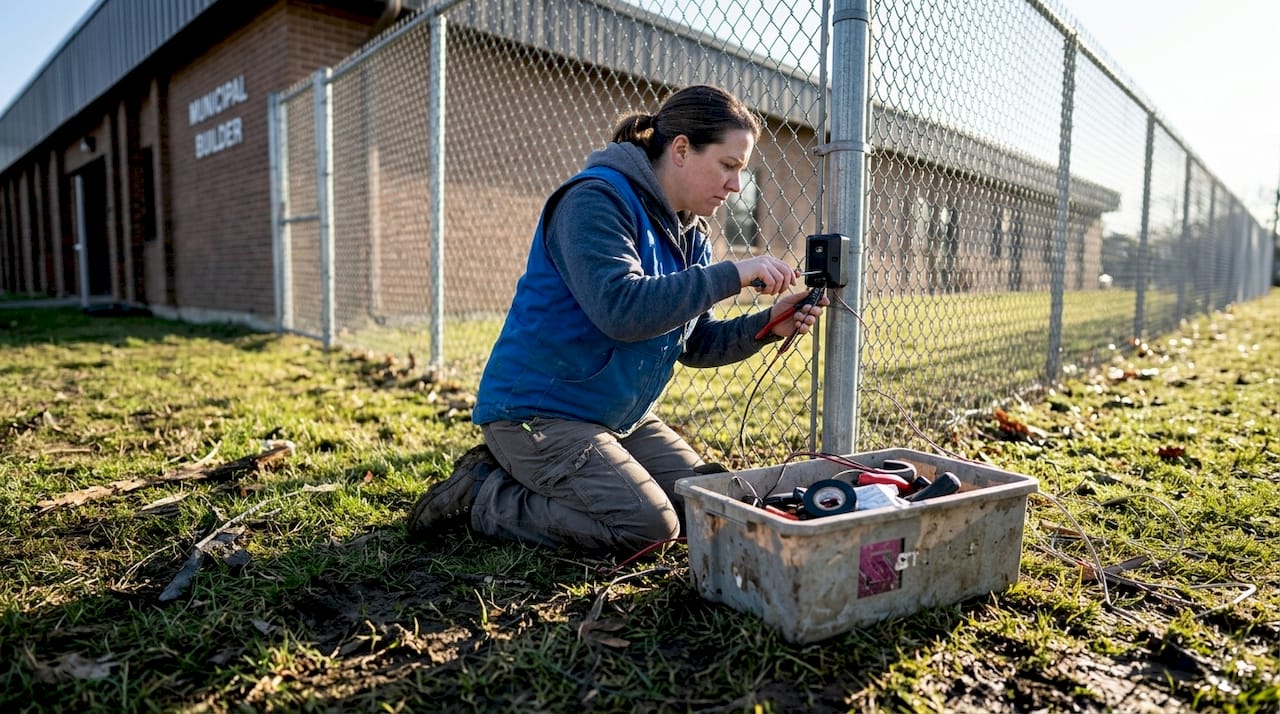
Traditional sensors remain prone to nuisance alarms; advanced AI-integrated and fusion-based sensors offer greater reliability but introduce added implementation complexity and cybersecurity considerations.
Common challenges security managers face:
- False alarms: PIR sensors triggered by HVAC airflow or small animals generate unnecessary responses, draining resources and eroding staff trust in the system.
- Environmental interference: Outdoor sensors are susceptible to weather, temperature swings, and vegetation movement.
- Cybersecurity exposure: Networked sensors create attack vectors. Firmware vulnerabilities and unencrypted data streams are real risks in IP-connected sensor networks.
- Interoperability gaps: Legacy sensors often cannot integrate with modern platforms without costly middleware or full replacement.
- Calibration drift: Sensors degrade over time. Without regular testing, detection thresholds shift and reliability drops silently.
"The weakest link in any sensor network is not the hardware. It is the gap between installation and the first annual review."
AI-enhanced sensors address many of these issues by classifying detected events contextually rather than triggering on raw signal changes alone. However, they require careful configuration, staff training, and cybersecurity hardening to deliver on their promise. Understanding optimizing advanced sensors operationally and recognizing the sensor solutions advantages alongside adherence to sensor compliance standards forms the complete picture for sustainable sensor performance.
From assessment to application: Best practices for sensor deployment
Knowing sensor types and layering principles is only useful if you can translate them into an actionable deployment plan. The critical starting point is always the threat and risk assessment.
Threat and risk assessments guide sensor selection by zone, emphasizing tailored solutions over single-technology reliance. Generic sensor packages applied uniformly across a facility almost always create coverage gaps and inflated costs.
Follow this deployment sequence for best results:
- Conduct a formal threat and risk assessment. Identify the specific threats each zone faces: unauthorized access, vandalism, environmental hazards, or insider threats.
- Develop a sensor coverage map. Overlay sensor placement on facility blueprints, documenting detection fields and overlap zones.
- Select sensors by zone requirements. Prioritize detection accuracy and integration compatibility over unit cost alone.
- Perform staged installation and calibration. Install by zone, calibrate, and validate before expanding to the next area.
- Document and review annually. Threat landscapes change. Sensor strategies must evolve with them.
- Train response teams on alert workflows. The best sensor network delivers no value if response protocols are unclear or untested.
Pro Tip: Pilot test new sensor technology in a single high-risk zone before facility-wide rollout. Real-world performance data from your specific environment is far more reliable than vendor specifications alone.
Exploring tailored sensor solutions versus off-the-shelf packages consistently shows that customized approaches deliver stronger detection accuracy and lower long-term operational costs.
A smarter approach: Rethinking sensors beyond the basics
Here is the uncomfortable truth that most vendors will not say directly: adding more sensors rarely makes a facility more secure on its own. Security directors who focus on sensor count rather than sensor intelligence consistently end up with noisy, expensive networks that alert operators dozens of times per shift without actionable insight.
The shift we advocate at BeyondSensor is from volume to precision. Real security ROI comes from sensors that are correctly matched, properly calibrated, deeply integrated, and continuously reviewed. A 20-sensor network designed around a current threat assessment outperforms a 200-sensor installation built on a five-year-old compliance checklist.
Data integration is equally critical. Sensors generate enormous volumes of event data. Without a platform that correlates sensor inputs with access logs, video triggers, and environmental readings, that data becomes noise rather than intelligence. The advanced sensing insights that drive genuine security outcomes come from treating sensor networks as living systems, not installed hardware.
The agencies and enterprises that lead in physical security resilience are not those with the largest sensor budgets. They are the ones that iterate, integrate, and adapt their sensing ecosystems continuously.
Enhance your facility's security with next-generation sensor solutions
Building a sensor-first security posture requires the right technology partner, not just the right hardware catalog. BeyondSensor works directly with government agencies and corporate security teams to design, validate, and deploy advanced sensing architectures that match real threat environments.

Whether you are protecting critical government infrastructure or managing enterprise facilities across multiple sites, our platform connects you with precision sensing tools, integration support, and regional expertise across Southeast Asia. Explore purpose-built resources for security agency solutions and tailored offerings designed specifically for facility owner offerings. The right sensor strategy is not a one-time decision. Let BeyondSensor help you build one that scales.
Frequently asked questions
What are the main types of sensors used in physical security systems?
Core sensor types include motion (PIR), microwave, ultrasonic, vibration, contact, glass break, photoelectric, tomographic, fiber optic, and seismic, each designed for specific detection environments and threat profiles.
Why is a layered sensor strategy more effective than using a single type of sensor?
Layered sensor methodologies apply defense-in-depth across distinct security zones, eliminating single-point failures and reducing false alarms by requiring multi-sensor confirmation before triggering high-priority alerts.
How can false alarms from physical security sensors be minimized?
Combining complementary sensor types, applying AI-based event classification, and configuring environment-specific detection thresholds all significantly reduce nuisance alerts without compromising sensitivity.
What steps should a facility take to select the right sensors for each zone?
Complete a formal threat and risk assessment for each area first, then match sensor technology to the specific risk profile, detection range requirements, and integration needs of that zone.
Recommended
Read More Articles
RTSP Security Risks: Integrators Must Block Exposed Ports 554 and 8554
See how integrators can reduce RTSP security risks: close exposed ports 554 and 8554, secure camera access, and verify each deployment with practical checks.
Require MAEpp and X Accuracy Before You Buy People Counting Systems
Verify people counting accuracy by demanding MAEpp, X Accuracy, and directional-bias reports. Validate on-site with at least 100 events per direction...
30–90 Day Pilot Validates Redundant Camera Networks for Engineers
Standards led, practical steps for engineers to deploy redundant camera networks: MRP, dual homing, and aggregation patterns, commissioning checks, and...
30 Day Pilot Proves Video Analytics Accuracy for Security Teams
Validate video analytics accuracy with scenario tests, camera tuning, transfer learning and a 30 day edge first pilot for security teams.
Let's Build YourSecurity Ecosystem.
Whether you're a System Integrator, Solution Provider, or an End-User looking for trusted advisory, our team is ready to help you navigate the BeyondSensor landscape.
Direct Advisory
Connect with our regional experts for tailored solutioning.