
Understand security compliance frameworks like ISO 27001, NIST CSF, and regional PDPAs. A practical guide for compliance officers in Southeast Asia.

Security compliance: Key frameworks for Southeast Asia

TL;DR:
- Security compliance is an ongoing, multi-element process involving policies, controls, and documentation.
- Frameworks like ISO 27001 and NIST CSF help structure compliance efforts, with specific uses for certifiability and operational needs.
- In Southeast Asia, organizations must adapt to diverse local laws, maintain momentum, and implement scalable, automated evidence collection.
Security compliance is not a one-time audit you survive and forget. For organizations operating across Singapore, Malaysia, the Philippines, Thailand, and Vietnam, it is a continuous obligation that intersects regulatory law, technical controls, and governance documentation simultaneously. Many teams still treat it as a checkbox exercise, and that misalignment is exactly how a single breach costs millions. This article breaks down what security compliance actually means, which frameworks matter most, how to implement them practically, and what makes Southeast Asia's regulatory environment uniquely challenging to navigate.
Table of Contents
- What is security compliance?
- Major frameworks: ISO 27001, NIST CSF, SOC 2, PCI DSS
- Implementation methodologies and practical steps
- Navigating Southeast Asia's regulatory landscape
- What most guides miss: Momentum, scope, and real-world pitfalls
- How BeyondSensor helps streamline compliance for Southeast Asia organizations
- Frequently asked questions
Key Takeaways
| Point | Details |
|---|---|
| Compliance is ongoing | Maintaining security compliance requires continuous monitoring, documentation, and proactive improvements. |
| Frameworks must be integrated | Combining ISO 27001 and NIST CSF helps cover both governance and operational detection needs. |
| Local laws drive complexity | Regional regulations differ significantly and require tailored, cross-jurisdiction strategies for compliance. |
| Common pitfalls exist | Momentum loss, unclear scoping, and scattered evidence are issues to address for sustainable compliance. |
| Automation is on the rise | Investing in automation tools saves time and reduces costs, especially as compliance demands increase. |
What is security compliance?
Security compliance, at its core, is the ongoing process of meeting security requirements drawn from laws, regulations, industry standards, and contracts. It operates through four interconnected elements: policies, procedures, technical controls, and documentation. Miss any one of them, and your compliance posture has a gap that auditors will find.
Here is what that looks like in practice:
- Policies: Written rules defining what is allowed and what is not within your systems and operations
- Procedures: Step-by-step instructions for carrying out security tasks consistently
- Technical controls: Firewalls, access management tools, encryption, and sensor-based monitoring systems
- Documentation: Evidence that controls exist, are configured correctly, and are reviewed regularly
One of the most persistent misunderstandings in this field is conflating compliance with actual security. They are related, but not the same thing.
Compliance is baseline and provable. Security is ongoing risk reduction. Strong security practices ease compliance, but compliance alone does not make you secure.
Think of compliance as the floor, not the ceiling. An organization can pass every audit item and still be vulnerable to a novel attack vector not covered by any current standard. The organizations that understand why security compliance matters move beyond checkbox thinking and treat controls as living mechanisms, not static documents.
Common pitfalls include treating compliance as a project with a finish line, neglecting to update controls when technology changes, and failing to assign clear ownership for each control. For teams working in physical security environments, the physical security compliance guide provides specific guidance on how sensor-based controls integrate with governance requirements. Organizations serving government user compliance needs face additional scrutiny, making robust documentation even more critical.
Major frameworks: ISO 27001, NIST CSF, SOC 2, PCI DSS
With the fundamentals established, the next step is understanding which frameworks provide structure for compliance efforts. Common frameworks include ISO 27001, NIST CSF, SOC 2, and PCI DSS, each designed for different organizational needs and risk profiles.

| Framework | Primary focus | Certifiable | Best for |
|---|---|---|---|
| ISO 27001 | Information security management system (ISMS) | Yes | Governance, supplier trust |
| NIST CSF | Risk management functions | No | Operational teams, government |
| SOC 2 | Service organization controls | Yes (attestation) | SaaS and cloud providers |
| PCI DSS | Payment card data security | Yes | Any org handling card payments |
ISO 27001 is the most widely recognized certifiable standard globally. It requires organizations to build and maintain an ISMS, complete risk assessments, define a Statement of Applicability (SoA), and undergo third-party audits. NIST CSF, by contrast, is a voluntary framework built around six functions: Govern, Identify, Protect, Detect, Respond, and Recover. It is particularly useful for teams that need operational clarity without the formality of certification.
A practical approach many leading organizations use:
- Start with NIST CSF to map your current detection and response capabilities
- Layer ISO 27001 governance controls on top for certifiable proof of your ISMS
- Add SOC 2 Type II if you provide services to enterprise clients
- Implement PCI DSS controls if your systems touch payment data
Pro Tip: Using NIST CSF for operations combined with ISO 27001 for certifiable governance creates a hybrid approach that avoids critical gaps in detection and response. These two frameworks are complementary, not competing.
For teams building out physical infrastructure, the infrastructure safeguards checklist maps directly to several NIST CSF protective functions. Organizations needing to meet SOC 2 and PCI DSS demands will find that a strong ISMS foundation reduces duplicated effort significantly. Teams working with security agency requirements may also need to align with government-mandated frameworks beyond these four.
Implementation methodologies and practical steps
Frameworks alone are not enough. What matters is how you implement them systematically and sustain them over time. The most effective methodology follows a phased structure:
- Define scope: Identify which systems, locations, and data flows fall within your compliance boundary
- Conduct risk assessment: Use a structured matrix (4x4 or 5x5) to evaluate likelihood and impact for each identified risk
- Select controls: Document chosen controls and exclusions in a Statement of Applicability
- Collect evidence: Automate evidence gathering wherever possible; manual collection creates bottlenecks
- Perform internal audits: Validate that controls operate as intended before external audits
- Continuous improvement: Apply the PDCA cycle (Plan, Do, Check, Act) to keep the program current
| Phase | Key output | Common failure point |
|---|---|---|
| Scope definition | Asset inventory | Scope too broad or too narrow |
| Risk assessment | Risk register | Subjectivity in scoring |
| Control selection | Statement of Applicability | Controls not mapped to risks |
| Evidence collection | Audit-ready documentation | Scattered across multiple tools |
| Internal audit | Findings report | Treated as a formality |
The financial stakes make rigor non-negotiable. The global breach cost reached $4.4 million in 2025, and 67% of organizations are now increasing compliance automation. Automation is not a luxury; it is a response to scale.
Pro Tip: Prioritize automation for evidence collection from the start. Tools that pull logs, access records, and sensor alerts automatically reduce both human error and audit preparation time significantly. Reviewing sensor security tips can help identify where sensor data feeds directly into your compliance evidence chain. For broader efficiency gains, operational efficiency insights show how integrated monitoring platforms reduce compliance overhead.
Navigating Southeast Asia's regulatory landscape
Global frameworks must be adapted to Southeast Asia's regulatory realities, which add a distinct layer of complexity for compliance officers managing multi-country operations.
Each country in the region has enacted its own data protection law, and they are not harmonized:
- Singapore PDPA: Requires consent for data collection, mandatory Data Protection Officer (DPO) appointment from 2025 onward, and specific transfer protection mechanisms
- Thailand PDPA: Mandates a 72-hour breach notification window and has extraterritorial reach for organizations handling Thai residents' data
- Malaysia PDPA: Requires opt-in consent for sensitive personal data categories; enforcement has been increasing since 2023
- Vietnam PDPL (draft): Includes data localization requirements, meaning certain data must be stored on servers physically within Vietnam
There is no ASEAN-wide harmonization. Each jurisdiction operates independently, which means an organization expanding from Singapore to Thailand cannot simply replicate its existing program.
Penalties are real and growing. Thailand fines reach up to THB 5 million (approximately USD 140,000), while Singapore's PDPA carries fines of up to SGD 1 million. These are not theoretical risks.
Pro Tip: Align global frameworks like ISO 27001 and NIST CSF with each local PDPA from the start. Design your consent management, DPO appointment, and data transfer mechanisms to be modular so they adapt to each jurisdiction without requiring a full rebuild on expansion.
For organizations looking at a structured approach, step-by-step sensing system compliance guidance addresses how physical sensing infrastructure intersects with data protection obligations. Tailored solutions for compliance consistently outperform generic deployments when local regulatory nuance is involved.
What most guides miss: Momentum, scope, and real-world pitfalls
Most compliance guides focus on the initial implementation and stop there. That is where the real problems begin.
In our experience working with organizations across Southeast Asia, the most consistent failure pattern is momentum loss after initial certification. Teams celebrate the audit result, then slowly allow controls to drift. Evidence stops being collected consistently. Risk registers are not updated when new systems are deployed. The ISMS becomes a historical document rather than a living program.
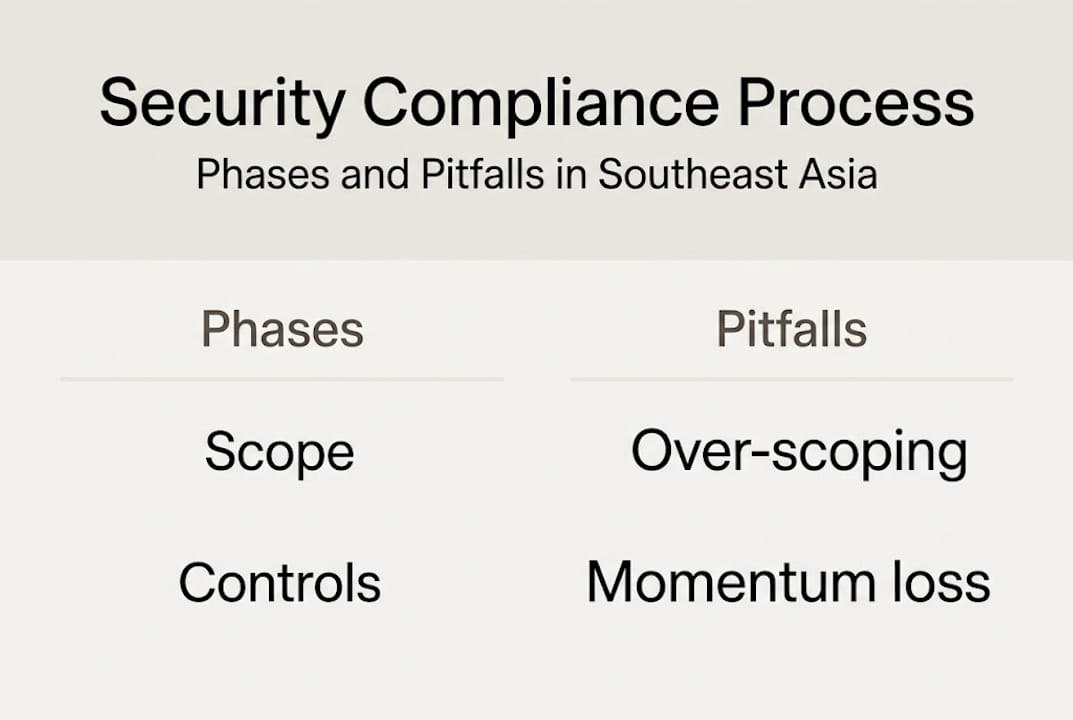
Post-implementation momentum loss is one of the most documented challenges in ISO 27001 programs. So is over-scoping, which happens when teams include every system in their compliance boundary instead of focusing on what is actually critical. Scattered evidence across disconnected tools is another persistent problem, making audit preparation unnecessarily painful.
The counter-intuitive lesson here: a smaller, tightly governed scope with strong continuous monitoring is more defensible than a sprawling program with weak evidence. Review the critical safeguards checklist periodically to ensure your controls remain current. The organizations that sustain compliance are the ones that treat it as an operational discipline, not a periodic event.
How BeyondSensor helps streamline compliance for Southeast Asia organizations
For compliance officers and security managers looking to operationalize what this article covers, technology infrastructure matters as much as process design.

BeyondSensor delivers tailored hardware-software solutions built specifically for the regulatory and operational demands of Southeast Asia. Our sensor-based platforms generate audit-ready data streams, support automated evidence collection, and integrate with governance frameworks including ISO 27001 and NIST CSF. System integrators benefit from scalable deployment tools that simplify multi-site compliance rollouts. Security agencies gain access to precision monitoring infrastructure that meets government-mandated standards. Explore the full compliance and security platform to see how BeyondSensor's regional expertise translates into faster audit readiness and lower compliance overhead.
Frequently asked questions
What's the difference between security compliance and security?
Compliance is baseline and provable, focused on meeting defined requirements, while security is about continuous risk reduction. Robust security practices make achieving and maintaining compliance significantly easier.
Which frameworks should Southeast Asian organizations prioritize?
ISO 27001 and NIST CSF are the most widely adopted starting points. Aligning them with local PDPAs ensures your compliance program covers both global governance and regional legal obligations without critical gaps.
How do compliance requirements differ between Singapore, Thailand, Malaysia, and Vietnam?
Each country enforces its own data protection law with unique requirements around breach notification timelines, consent mechanisms, data localization, and DPO appointment. Singapore, Thailand, Malaysia, and Vietnam each carry distinct penalties for non-compliance, ranging from fines to operational restrictions.
What's the typical phased process for implementing security compliance?
Organizations define scope, assess risk using a structured matrix, select applicable controls via a Statement of Applicability, collect evidence continuously, and run internal audits. The PDCA cycle governs ongoing improvement across all phases.
Recommended
- Security compliance in sensing systems: a step-by-step guide | News | BeyondSensor
- Why tailored security solutions outperform generic systems | News | BeyondSensor
- Security compliance: why it matters and how to master it | News | BeyondSensor
- Top advantages of sensing solutions for secure facilities | News | BeyondSensor
Read More Articles

RTSP Security Risks: Integrators Must Block Exposed Ports 554 and 8554
See how integrators can reduce RTSP security risks: close exposed ports 554 and 8554, secure camera access, and verify each deployment with practical checks.

Require MAEpp and X Accuracy Before You Buy People Counting Systems
Verify people counting accuracy by demanding MAEpp, X Accuracy, and directional-bias reports. Validate on-site with at least 100 events per direction...

30–90 Day Pilot Validates Redundant Camera Networks for Engineers
Standards led, practical steps for engineers to deploy redundant camera networks: MRP, dual homing, and aggregation patterns, commissioning checks, and...

30 Day Pilot Proves Video Analytics Accuracy for Security Teams
Validate video analytics accuracy with scenario tests, camera tuning, transfer learning and a 30 day edge first pilot for security teams.
Let's Build YourSecurity Ecosystem.
Whether you're a System Integrator, Solution Provider, or an End-User looking for trusted advisory, our team is ready to help you navigate the BeyondSensor landscape.
Direct Advisory
Connect with our regional experts for tailored solutioning.