
Discover the crucial role of automation in security. Learn how to leverage it effectively to enhance your industrial security operations.
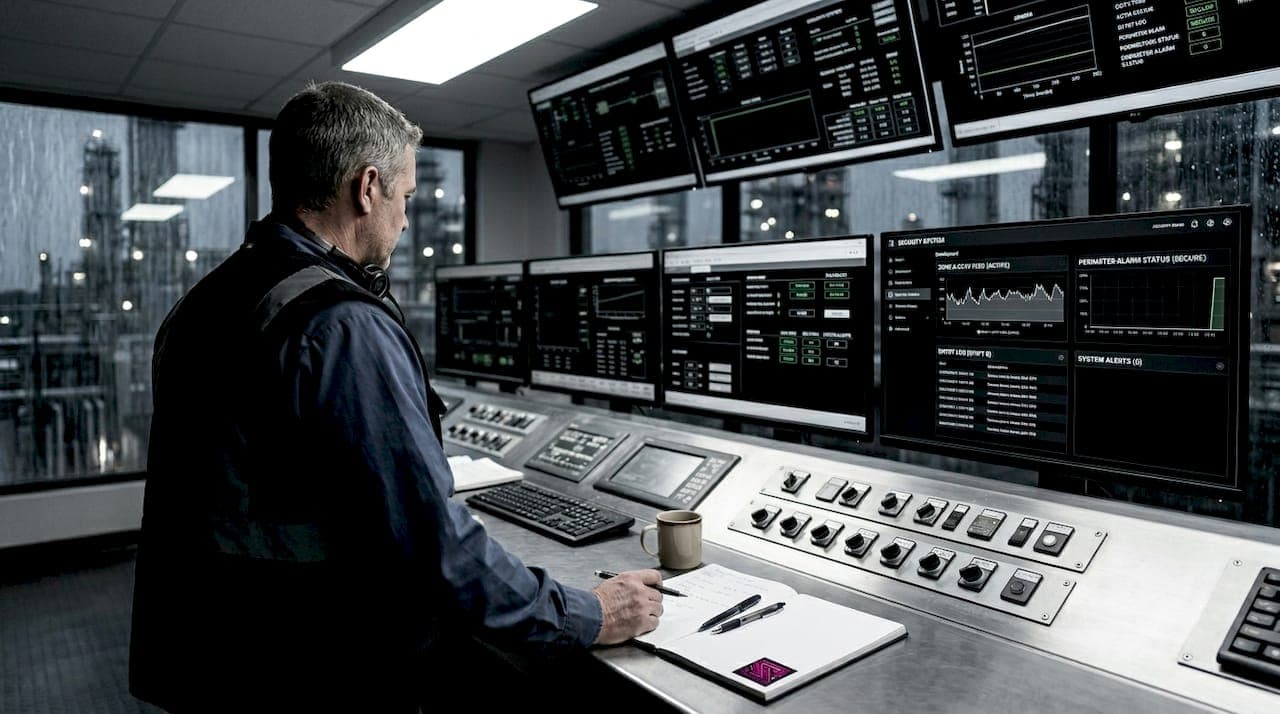
How automation strengthens industrial security operations
TL;DR:
- Automation is often misrepresented as a simple plug-and-play solution; however, without proper controls, it can create dangerous blind spots exploited by attackers. When thoughtfully designed within standards-based frameworks, automation significantly enhances operational efficiency, continuous monitoring, and compliance in industrial security environments. Effective automation relies on disciplined implementation, human oversight, and ongoing process improvement to ensure reliability and security resilience.
Automation is often sold as a plug-and-play fix for industrial security, but that framing is dangerously misleading. Security professionals who deploy automation without proper controls risk creating dangerous blind spots or over-trust that attackers and system failures can exploit without triggering a single alert. The reality is more nuanced: when designed thoughtfully and governed by solid frameworks, automation becomes a genuine force multiplier for industrial facilities managing large-scale infrastructure, continuous operations, and high-consequence threat environments. This guide cuts through the confusion and gives you a clear, standards-grounded strategy for applying automation correctly.
Table of Contents
- What is security automation and why does it matter?
- Building a foundation: Standards, continuous monitoring, and testable controls
- From operation to action: How automation transforms industrial security
- The human factor: Dangers, limitations, and smart supervision
- A fresh perspective: Why smart automation in security is more about design than technology
- Next steps: Implementing smarter security automation
- Frequently asked questions
Key Takeaways
| Point | Details |
|---|---|
| Automation enables scaling | Automated monitoring and controls help industrial facilities keep up with complex, fast-changing security demands. |
| Standards matter | Building automation atop recognized frameworks like NIST ensures measurable, reliable security improvements. |
| Human oversight is critical | Even the best automation requires human approval and review to avoid dangerous blind spots. |
| Hybrid approaches are best | The most resilient facilities combine smart automation with experienced teams for ongoing improvement. |
What is security automation and why does it matter?
Security automation, in the context of industrial environments, means far more than scheduling a vulnerability scan overnight. NIST frames security automation as automating security programs and operations, including mechanisms such as SCAP (Security Content Automation Protocol) and associated validation programs. That scope covers configuration management, compliance checking, continuous monitoring, and automated incident workflows.
For large industrial facilities, this scope is not a luxury. Think of a petrochemical plant managing hundreds of networked sensors, PLCs (programmable logic controllers), and HMI (human-machine interface) terminals across multiple production zones. Manual security checks at that scale are slow, inconsistent, and prone to human fatigue. A single misconfiguration that slips through a manual review can persist undetected for weeks, creating a window for lateral movement or operational disruption.
Key mechanisms that make security automation practical at industrial scale include:
- SCAP (Security Content Automation Protocol): Standardizes the format and language for security checklists, vulnerability data, and configuration assessments, enabling tools to communicate consistently across vendors.
- Continuous control monitoring: Automated agents that check system states in near-real time against approved baselines, flagging deviations immediately rather than waiting for a quarterly audit.
- Automated alerting and escalation workflows: Removes manual triage steps for well-understood threat patterns, routing alerts to the right team or triggering a pre-approved response action.
- Compliance reporting automation: Pulls telemetry from endpoints and infrastructure to generate audit-ready reports without analyst labor.
"Security automation is not about removing humans from the equation. It is about reducing the manual burden on those humans so they can focus on the decisions that genuinely require judgment."
Understanding these mechanisms is the foundation. Without it, organizations tend to buy automation tools that sit underutilized or, worse, generate alert fatigue that is more damaging than no automation at all. Reviewing physical security best practices alongside technical automation frameworks gives you a complete operational picture, while exploring essential security safeguards helps you identify which controls are automation-ready from day one.
Building a foundation: Standards, continuous monitoring, and testable controls
Now that we see what security automation means, it is crucial to understand the frameworks that allow automation to add real value. Without a structured foundation, automation becomes a collection of disconnected scripts rather than a coherent, measurable program.
NIST IR 8011 provides methodology that ties security automation directly to testable, automatable controls and continuous monitoring methods. The methodology works by mapping controls from NIST SP 800-53 (the federal catalog of security and privacy controls) to specific, machine-verifiable test cases. This means your automation tools are not just scanning for generic threats; they are validating known, documented requirements that your organization has committed to maintaining.
Here is a simplified view of how that mapping works in practice:
| Control family | Example control | Automatable aspect | Tool/method |
|---|---|---|---|
| Access control | Least privilege enforcement | User permission baseline scanning | SCAP-compliant scanner |
| Configuration management | Baseline configuration | Drift detection vs. approved baseline | Continuous monitoring agent |
| Incident response | Automated alerting | Threshold-based alert generation | SIEM integration |
| Audit and accountability | Log retention | Log completeness verification | Log aggregation platform |
| System and communications protection | Encryption enforcement | Certificate validation checks | Automated certificate scanner |
Building your automation program on this foundation requires a disciplined sequence:
- Identify your control catalog. Start with NIST SP 800-53 or a sector-specific overlay (such as ICS-CERT guidance for industrial control systems). Know exactly which controls apply to your environment.
- Classify controls by testability. Not every control is automatable. Access control and configuration management are highly testable. Training and awareness programs are not. Focus automation resources where they deliver measurable coverage.
- Select tools aligned to testable controls. Choose platforms that support SCAP or equivalent machine-readable formats, ensuring your data is consistent and reportable without manual reinterpretation.
- Deploy continuous monitoring agents. Static snapshots are insufficient. Industrial systems change constantly. Continuous monitoring, supported by smart infrastructure security practices, ensures your baselines are enforced at all times.
- Automate compliance evidence collection. Every check your system runs should generate machine-readable evidence, feeding directly into your infrastructure security checklist reporting cycle.
Pro Tip: Start automation with the controls that have the most mature, well-documented test cases, specifically configuration management and access control. These produce the highest fidelity results immediately and build team confidence before tackling more complex behavioral monitoring scenarios.
The difference between organizations that succeed with security automation and those that struggle often comes down to this foundational discipline. Jumping straight to advanced behavioral analytics without testable baselines is like building a surveillance system without knowing what you are looking for.
From operation to action: How automation transforms industrial security
With a standards-based foundation in place, let us examine the real changes automation brings to everyday security operations. The gains are measurable, and the failure modes without automation are equally well-documented.
Operational efficiency is the first visible win. Manual alert triage in a large facility security operations center (SOC) can consume dozens of analyst hours weekly, often reviewing noise rather than genuine incidents. Automation filters that noise, elevating only the alerts that meet pre-defined escalation criteria. Teams that previously processed 500 alerts per shift can redirect energy toward the 20 alerts that truly require investigation.

Surveillance improvements are equally significant. Automated threat detection AI enables continuous behavioral analysis across video feeds, network telemetry, and sensor data simultaneously. Unlike a human monitor who must divide attention, automation never loses focus. It applies the same detection logic at 3 AM on a public holiday as it does during peak operational hours.
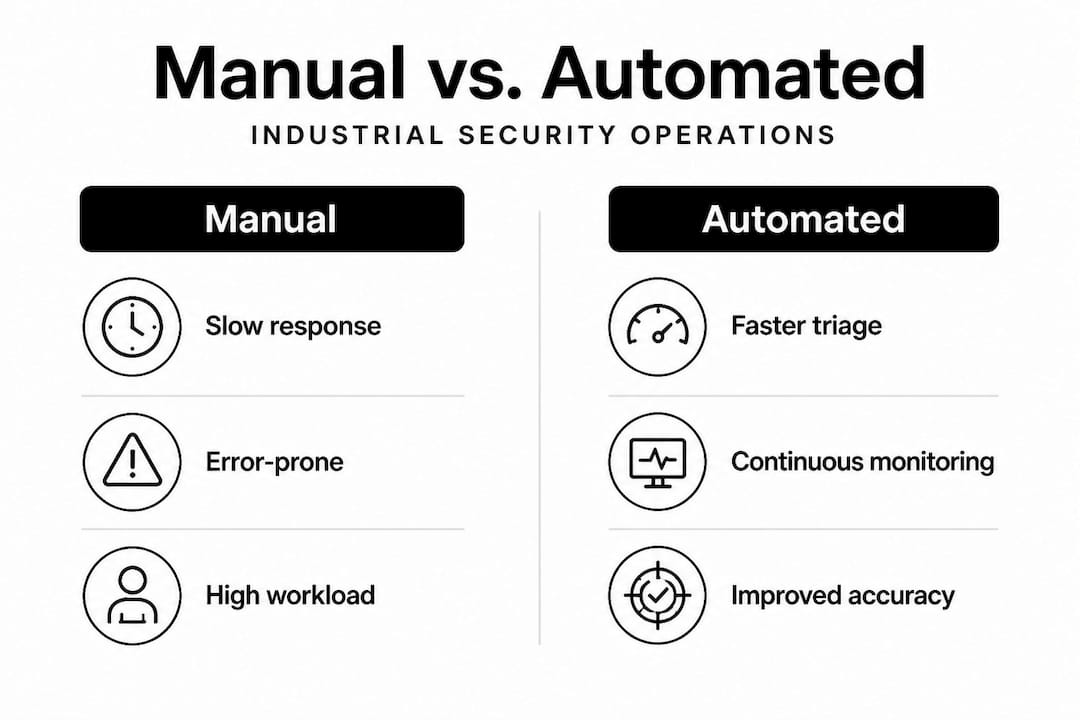
The contrast between manual and automated workflows is stark:
| Security operation | Manual workflow | Automated workflow |
|---|---|---|
| Threat alerting | Analyst reviews log queue periodically | Rule-based alert fires instantly on threshold breach |
| Incident containment | Analyst manually isolates affected system | Pre-approved playbook triggers automated isolation |
| Compliance reporting | Analyst extracts data and formats report manually | Automated report generated on schedule |
| Configuration drift detection | Weekly or monthly manual audit | Continuous agent flags drift within minutes |
| Access anomaly detection | Periodic user access reviews | Behavioral baseline triggers alert on deviation |
Automation tied to standardized control catalogs and continuous monitoring produces more measurable operational assurance than any point-in-time manual approach. The audit trail is richer, the response times are faster, and the consistency across shifts eliminates human variability.
Common mistakes in early implementation include deploying automation without tuning alert thresholds, which creates noise that overwhelms analysts and defeats the purpose. Review AI for security systems deployment case studies before finalizing your automation architecture. Also, keeping pace with security technology trends 2026 ensures your automation choices do not become outdated as threat landscapes shift.
Pro Tip: Before going live with any automated response action (not just alerting), run it in simulation mode for at least 30 days. Measure false positive rates against real operational baselines. This one step prevents automated actions from disrupting production systems due to benign events that look like threats in isolation.
The human factor: Dangers, limitations, and smart supervision
Automation excels in speed, but it can also create risks. Understanding where automation fails is as important as knowing where it succeeds.
SOC automation can introduce dangerous blind spots, with documented failures arising from automation that silences real threats or suppresses and contains assets incorrectly. The most dangerous scenario is auto-suppression: when an automation rule is tuned to reduce noise from a specific system but inadvertently mutes a genuine attack pattern that mimics that noise profile. This is not theoretical. It has occurred in production environments where automation that was never reviewed after deployment continued silencing alerts for a class of behavior that had since become adversarial.
A structured human-in-the-loop program prevents these failures. Consider these essential policies:
- Mandatory alert validation cycles. Every automated suppression or containment rule must be reviewed and revalidated on a defined schedule, typically quarterly, against current threat intelligence.
- Two-person rule for high-impact automated actions. Any automated action that isolates a production asset, blocks a network segment, or modifies access permissions must require confirmation from two qualified personnel before execution, unless a pre-approved emergency exception applies.
- Incident override procedures with full audit logging. Analysts must be able to pause or override any automated response within 60 seconds, with every override logged for post-incident review.
- Tuning review boards. Convene a regular session with analysts, engineers, and operations staff to review automation performance data, specifically false positive rates, missed detections, and operational impacts.
- Escalation path documentation. Every automated workflow must have a documented human escalation path so analysts know exactly what to do when automation reaches its limits.
"Any automated response capability that cannot be quickly undone is a liability, not an asset. The ability to reverse an automated action in seconds is not optional in an industrial environment where downtime carries real financial and safety consequences."
Teams working with security agency partnerships can also benefit from external validation of their human-in-the-loop policies, ensuring that supervision frameworks are tested against real-world scenarios, not just theoretical runbooks. Automation is a powerful tool, but the professionals who manage it remain the last line of defense against both external attackers and internal automation failures.
A fresh perspective: Why smart automation in security is more about design than technology
After reviewing technology and risk, let us reconsider what makes automation truly effective in the real world. Most failed automation projects share a common root cause: the organization treated automation as a product purchase rather than a design problem.
The most resilient industrial security programs we observe are built on hybrid workflows where automation handles volume and consistency while humans handle ambiguity and context. Fully automated programs break down the moment they encounter a novel threat pattern that falls outside their training data or rule set. Fully manual programs buckle under scale. The hybrid model is not a compromise. It is the architecturally correct answer.
What distinguishes the best designs is continuous process improvement. The organizations that extract sustained value from automation are those that treat every false positive, every missed detection, and every operational disruption caused by automation as a data point for improvement. They do not patch and forget. They instrument, measure, and iterate. That mindset, more than any specific technology stack, drives resilience.
There is also an uncomfortable truth worth naming: many organizations automate the wrong things first because automation vendors sell the most visible capabilities, not the most foundational ones. Behavioral analytics and AI-driven threat hunting are compelling. But if your configuration management baseline is not automated and continuously monitored, your advanced behavioral analytics will flag anomalies that are actually just untracked configuration drift, creating false positives that erode analyst trust in the entire system.
Reviewing security efficiency insights with this lens reveals a consistent pattern: the facilities that achieve measurable security ROI from automation are the ones that sequenced their investments correctly, starting with foundational controls and adding behavioral and predictive capabilities on top of a solid, validated base.
The best automation is nearly invisible in daily operations. It quietly maintains compliance, routes genuine alerts, and handles routine containment while analysts focus on strategic decisions. That level of reliability comes from design, not from deploying the most sophisticated tool on the market.
Next steps: Implementing smarter security automation
Translating strategic guidance into action calls for the right partners and platforms. BeyondSensor builds tailored automation and sensing solutions specifically for industrial security environments, giving system integrators and security teams the tools they need to move from manual processes to measurable, standards-aligned automation without disrupting operations.

Whether you are designing a new automation architecture from the ground up or modernizing an existing security program, BeyondSensor's ecosystem offers a clear path forward. Explore solutions for system integrators to understand how BeyondSensor supports integration across complex industrial environments. Access field-ready industrial security tools built for scale, compliance, and operational continuity. And if you want to see what is next in automated security technology, the security automation innovations page maps out where the field is heading and how BeyondSensor is leading that direction.
Frequently asked questions
What is the difference between traditional and automated security monitoring?
Automated monitoring uses algorithms to continuously scan for threats and deviations in near-real time, while traditional approaches rely on manual review and periodic checks that leave detection gaps between cycles. Automation tied to continuous monitoring produces faster, more consistent detection than any manual program at industrial scale.
What is a testable control in security automation?
A testable control is a security requirement written precisely enough to be verified automatically by software, removing the need for manual validation of every control state. NIST IR 8011 identifies testable controls for automated assessment and maps them to specific monitoring methods.
Can automation fully replace security staff in industrial environments?
No. Automation is a force multiplier, but human oversight remains essential for context-aware decisions, novel threat response, and situations where automated actions could cause operational harm. Failures from automation suppressing real threats without human approval are well-documented and preventable only through structured human-in-the-loop policies.
What is SCAP and how is it used?
SCAP is the Security Content Automation Protocol, a standardized framework used to automate security configuration checks and vulnerability assessments across diverse systems and vendors. NIST automation mechanisms include SCAP and associated validation programs that ensure tool interoperability and consistent, machine-readable security data.
Recommended
- 10 Real-World Industrial Automation Examples Driving Efficiency | News | BeyondSensor
- How sensor technology drives smarter industrial automation | News | BeyondSensor
- Optimize physical security workflows with advanced sensors | News | BeyondSensor
- Harnessing AI for Security Systems: Boost Protection and Efficiency | News | BeyondSensor
Read More Articles
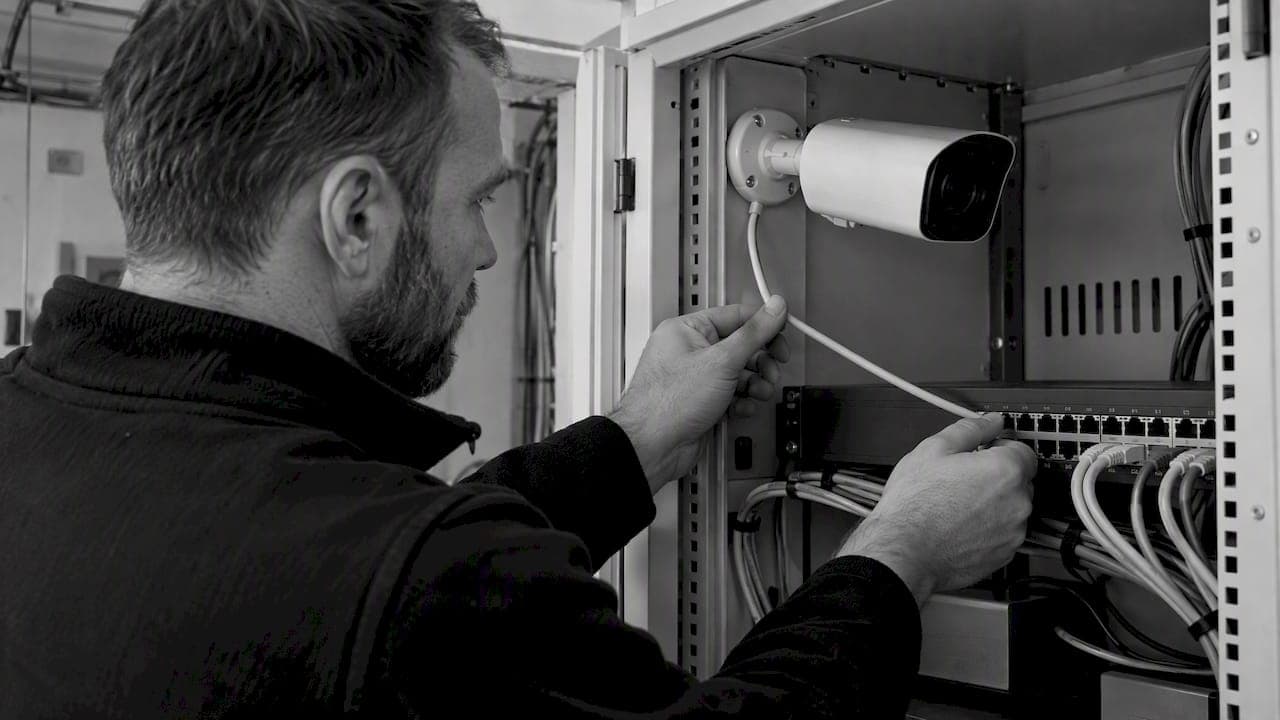
RTSP Security Risks: Integrators Must Block Exposed Ports 554 and 8554
See how integrators can reduce RTSP security risks: close exposed ports 554 and 8554, secure camera access, and verify each deployment with practical checks.

Require MAEpp and X Accuracy Before You Buy People Counting Systems
Verify people counting accuracy by demanding MAEpp, X Accuracy, and directional-bias reports. Validate on-site with at least 100 events per direction...
30–90 Day Pilot Validates Redundant Camera Networks for Engineers
Standards led, practical steps for engineers to deploy redundant camera networks: MRP, dual homing, and aggregation patterns, commissioning checks, and...
30 Day Pilot Proves Video Analytics Accuracy for Security Teams
Validate video analytics accuracy with scenario tests, camera tuning, transfer learning and a 30 day edge first pilot for security teams.
Let's Build YourSecurity Ecosystem.
Whether you're a System Integrator, Solution Provider, or an End-User looking for trusted advisory, our team is ready to help you navigate the BeyondSensor landscape.
Direct Advisory
Connect with our regional experts for tailored solutioning.