
Discover what is sensor interoperability and its importance for effective security systems. Learn how it enhances integration and data exchange.

What Is Sensor Interoperability in Security Systems

TL;DR:
- Sensor interoperability enables different sensing devices and platforms to exchange and interpret data accurately across standards. It requires shared protocols, metadata, and semantic models; neglecting the semantic layer often causes silent integration failures. Implementing frameworks like IEEE 1451, SOSA, and NIST testing ensures scalable, reliable, and cost-effective sensor integration in security systems.
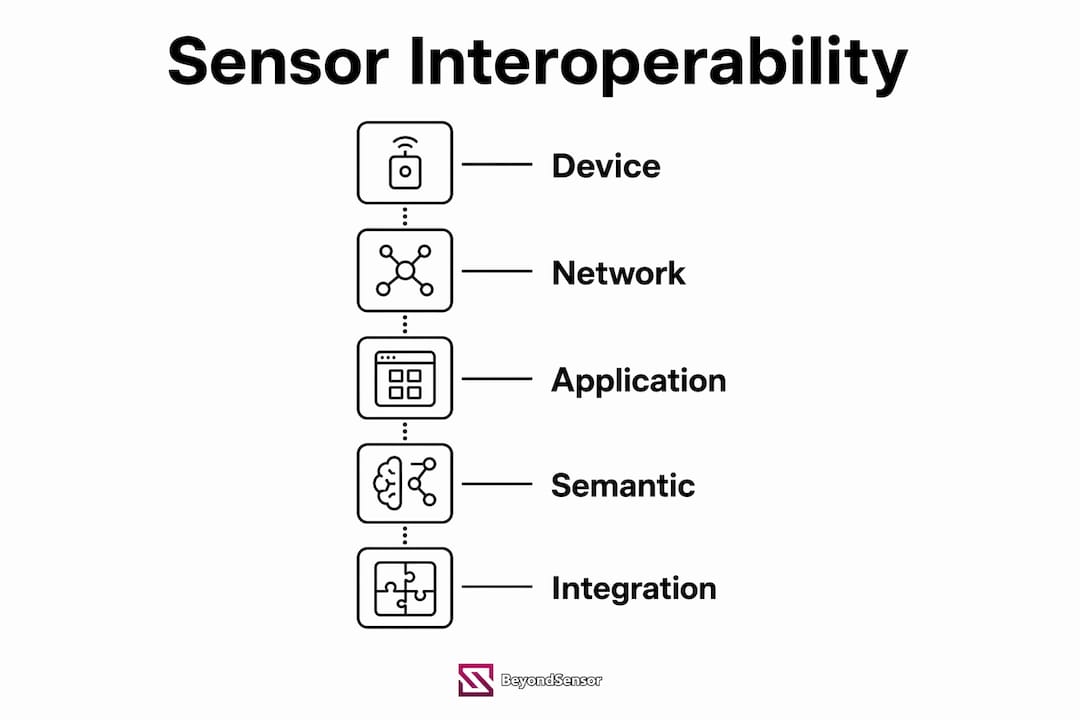
Sensor interoperability is defined as the technical ability of different sensing instruments and platforms to exchange, interpret, and utilize shared data streams without data fidelity loss. It spans four core dimensions: device, network, application, and semantic. Each dimension requires shared standards and metadata to function correctly. Frameworks like IEEE 1451, the W3C SSN/SOSA ontology, and NIST guidance give security system designers a concrete foundation for building interoperable sensor networks. For technology professionals and decision-makers, understanding these dimensions is the difference between a security system that scales and one that creates expensive integration debt.
What is sensor interoperability, and why does it matter for security?
Sensor interoperability is not simply about getting devices to connect. It is about ensuring that data exchanged between those devices carries consistent meaning and can drive real decisions. A motion sensor from one manufacturer and a thermal camera from another may both transmit data, but without shared standards, the security platform receiving that data cannot reliably interpret it.

The four dimensions of interoperability define the full scope of the problem. Device interoperability covers physical and electrical compatibility. Network interoperability addresses communication protocols like MQTT, CoAP, and OPC UA. Application interoperability ensures that software platforms can process data from multiple sources. Semantic interoperability, the most demanding dimension, requires that all systems agree on what the data means, not just its format.
The role of interoperability in sensors extends directly to compliance and operational efficiency. Security systems that lack interoperability force operators to manage data in isolated silos, which slows incident response and increases the risk of missed alerts. For decision-makers overseeing multi-site security infrastructure, this is not a theoretical concern. It is a daily operational cost.
What are the main technical challenges to achieving sensor interoperability?
Inconsistent and proprietary communication protocols are the most visible barrier. When sensor vendors build closed ecosystems, integration requires custom middleware or manual reconfiguration for every new device added. That reconfiguration inflates integration costs and blocks scalability at exactly the moment a security system needs to grow.
The deeper challenge is semantic ambiguity. Two sensors may report "temperature" using different units, sampling rates, or metadata schemas. Without a shared semantic model, the receiving application cannot reliably compare or combine those readings. This is the layer where most integration projects fail silently. Data arrives, but it does not translate into knowledge.
Key barriers to sensor interoperability include:
- Proprietary protocols: Vendor-specific communication formats prevent cross-platform data exchange without custom adapters.
- Inconsistent metadata: Sensors from different manufacturers describe the same physical phenomena using different labels and units.
- Semantic gaps: Without shared ontologies, data meaning is lost in translation between systems.
- Retrofitting costs: Adding interoperability after deployment multiplies complexity and budget requirements significantly.
- Heterogeneous payload formats: In wireless sensor networks, mixed payload formats are a primary bottleneck, not just protocol differences.
Pro Tip: When evaluating sensor vendors, request documentation of their protocol support and metadata schema. If a vendor cannot provide a clear metadata specification, budget for a translation layer before the project starts.
Semantic interoperability is often misunderstood as a connectivity problem. The true challenge is shared meaning comprehension across devices from different manufacturers. Solving connectivity without solving semantics leaves a system that is connected but not coherent.
Which industry standards and frameworks enable sensor interoperability in security systems?
Three frameworks form the backbone of interoperable sensor design: IEEE 1451, the W3C SSN/SOSA ontology, and NIST's harmonization model. Each addresses a different layer of the interoperability stack.
IEEE 1451 and TEDS
IEEE 1451 defines a standard interface between sensors and networks. Its most practical component is the Transducer Electronic Data Sheet (TEDS). TEDS is a small block of memory embedded in a sensor that stores its identification, calibration, and configuration data. When a sensor connects to a network, the TEDS data allows the system to automatically identify and configure it without manual reprogramming. This is plug-and-play interoperability in practice. It reduces long-term maintenance costs and eliminates a major source of human error during sensor replacement or expansion.
W3C SSN ontology and SOSA
The W3C Semantic Sensor Network (SSN) ontology and its lightweight core module, SOSA (Sensor, Observation, Sample, and Actuator), provide a shared vocabulary for describing sensors and their observations. SOSA functions as a minimal interoperability fallback, meaning any system that implements SOSA can share data with any other SOSA-compliant system. This makes it a practical starting point for security integrators who need broad compatibility without committing to a full ontology implementation.
NIST's three-pillar strategy
NIST's approach to IIoT interoperability rests on three pillars: standardized interfaces, harmonized interaction models, and interoperability testing. The testing component, often called a "plugfest," involves connecting devices from multiple vendors in a controlled environment to verify that they exchange data correctly. This reduces single-vendor dependency and gives procurement teams objective evidence of compatibility before deployment.
| Framework | Layer addressed | Key benefit |
|---|---|---|
| IEEE 1451 / TEDS | Device and network | Plug-and-play sensor identification and configuration |
| W3C SSN / SOSA | Semantic | Shared vocabulary for sensor observations |
| NIST harmonization model | System and testing | Vendor-neutral integration and verified compatibility |
Pro Tip: Specify SOSA compliance as a minimum requirement in sensor procurement documents. It costs vendors nothing to support and gives your integration team a guaranteed semantic baseline.
How do semantic interoperability frameworks enhance sensor data integration?
Semantic interoperability means that systems do not just exchange data. They exchange data whose meaning is agreed upon in advance. Without this layer, a security platform might receive a valid data packet from a perimeter sensor and have no reliable way to determine whether it represents a motion event, a temperature reading, or a tamper alert.
Semantic web technologies, ontologies, and machine learning models for data enrichment each contribute to solving this problem. Ontologies define the relationships between concepts. Machine learning models can infer meaning from context when explicit metadata is missing. Together, they create a data layer that applications can query without needing to understand the specifics of each sensor's native format.
The practical benefit of semantic decoupling is significant. Research shows that decoupling data acquisition from application layers using standardized JSON-LD contexts reduces the number of application modifications needed during sensor integration from multiple changes to zero. That means adding a new sensor type to a security system does not require rewriting application logic. The semantic layer absorbs the difference.
"Adopting semantic standards like SOSA early in a project creates a minimal interoperability baseline that supports future expansion. Systems built on shared ontologies avoid the costly custom data silos that emerge when each integration is treated as a one-off engineering problem."
The numbered steps below reflect how semantic frameworks typically get applied in a security integration project:
- Define the observation vocabulary. Select an ontology, such as SOSA or a domain-specific extension, that covers the sensor types in your system.
- Map sensor outputs to ontology terms. Create a translation layer that converts each sensor's native data format into ontology-compliant descriptions.
- Publish data using JSON-LD contexts. JSON-LD attaches semantic meaning to data at the point of publication, making it reusable across applications.
- Validate with a test consumer. Connect a second application to the semantic data feed and confirm it can interpret observations without custom parsing.
- Expand incrementally. Add new sensor types by extending the ontology mapping, not by modifying downstream applications.
This approach directly supports multi-sensor integration in security environments where camera systems, access control readers, environmental sensors, and perimeter detectors must all feed a unified operations platform.
What practical strategies can decision-makers use to ensure sensor interoperability?
The most effective strategy is to design for interoperability from the project's first requirements document. Retrofitting interoperability after deployment adds complexity and cost that far exceeds what early planning would have required. This is not a technical observation. It is a budget reality that security project managers encounter repeatedly.
Practical steps for decision-makers include:
- Write interoperability into procurement specs. Require vendors to document protocol support, metadata schemas, and ontology compliance before contract award.
- Mandate unified communication protocols. Choose a single application-layer protocol, such as MQTT with JSON payloads, as the system standard. Require all sensors to support it natively or through a certified adapter.
- Run plugfest testing before deployment. Following NIST's model, connect all sensor types in a lab environment and verify data exchange before installing anything in the field.
- Use lightweight, unified payload formats. For wireless sensor networks mixing Bluetooth and Zigbee devices, JSON over MQTT provides a unified frame format that bridges protocol differences without custom middleware.
- Adopt TEDS-compliant sensors where possible. IEEE 1451 TEDS support eliminates manual reconfiguration during sensor replacement and reduces long-term maintenance burden.
Pro Tip: Build a sensor registry as part of your system architecture. A registry that stores each sensor's TEDS data, ontology mappings, and protocol profile gives your operations team a single source of truth for every device on the network.
The step-by-step integration guide approach also applies here. Security system projects that treat interoperability as a checklist item at the end of design consistently spend more on integration than projects that treat it as a core architectural requirement from day one.
Key Takeaways
Sensor interoperability requires addressing device, network, application, and semantic dimensions simultaneously, and the semantic layer is the one most likely to cause silent integration failures.
| Point | Details |
|---|---|
| Four-layer definition | Interoperability spans device, network, application, and semantic dimensions, each requiring distinct standards. |
| Semantic layer is critical | Without shared ontologies like SOSA, connected sensors still produce data that applications cannot reliably interpret. |
| IEEE 1451 TEDS reduces costs | TEDS-compliant sensors configure automatically, cutting manual reconfiguration and long-term maintenance expense. |
| Design early, not late | Retrofitting interoperability after deployment multiplies complexity and cost compared to designing for it upfront. |
| JSON-LD and MQTT unify data | Standardized payload formats bridge heterogeneous wireless protocols and eliminate the need for custom middleware. |
The semantic gap is the real problem, not the cable
I have watched security integration projects stall not because sensors could not connect, but because the data they produced meant different things to different applications. The team would celebrate getting devices online, then spend months writing custom parsers for each data feed. That is the semantic gap in action, and it is far more common than the industry acknowledges.
The misconception I see most often is that interoperability is a connectivity problem. Get the devices on the same network, pick a common protocol, and you are done. That thinking gets projects to 60% of the way there. The remaining 40% is semantic. It is the work of defining what "intrusion detected" means across a motion sensor, a thermal camera, and a door contact, and making sure every application in the stack agrees on that definition.
My honest view is that the W3C SOSA module deserves far more attention than it gets in security system design. It is lightweight, well-documented, and provides exactly the minimal semantic baseline that most projects need. Teams that adopt it early rarely need to revisit their data architecture when they add new sensor types. Teams that skip it spend that time writing and rewriting integration code.
The future of sensor integration in security is not more protocols. It is better shared meaning. Standards bodies are moving in that direction, and the organizations that build semantic interoperability into their systems now will have a measurable advantage when the next generation of sensing technology arrives.
— Eumir
How Beyondsensor supports interoperable security sensor integration
Beyondsensor builds AI-driven solutions specifically for system integrators who need to connect heterogeneous sensor networks without rebuilding their data architecture for every new device type.
Beyondsensor's platform addresses the full interoperability stack, from device-level protocol normalization to semantic data enrichment that makes sensor observations usable across applications. For integrators working across Singapore, Malaysia, the Philippines, and the broader Southeast Asian region, Beyondsensor provides localized validation and deployment support that generic enterprise platforms do not offer. The system integrators page details how Beyondsensor reduces integration complexity for multi-vendor security environments. Teams evaluating AI-driven sensor tools can also review Beyondsensor's technical innovations to see how the platform handles data enrichment and cross-protocol compatibility.
FAQ
What is the simplest definition of sensor interoperability?
Sensor interoperability is the ability of different sensors and platforms to exchange and correctly interpret data without data loss. It requires shared communication protocols, metadata standards, and semantic models across all connected devices.
Why is semantic interoperability harder than network interoperability?
Network interoperability requires devices to use the same communication protocol. Semantic interoperability requires that all systems agree on the meaning of the data exchanged, which demands shared ontologies and metadata schemas that most proprietary systems do not provide by default.
What does IEEE 1451 TEDS do in practice?
IEEE 1451 TEDS stores sensor identification and configuration data directly on the device. When a TEDS-compliant sensor connects to a network, the system reads that data automatically and configures the integration without manual reprogramming.
How does SOSA differ from the full W3C SSN ontology?
SOSA is a lightweight core module of the SSN ontology that covers the most common sensor observation concepts. It functions as a minimal interoperability baseline, making it practical for projects that need broad compatibility without implementing the full SSN specification.
When should interoperability be addressed in a security system project?
Interoperability should be a core requirement from the first design document. Retrofitting it after deployment consistently increases both complexity and cost compared to building it in from the start.
Recommended
Read More Articles
RTSP Security Risks: Integrators Must Block Exposed Ports 554 and 8554
See how integrators can reduce RTSP security risks: close exposed ports 554 and 8554, secure camera access, and verify each deployment with practical checks.

Require MAEpp and X Accuracy Before You Buy People Counting Systems
Verify people counting accuracy by demanding MAEpp, X Accuracy, and directional-bias reports. Validate on-site with at least 100 events per direction...
30–90 Day Pilot Validates Redundant Camera Networks for Engineers
Standards led, practical steps for engineers to deploy redundant camera networks: MRP, dual homing, and aggregation patterns, commissioning checks, and...

30 Day Pilot Proves Video Analytics Accuracy for Security Teams
Validate video analytics accuracy with scenario tests, camera tuning, transfer learning and a 30 day edge first pilot for security teams.
Let's Build YourSecurity Ecosystem.
Whether you're a System Integrator, Solution Provider, or an End-User looking for trusted advisory, our team is ready to help you navigate the BeyondSensor landscape.
Direct Advisory
Connect with our regional experts for tailored solutioning.