
Discover what is risk-based sensing and how it optimizes sensor deployment. Enhance security efficiency and improve detection strategies today.

What Is Risk-Based Sensing for Security Pros

TL;DR:
- Risk-based sensing allocates sensors based on continuous risk assessment rather than fixed coverage plans. It improves detection accuracy, reduces resource waste, and enhances regulatory compliance by focusing on high-risk zones. Implementing it requires structured risk assessments, dynamic re-mapping, and ongoing feedback to optimize sensor deployment.
Risk-based sensing is defined as a dynamic methodology that allocates sensor resources based on continuous risk assessment rather than fixed, uniform coverage grids. The recognized industry term for this practice is risk-prioritized sensor deployment, though security professionals increasingly use "risk-based sensing" to describe the same concept. Regulatory bodies including the FDA, EMA, WHO, and ISPE endorse risk-based approaches as a de facto standard, particularly in temperature mapping and compliance-driven monitoring. The core payoff is measurable: studies in pharmaceutical and object detection contexts show 20–34% efficiency improvements from dynamic sensor allocation while maintaining strong coverage. For security managers, that figure means fewer wasted resources and sharper detection where it counts most.
What is risk-based sensing and how does it differ from fixed grids?
Risk-based sensing replaces the "monitor everything equally" model with a system that concentrates high-fidelity sensor resources on areas where the cost of failure is highest. A traditional fixed sensor grid treats a server room entrance the same as a low-traffic storage corridor. Risk-based sensing does not. It uses quantified risk scores to decide which zones get high-bandwidth sensors, which get basic coverage, and which get none at all.

The practical difference shows up in resource consumption and detection quality. Fixed grids generate noise from low-risk areas, which increases processing load and dilutes analyst attention. Risk-based sensing reduces that noise by design. The result is a system where detection recall improved from 0.66 to 0.71 in tested environments while simultaneously cutting computational resource consumption. Better detection and lower costs are not a trade-off here. They move in the same direction.
This methodology also aligns with how security risk assessment frameworks already operate in most organizations. Risk-based sensing simply extends that logic into the physical sensor layer.
How does risk-based sensing work? The core methodology
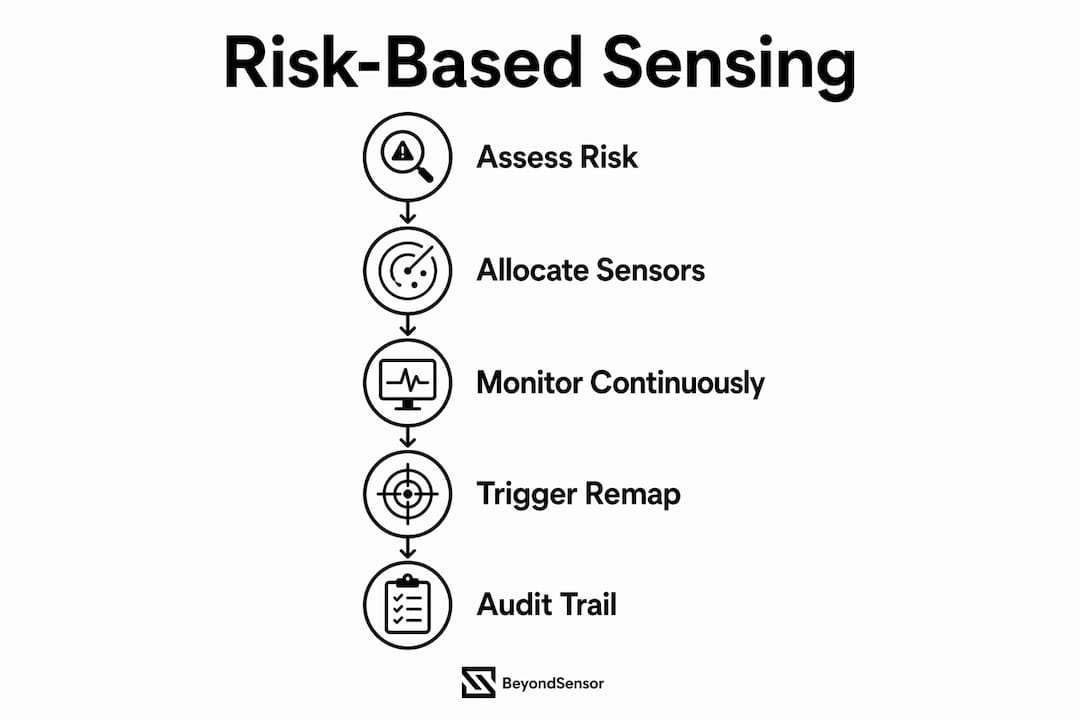
The methodology follows a structured sequence that repeats continuously rather than running once at installation.
-
Structural risk assessment. Map every zone in the facility and assign a risk score based on asset value, threat likelihood, and consequence of a breach. Entry points, server rooms, HVAC control areas, and high-value asset storage score highest. Low-traffic utility corridors score lowest.
-
Risk-weighted sensor configuration. Apply Bayesian decision theory to select sensor types and placement. Bayesian risk minimization calculates the expected cost of a missed detection against the cost of deploying a higher-fidelity sensor. High-risk zones receive high-bandwidth sensors. Lower-risk zones receive simpler, lower-cost devices.
-
Multi-step predictive modeling. Modern architectures run predictive models that update sensor weights in real time. These models balance detection probability against computational cost, adjusting which sensors are active and at what sampling frequency based on current threat signals.
-
Trigger-based re-mapping. Standard practice moves away from fixed three-year re-qualification cycles. Instead, re-mapping triggers activate when operational layouts change, new equipment is installed, or alarm trends shift. This keeps the sensor map aligned with actual risk rather than a calendar.
-
Continuous feedback loop. Sensor outputs feed back into the risk model. An uptick in access attempts at a specific entry point raises that zone's risk score, which can automatically prompt a sensor upgrade or increased sampling rate.
Pro Tip: Document every trigger event that causes a re-mapping. This audit trail becomes your compliance evidence and your diagnostic record when a blind spot appears.
What are the benefits of risk-based sensing over traditional approaches?
The benefits of risk-based sensing are concrete and measurable across detection quality, resource use, and regulatory standing.
- Higher detection accuracy. Concentrating high-fidelity sensors on critical zones reduces false negatives where they matter most. Tested systems show detection recall rising from 0.66 to 0.71 after switching to risk-weighted sensor selection.
- Energy and resource savings. Risk-based sensor placement saved 20% of ventilation energy in a pharmaceutical factory by placing sensors where air distribution uncertainty was highest, not where installation was easiest.
- Reduced processing load. Fewer active sensors in low-risk zones means less data to process. Analysts spend time on genuine alerts rather than filtering noise from areas that rarely generate meaningful events.
- Regulatory compliance confidence. The FDA, EMA, WHO, and ISPE all recognize risk-based monitoring protocols. Data-backed justification for sensor placement gives compliance teams a defensible record during audits.
- Adaptability to operational change. Fixed grids become outdated the moment a facility layout changes. Risk-based sensing updates when the environment changes, not on a fixed schedule.
A common misconception is that more sensors always mean better security. Over-sensorization increases noise and complexity without security gains. Qualitative risk mapping before deployment prevents this by identifying which zones genuinely need high-fidelity coverage. The discipline of saying "this area does not need a sensor" is as important as knowing where to place one.
What technical frameworks power risk-based sensing?
The technical foundation of risk-based sensing rests on three interconnected frameworks.
Bayesian decision theory in sensor selection
Bayesian risk minimization treats sensor selection as a decision problem with quantifiable costs. For each candidate sensor placement, the model calculates the expected loss from a missed detection and compares it against the deployment cost. The sensor configuration that minimizes total expected loss wins. This approach produces objectively optimal sensor weights rather than configurations based on installer preference or budget shortcuts.
Multi-criteria optimization
Risk alone is not enough to produce a workable system. Multi-criteria optimization frameworks balance risk against observability, integrability, and cost. A sensor placement that scores perfectly on risk but cannot integrate with existing network infrastructure is operationally useless. Pareto-optimal solutions satisfy fault diagnostics requirements and cost constraints simultaneously, producing systems that work in the real world, not just on paper.
Traditional vs. risk-based sensing: a technical comparison
| Criterion | Traditional fixed grid | Risk-based sensing |
|---|---|---|
| Sensor placement logic | Uniform coverage intervals | Risk-weighted zone prioritization |
| Update trigger | Fixed schedule (e.g., every 3 years) | Operational change or alarm trend |
| Sensor type allocation | Same tier across all zones | High-fidelity in critical zones, basic elsewhere |
| Computational load | High due to uniform data volume | Reduced by limiting active sensors in low-risk areas |
| Compliance justification | Installation records | Data-backed risk assessment documentation |
| Adaptability | Low | High |
Pro Tip: Run a multi-criteria scoring exercise before finalizing any sensor map. Score each candidate location on risk, observability, and integration cost. Locations that score low on all three are candidates for removal, not addition.
How to implement risk-based sensing in security systems
Practical implementation follows a sequence that security teams can apply regardless of facility size.
- Start with a written risk register. List every zone, asset, and threat vector. Assign a severity score and a likelihood score to each. Multiply them to get a risk priority number. This document becomes the foundation for every sensor placement decision. A security risk assessment checklist helps structure this process for facility owners.
- Map critical zones explicitly. Entry and exit points, HVAC control rooms, server rooms, and areas with high-value assets require the most attention. Cold spots and areas with poor air circulation in environmental monitoring contexts also qualify as high-risk zones due to measurement uncertainty.
- Match sensor type to zone risk level. Deploy high-bandwidth, high-fidelity sensors in zones with catastrophic failure potential. Use lower-cost sensors in zones where a missed event has limited consequence. Weighting sensors by failure cost prevents budget waste and keeps the system defensible.
- Define re-mapping triggers in writing. Specify exactly which events require a risk reassessment: new equipment installation, layout changes, staffing pattern shifts, or a sustained increase in alarm frequency. Trigger-based updates prevent sensor drift and blind spots that accumulate when teams rely on fixed schedules.
- Monitor for drift continuously. Sensor performance degrades over time. Build a monitoring routine that checks sensor output against expected baselines. A sensor that stops generating alerts in a high-risk zone is either a sign of excellent security or a sign of equipment failure. Distinguish between the two.
- Review the risk register after every significant operational change. A new server rack, a relocated access point, or a change in shift patterns all alter the risk profile of a facility. The sensor map must follow.
Connecting sensor integration strategies to the risk register from day one prevents the common failure mode where sensor networks grow organically without a coherent risk rationale.
Key Takeaways
Risk-based sensing is the most resource-efficient security methodology available because it concentrates high-fidelity monitoring on zones where the cost of failure is highest, not where installation is easiest.
| Point | Details |
|---|---|
| Core definition | Risk-based sensing allocates sensors by risk score, not by uniform coverage intervals. |
| Efficiency gains | Dynamic allocation produces 20–34% efficiency improvements over fixed sensor grids. |
| Technical foundation | Bayesian decision theory and multi-criteria optimization drive sensor selection and placement. |
| Update discipline | Re-map sensors when operations change, not on a fixed calendar schedule. |
| Compliance advantage | Data-backed risk documentation gives audit teams a defensible record under FDA, EMA, and ISPE standards. |
The cultural shift nobody talks about
The hardest part of adopting risk-based sensing is not the technology. I have worked through enough security deployments to say that with confidence. The hard part is convincing teams to stop treating sensor density as a proxy for security quality.
There is a deeply ingrained belief in physical security that more coverage equals more protection. It feels intuitive. It is also wrong in most real-world contexts. Over-sensorization creates noise, and noise creates fatigue. Analysts who spend their shifts filtering false positives from low-risk corridors are not protecting the server room. They are managing a system that was never designed to prioritize.
The shift to risk-prioritized monitoring requires upfront analytical work that many teams resist because it feels slower than just installing sensors. That resistance is the real obstacle. Organizations that commit to the risk register process before touching a single sensor consistently end up with systems that are easier to manage, cheaper to run, and more defensible during audits. The ones that skip it spend years adding sensors to compensate for blind spots they never mapped in the first place.
My recommendation: treat the risk register as a living document, not a project deliverable. The moment it becomes a static file on a shared drive, the sensing system starts drifting away from reality.
— Eumir
Beyondsensor tools for intelligent sensor deployment
Security teams that understand risk-based sensing principles need tools that can execute them at scale.

Beyondsensor builds AI-powered sensing tools designed specifically for security professionals who need dynamic sensor analytics and intelligent resource allocation. The Beyondsensor tools platform supports risk-weighted sensor configuration, real-time monitoring, and trigger-based re-mapping workflows that align directly with the frameworks covered here. For end-users ready to move beyond fixed sensor grids, the Beyondsensor end-user solutions page outlines how these capabilities translate into deployable security systems across industrial, infrastructure, and physical security environments. Beyondsensor operates across Singapore, Malaysia, and the Philippines, with regional expertise that matters when compliance requirements vary by jurisdiction.
FAQ
What is the risk-based sensing definition in security?
Risk-based sensing is a methodology that allocates sensor resources based on continuous risk assessment, concentrating high-fidelity monitoring on zones where the cost of failure is highest. It replaces uniform coverage grids with dynamic, risk-weighted sensor deployment.
How does risk-based sensing improve detection accuracy?
By focusing high-bandwidth sensors on critical zones, risk-based sensing reduces false negatives where they matter most. Tested systems show detection recall improving from 0.66 to 0.71 after switching to risk-weighted sensor selection.
What triggers a sensor re-mapping in risk-based sensing?
Re-mapping triggers include operational layout changes, new equipment installation, staffing pattern shifts, and sustained increases in alarm frequency. Fixed calendar schedules are replaced by event-driven updates tied to actual changes in risk.
What regulatory bodies support risk-based sensing approaches?
The FDA, EMA, WHO, and ISPE all endorse risk-based monitoring approaches, particularly in temperature mapping and compliance-driven environments. Data-backed sensor placement documentation strengthens audit readiness under all four frameworks.
What is the biggest implementation mistake in risk-based sensing?
The most common mistake is skipping the upfront risk register and placing sensors based on installation convenience. Without a written risk assessment, teams cannot justify sensor placement decisions or identify blind spots before they become incidents.
Recommended
- How to choose the right sensing technology for security | News | BeyondSensor
- Secure Sensing Explained: Defend Industrial & Environmental Ops | News | BeyondSensor
- Sensing Solution Selection Guide for Security Pros | News | BeyondSensor
- Security compliance in sensing systems: a step-by-step guide | News | BeyondSensor
Read More Articles

Geofencing Alerts for Site Security: Setup Guide for Singapore
How to design geofencing alerts that flag real security events, cut alert fatigue and stay within PDPA and IPA rules at Singapore sites.

CCTV Operator Training in Singapore: Skills, Courses and Costs
What CCTV operator training involves in Singapore: the PRSF course, fees and subsidies, the 31 December 2026 deadline, and skills for AI-assisted control rooms.

Role-Based Access Control: A Practical Guide for Singapore Security Teams
How role-based access control works, where it breaks (role explosion, stale roles), and how to apply it to both cyber and physical security in Singapore.

Security Site Survey: Facility Teams’ Checklist for Funded Fixes
Assess site risks, turn findings into budgeted action, and use field checklists, reporting templates, and PDPA notes for camera and biometric deployments.
Let's Build YourSecurity Ecosystem.
Whether you're a System Integrator, Solution Provider, or an End-User looking for trusted advisory, our team is ready to help you navigate the BeyondSensor landscape.
Direct Advisory
Connect with our regional experts for tailored solutioning.