
Discover what is contextual sensing and how it transforms data into intelligent actions. Enhance your understanding for effective technology deployment.

What Is Contextual Sensing? A Professional Guide

TL;DR:
- Contextual sensing enables systems to interpret environmental data and adapt behavior intelligently. It relies on multi-modal data fusion, AI-driven preprocessing, and accurate context inference for effective deployment. Challenges include environment boundaries, privacy concerns, and the need for standardized terminology across platforms.
Contextual sensing is defined as the capability of a system to acquire data from its environment, infer situational meaning from that data, and adapt its behavior accordingly. The term traces back to foundational work by Schilit (1994) and Dey (2001), who established the three core components of context awareness: acquisition, abstraction and inference, and application behavior. These components remain the accepted industry standard today. For professionals deploying security systems, industrial automation, or smart infrastructure, understanding what is contextual sensing is the difference between a sensor network that collects data and one that acts on it intelligently.
What is contextual sensing and how does it work?
Contextual sensing is not simply reading sensor values. It is the full pipeline from raw data collection through to a system decision or behavioral change. A temperature sensor alone tells you a room is hot. A contextual sensing system tells you the room is hot, occupied by three people, and that the HVAC system should adjust now because a meeting ends in ten minutes.
The three-stage model defines this clearly. Acquisition covers the physical capture of signals from the environment. Abstraction and inference convert those signals into meaningful context labels, such as "user is commuting" or "perimeter is breached." Application behavior is the system's response, whether that is an alert, an automated adjustment, or a logged event for review.
Multi-modal sensor fusion sits at the heart of how contextual sensing works in practice. Accelerometers, biometric readers, radio frequency (RF) sensors, cameras, and environmental monitors each contribute a partial picture. The system combines these streams to build a complete situational understanding. Beyondsensor's approach to intelligent sensing for security reflects exactly this architecture, fusing physical and environmental data into a unified operational picture.

How does contextual sensing process raw sensor data?
Raw sensor data is noisy and redundant. Data-centric feature selection with explainable AI (XAI) for imputation matters more than model choice when building reliable context inference. That finding reframes the common assumption that better algorithms alone solve sensing problems. The data pipeline is the foundation.
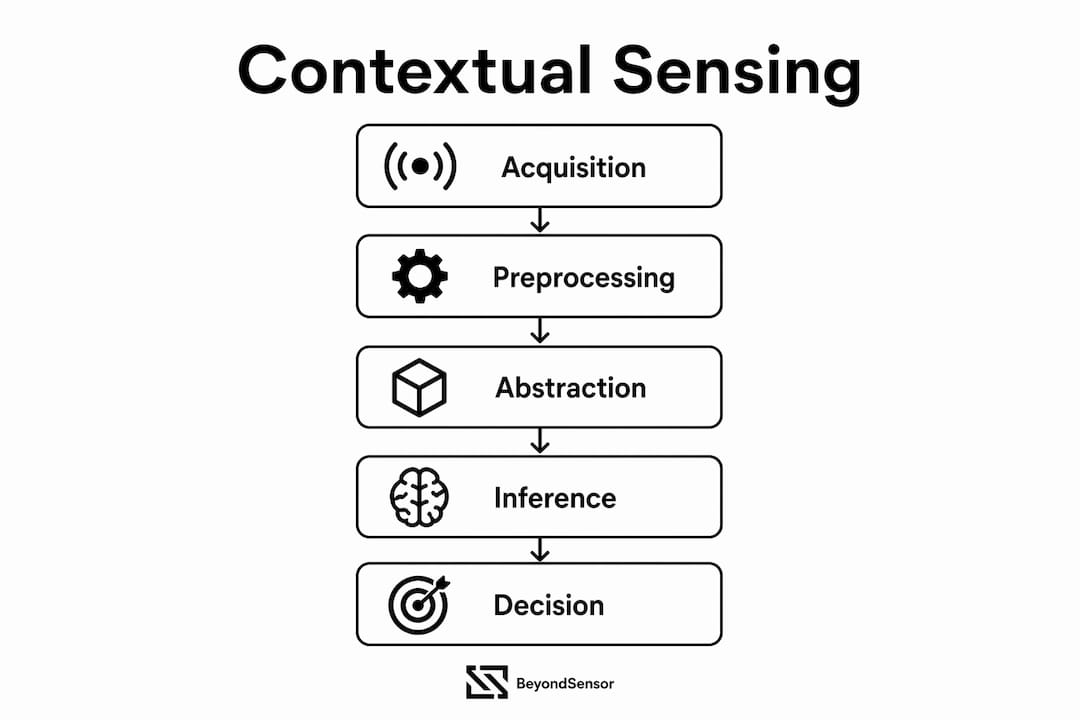
The processing workflow typically follows these stages:
- Signal acquisition: Sensors capture raw inputs across modalities, including motion, biometrics, RF signals, and environmental conditions.
- Noise filtering and imputation: Missing or corrupted values are filled using XAI-driven methods that preserve interpretability.
- Feature selection: Relevant signal features are extracted and irrelevant ones discarded to reduce computational load.
- Context compression: Multi-granularity compression reduces data volume. Research shows this approach can improve inference accuracy by 1.3% to 8.3% while compressing data to between 1/70 and 1/40 of its original size.
- Context inference: Machine learning models, including Large Language Models (LLMs), interpret compressed features and assign context labels.
- Behavioral output: The inferred context triggers a system response, from an automated alert to a personalized device adjustment.
LLMs now play a meaningful role in step five. They can convert sensor outputs such as inertial measurement unit (IMU) readings into rich behavioral narratives, for example "user is running to catch a train." That level of interpretive depth was not achievable with traditional classification models.
Pro Tip: Invest in your data preprocessing pipeline before selecting your inference model. Explainable AI-driven imputation and feature selection consistently outperform model upgrades when data quality is poor.
What are the key applications of contextual sensing in industry?
Contextual sensing applications span a wide range of sectors. The unifying factor across all of them is the same: systems stop reacting to raw signals and start responding to understood situations.
Physical security and surveillance
Adaptive surveillance is the most direct application for security professionals. A contextual sensing system does not just detect motion. It classifies whether that motion is a maintenance worker following a known route or an unauthorized person in a restricted zone at 2:00 AM. Intrusion detection systems that incorporate biometric monitoring, RF-based presence detection, and camera feeds can reduce false alarms significantly. Access control integration with contextual data layers adds another dimension, allowing systems to flag anomalies such as a valid credential used in an impossible location sequence.
Operational efficiency and worker safety
Industrial environments use contextual sensing to track asset location, monitor worker posture and fatigue, and adjust environmental conditions in real time. A system that knows a worker has been stationary in a high-heat zone for an extended period can trigger a welfare check automatically. That is not a rule-based alarm. It is context-driven response.
Key application areas across industries
- Physical security: Adaptive surveillance, perimeter intrusion detection, biometric access control, and anomaly flagging in restricted zones
- Industrial automation: Asset tracking, predictive maintenance triggers based on combined vibration and thermal context, and worker safety monitoring
- Healthcare and wellness: Patient activity recognition, fall detection, and comfort state inference using biometric and environmental data
- Smart buildings: HVAC and lighting adjustment based on occupancy context, meeting schedules, and user preference patterns
- Transportation: Commute mode detection, vehicle occupancy sensing, and driver behavior monitoring for fleet safety
The Human-as-a-Sensor (HaaS) model represents an emerging frontier. It uses biological signals, including brain-computer interface outputs and heart rate variability, as direct contextual inputs. Business surveillance setups increasingly incorporate physiological data to assess operator alertness and situational readiness. Beyondsensor's work in sensor tech for safety and efficiency addresses this convergence directly.
What are the benefits and challenges of contextual sensing systems?
The benefits of contextual sensing are concrete and measurable. Systems that understand context make fewer unnecessary interventions, respond faster to genuine events, and generate more useful data for post-incident analysis.
Core benefits include:
- Improved decision quality: Context-aware systems distinguish between a door left open by staff and a door forced open after hours, without human review of every alert.
- Reduced operator fatigue: Exception-based monitoring, where operators only see flagged anomalies, replaces continuous video review.
- Personalization at scale: Smart environments adjust to individual user patterns without manual configuration.
- Audit-ready event logs: Context labels attached to sensor events make incident reconstruction faster and more defensible.
The challenges are equally real. Transition-zone ambiguity is a common failure point. Systems struggle to classify user context accurately when a person moves between indoor and outdoor environments, or between transport modes. Multimodal label synchronization, aligning place, motion state, transport mode, and device pose simultaneously, improves robustness in these edge cases.
Privacy is the other major barrier. The Human-as-a-Sensor approach highlights that continuous collection of biological data raises adoption concerns that go beyond sensor accuracy. Researchers identify privacy management as the primary obstacle, not technical performance.
Pro Tip: Map your transition zones before deployment. Define explicit rules for how the system should behave when context is ambiguous, rather than letting the model guess. Documented fallback logic reduces both errors and liability.
A lack of unified taxonomy for context in RF-based sensing compounds integration challenges. Without agreed definitions for what constitutes a "context state" across platforms, building cross-device services that feel natural to users remains difficult. Beyondsensor's industrial security sensing guide addresses this fragmentation with a structured approach to sensor taxonomy and integration standards.
What does the future of contextual sensing look like?
The next evolution of contextual sensing is convergent sensing, which combines biometric signals with environmental monitoring to resolve complex states that neither stream could identify alone. Heart rate variability and electrocardiogram (ECG) data, fused with ambient temperature and air quality readings, can detect nuanced health and comfort states that single-modality systems miss entirely.
| Trend | Technology Involved | Primary Benefit |
|---|---|---|
| Convergent sensing | Biometric + environmental fusion | Resolves complex health and comfort states |
| LLM-driven context reasoning | Large Language Models on sensor streams | Converts raw data into behavioral narratives |
| Edge AI inference | On-device processing without cloud dependency | Reduces latency and data exposure |
| Human-as-a-Sensor (HaaS) | Brain-computer interfaces, ECG, HRV | Adds biological context to environmental sensing |
| Standardization frameworks | Unified context taxonomies across RF and IoT | Enables cross-platform interoperability |
LLMs are moving from experimental to practical in this space. Activity recognition models are evolving from fine-grained action classification to context-rich behavioral narratives that give operators genuinely useful situational summaries. An operator reading "subject has been stationary in Zone 4 for 22 minutes, outside normal work pattern" acts faster than one reviewing raw motion logs.
Privacy safeguards and standardization efforts will define how quickly these advances reach production deployments. Beyondsensor's sensor integration strategies reflect the convergent sensing direction, combining biometric and environmental data streams within a structured, compliance-aware architecture.
Key Takeaways
Contextual sensing transforms raw sensor data into situational understanding, enabling systems to respond to what is actually happening rather than what individual sensors detect in isolation.
| Point | Details |
|---|---|
| Three-stage model | Every contextual sensing system follows acquisition, abstraction and inference, and application behavior. |
| Data preprocessing is critical | Explainable AI-driven feature selection outperforms model upgrades when data quality is poor. |
| Transition-zone ambiguity | Multimodal label synchronization across place, motion, and pose reduces classification errors at environment boundaries. |
| Privacy is the top adoption barrier | Continuous biological data collection raises concerns that technical performance alone cannot resolve. |
| Convergent sensing is the next frontier | Fusing biometric and environmental streams reveals complex states that single-modality systems cannot detect. |
Why contextual sensing is harder than it looks
I have watched organizations deploy sensor networks with genuine ambition and then discover, six months later, that their systems are generating more noise than insight. The hardware works. The models run. But nobody thought carefully about what "context" actually means for their specific environment, and the taxonomy they built in week one does not match the operational reality of week twenty-four.
The foundational research from Schilit and Dey is still the right starting point, but it was written before multi-modal fusion, LLMs, and edge AI existed as practical tools. The three-stage model holds. The implementation complexity has multiplied. What I find most professionals underestimate is the transition-zone problem. It sounds like an edge case. In practice, it is where most real-world deployments break down, because real environments are full of boundaries.
My honest recommendation: treat your context taxonomy as a living document, not a deployment artifact. Revisit it quarterly. The practical guide for security managers from Beyondsensor takes this approach, and it is the right one. Privacy is not a compliance checkbox either. If your system collects biological signals, your users need to understand why and what happens to that data. Trust is an operational asset.
— Eumir
Beyondsensor's sensing solutions for security and operations
Beyondsensor builds sensor-based security and operational systems designed for the exact challenges this article describes: multi-modal data fusion, context inference at the edge, and compliance-aware deployment across industrial and physical security environments.

For system integrators building contextual sensing infrastructure, Beyondsensor offers hardware-software solutions validated across Singapore, Malaysia, and the Philippines, with regional expertise that generic platforms cannot match. Security agencies working on adaptive surveillance and intrusion detection will find purpose-built tools aligned with the convergent sensing direction the industry is moving toward. Beyondsensor's ecosystem covers the full pipeline from sensor acquisition through to behavioral output, with support for cross-platform integration and local regulatory compliance.
FAQ
What is contextual sensing in simple terms?
Contextual sensing is the process by which a system collects data from its environment, interprets what is happening, and adjusts its behavior based on that interpretation. It goes beyond raw signal detection to understand situational meaning.
How does contextual sensing differ from standard sensor monitoring?
Standard sensor monitoring reports raw values. Contextual sensing infers meaning from those values, for example classifying a motion event as authorized staff activity versus an intrusion, and triggers an appropriate response automatically.
What are the biggest challenges in deploying contextual sensing systems?
The three primary challenges are transition-zone ambiguity when users move between environments, privacy concerns around continuous biological data collection, and the lack of unified taxonomy across RF-based and IoT sensing platforms.
How do Large Language Models improve contextual sensing?
LLMs convert granular sensor outputs, such as IMU motion data, into behavioral narratives that describe what a user is actually doing, enabling richer situational awareness than traditional classification models provide.
What industries benefit most from contextual sensing applications?
Physical security, industrial automation, healthcare, smart buildings, and transportation all benefit directly. Each sector uses contextual sensing to move from reactive alerting to proactive, situation-aware system behavior.
Recommended
- What Is Edge Sensing? A Technical Guide for Professionals | News | BeyondSensor
- Defining Sensing Ecosystems for Security Professionals | News | BeyondSensor
- Sensing Solution Selection Guide for Security Pros | News | BeyondSensor
- Intelligent sensing deployment process: A guide for tech leaders | News | BeyondSensor
Read More Articles

Smart Facility Integration Ideas for Facility Managers
Discover smart facility integration ideas that enhance operational efficiency. Learn how unified systems can prevent failures and optimize management.

The Role of Digital Twins in Security: 2026 Guide
Discover the role of digital twins in security. Learn how these powerful tools enhance threat detection and improve defense strategies.

What Is Risk-Based Sensing for Security Pros
Discover what is risk-based sensing and how it optimizes sensor deployment. Enhance security efficiency and improve detection strategies today.

Key Features of Secure Sensors: 2026 Professional Guide
Discover the key features of secure sensors in our 2026 guide. Learn how encryption and authentication enhance safety and security for your systems.
Let's Build YourSecurity Ecosystem.
Whether you're a System Integrator, Solution Provider, or an End-User looking for trusted advisory, our team is ready to help you navigate the BeyondSensor landscape.
Direct Advisory
Connect with our regional experts for tailored solutioning.