
Discover how to evaluate security threats effectively. This practical guide helps you prioritize risks and make informed decisions.

How to Evaluate Security Threats: A Practical Guide

TL;DR:
- Effective threat evaluation begins with a thorough asset inventory and clear classification of threats by category, such as deliberate, accidental, or natural.
- Organizations must assess vulnerabilities, likelihood, and impact consistently, utilizing standardized scales and documented criteria to produce comparable, repeatable risk scores.
- Continuous monitoring, validation of control effectiveness, and addressing trust propagation are critical for accurate risk management and informed decision-making.
Security professionals know the problem firsthand: you have a growing list of identified threats, a finite team, and stakeholders demanding clear answers about where the real risk lies. Knowing how to evaluate security threats with precision, rather than gut instinct, separates teams that prioritize correctly from those that exhaust resources on low-probability scenarios. This guide walks through the foundational concepts, execution steps, common pitfalls, and communication strategies security practitioners need to turn raw threat data into decisions that hold up under scrutiny.
Table of Contents
- Key Takeaways
- Before you start: foundational concepts
- Steps to assess and score security threats
- Common pitfalls and best practices
- Turning evaluation outputs into prioritized responses
- My take on what most teams get wrong
- How Beyondsensor supports your threat evaluation workflow
- FAQ
Key Takeaways
| Point | Details |
|---|---|
| Start with asset inventory | Classify and rank your critical assets before assigning threat scores to any risk. |
| Use likelihood and impact together | Risk is a combined function of threat probability and potential harm, not either factor alone. |
| Score controls for usability | Weigh operational burden alongside effectiveness so selected controls are actually enforced in practice. |
| Residual risk drives decisions | Inherent risk tells you what exists; residual risk tells you what to act on after safeguards are applied. |
| Build in repeatability | Define your criteria and scoring scales before you start so evaluations stay comparable across assessment cycles. |
Before you start: foundational concepts
No structured threat evaluation survives contact with reality unless the groundwork is solid. Three areas demand attention before any scoring begins.
Asset inventory and classification. Every evaluation starts with knowing what you are protecting. Build a tiered inventory that separates mission-critical systems, sensitive data repositories, and operational infrastructure from lower-value assets. Without this tier structure, likelihood and impact scores have no anchor point.
Understanding the threat taxonomy. Threats fall into three categories that shape how you assess probability and response options:
- Deliberate threats: Malicious actors, insider threats, targeted cyberattacks, physical intrusion
- Accidental threats: Human error, misconfiguration, unintended data exposure
- Natural threats: Environmental events like floods, fires, or power failures affecting physical infrastructure
This distinction matters. A natural threat affecting an unprotected data center carries a different remediation path than a deliberate ransomware campaign targeting the same facility.
Vulnerabilities versus threats. Practitioners sometimes conflate these. A threat is a potential event or actor that can cause harm. A vulnerability is a weakness that a threat can exploit. A server running unpatched software is a vulnerability. An attacker targeting that server is the threat. Conflating the two leads to misprioritized responses.

Risk as a function of likelihood and impact. NIST SP 800-30 frames risk as the combined product of how likely a threat event is and how severely it would affect the organization. This framing prevents teams from treating all threats as equal urgencies. A high-likelihood, low-impact event may rank below a low-likelihood, catastrophic-impact scenario in your priority queue.
ISO/IEC 27005 adds a critical layer: context establishment and defined evaluation criteria must precede the assessment itself. Setting your risk tolerance thresholds and impact dimensions upfront is what makes results comparable across future cycles.
Pro Tip: Document your asset classification criteria and risk tolerance thresholds in a single reference document before your first evaluation session. Any analyst joining mid-cycle will apply the same definitions, keeping scores consistent.
Steps to assess and score security threats
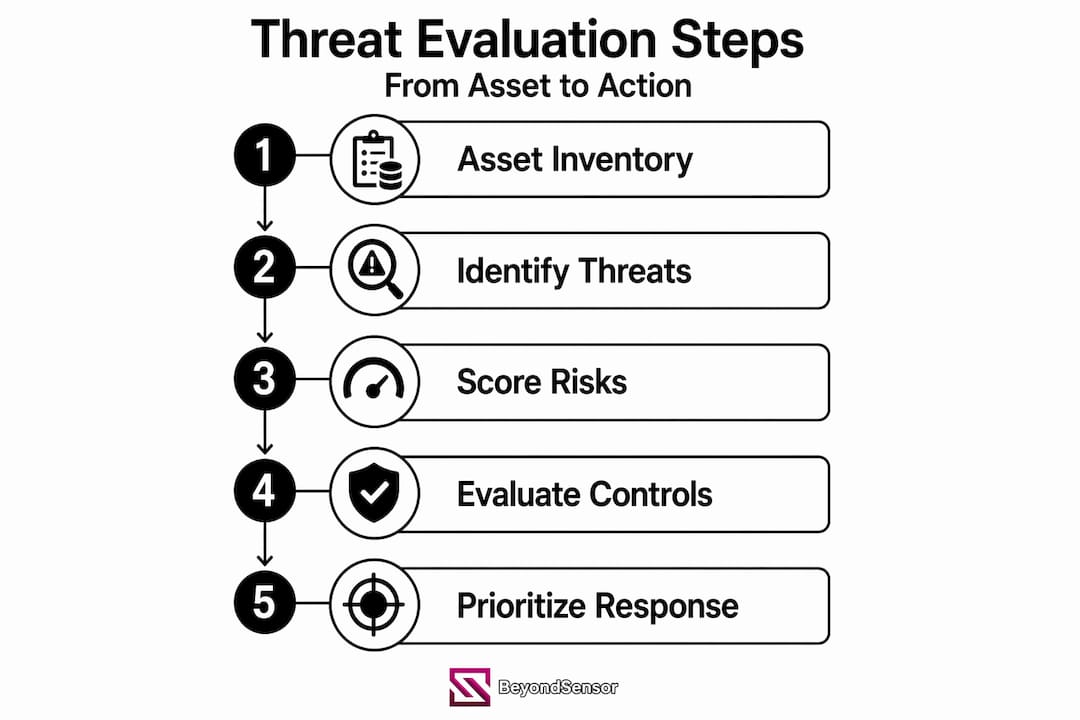
This is where structured methodology converts preparation into prioritized output. Follow these steps in sequence; skipping ahead undermines the integrity of your final risk matrix.
-
Identify and classify threats. Pull from multiple sources: threat intelligence feeds, historical incident data, red team findings, and sector-specific advisories. Classify each threat by category (deliberate, accidental, natural) and assign a threat source and threat event description. The NIST risk model defines risk determination as evaluating threat source, threat event, vulnerability, likelihood, and impact together.
-
Scan for vulnerabilities with exploitation context. Run your vulnerability scans, then resist the urge to treat every finding as equal. Vulnerability findings correlated with external exposure, privilege escalation paths, and real attack vectors reveal which weaknesses are realistically exploitable. A critical CVE on an air-gapped internal system sits far lower in priority than a medium CVE on an internet-facing authentication service.
-
Score likelihood on a consistent scale. Use a qualitative scale such as Very Low / Low / Medium / High / Very High, or a semi-quantitative equivalent (1 to 5). Apply it uniformly across all threats in the assessment cycle. Document the criteria for each level so there is no ambiguity between analysts.
-
Assess impact across multiple dimensions. Operational disruption, financial loss, reputational damage, regulatory penalty, and physical harm each warrant separate consideration. A single threat event can score differently across dimensions. Score each dimension and select either the highest individual score or a weighted aggregate depending on your organization's methodology.
-
Combine scores in a risk matrix. Plot likelihood against impact. A color-coded risk matrix gives stakeholders an immediate visual of where the top risks sit and supports defensible prioritization in review meetings.
-
Score your existing controls. Evaluate each control on both effectiveness and operational usability. Control effectiveness scoring using a simple scale (None=0 to High=3) adjusted for negative operational implications produces a realistic picture of what protection you actually have in place versus what the policy document says you have.
Here is an example of how those control scores translate into a residual risk determination:
| Threat | Inherent Risk | Control Effectiveness | Operational Usability | Residual Risk |
|---|---|---|---|---|
| Phishing campaign | High | High | High | Low |
| Insider data exfiltration | High | Medium | Low | High |
| Unauthorized physical access | Medium | High | Medium | Low |
| Ransomware via unpatched endpoint | Very High | Low | Medium | Very High |
Pro Tip: When scoring operational usability, ask the team that actually uses the control, not the team that designed it. Enforcement gaps almost always live in the gap between policy intent and daily practice.
Common pitfalls and best practices
Even experienced teams fall into patterns that compromise the quality and usefulness of their threat evaluations. Awareness is the first line of defense against them.
-
Skipping risk criteria definition. Evaluations without pre-defined impact dimensions and tolerance thresholds produce scores that cannot be compared year over year. Repeatable, comparable evaluations require these criteria to be locked in before assessment begins, not inferred after the fact.
-
Stopping at inherent risk. Inherent risk tells you the threat landscape without controls. It is analytically interesting but operationally incomplete. Residual risk is the decision artifact that drives treatment choices after the effectiveness of your safeguards is factored in.
-
Over-investing in high-burden controls. Controls that create significant operational friction get worked around. High operational burden reduces enforcement and increases exception rates. A control that is theoretically excellent but practically ignored offers less actual protection than a moderate control with near-universal adoption.
-
Ignoring trust propagation. Modern threat environments span cloud, on-premise, and third-party systems. Attackers exploit trust relationships across interconnected systems to amplify damage well beyond the initial point of compromise. Your threat models need to account for blast radius, not just point-of-entry impact.
-
Treating evaluation as a one-time event. Threat environments shift. New vulnerabilities emerge. Business processes change and create new exposure. Measurement programs per NIST SP 800-55 enable repeatability and ongoing correction of evaluation results, differentiating genuine risk improvement from assumption drift.
"Residual risk is the true measure of an organization's security posture. Teams that report on inherent risk alone are reporting on a problem they know exists, not on whether their defenses actually close the gap."
You can find additional guidance on building systematic evaluation practices aligned with physical security best practices across facility environments.
Turning evaluation outputs into prioritized responses
A completed risk matrix is not the finish line. It is the starting point for decisions that allocate budget, assign ownership, and schedule remediation.
-
Rank risks and assign treatment categories. Separate identified risks into four treatment tracks: accept, avoid, transfer, or mitigate. Very high and high residual risks generally require active mitigation or transfer (such as cyber insurance). Medium risks may warrant acceptance with documented rationale. Low risks can be acknowledged and monitored without immediate resource allocation.
-
Select controls aligned to risk level and operational context. Match control selection to the residual risk tier and the environment's operational constraints. A control appropriate for a data center perimeter may be impractical in a distributed industrial sensor network. Reference your security compliance frameworks to confirm controls meet applicable regulatory requirements, particularly in regulated industries or cross-border operations.
-
Document assumptions and uncertainty. Likelihood and impact scores carry inherent uncertainty. Document the assumptions behind each score (for example, "this likelihood score assumes the current firewall ruleset remains in place"). This protects the integrity of the assessment when personnel change and provides context for future reviewers comparing scores across cycles.
-
Communicate risks visually to stakeholders. Executives and board members do not read raw score tables. A well-designed risk matrix with color coding, concise threat descriptions, and trend indicators against the previous cycle gives decision-makers exactly what they need. Pair the matrix with a short narrative for the top three to five risks.
-
Link evaluation outputs to monitoring cycles. Assign review triggers: scheduled (quarterly or annual), event-driven (new system deployment, significant incident, major threat intelligence update), and threshold-based (a control's effectiveness score drops below a defined floor). This keeps your threat evaluation living and current rather than a static annual artifact.
Here is a comparison of how evaluation output translates across different communication audiences:
| Audience | What they need | Format |
|---|---|---|
| Security operations team | Specific threats, CVEs, control gaps | Detailed risk register with scores and owners |
| Facility and operations managers | Operational impact, control usability issues | Prioritized list with business impact language |
| Executive leadership | Top risks, trend direction, budget implications | Risk matrix summary with narrative |
| Regulators or auditors | Methodology, criteria, evidence of controls | Documented assessment with supporting evidence |
My take on what most teams get wrong
I've spent years working alongside security teams running threat assessments, and the pattern I see most often is this: teams invest heavily in building the threat list and almost nothing in validating whether their controls actually work under real conditions. They score control effectiveness based on design intent rather than observed behavior. That gap between what a control is supposed to do and what it does during an actual incident is where residual risk hides.
The other thing most teams underestimate is how quickly assumptions expire. A likelihood score assigned in January based on a specific network topology can be completely wrong by April if a new integration goes live. Evidence programs aligned with NIST SP 800-55 are not bureaucratic overhead. They are the mechanism that separates a risk assessment that reflects current reality from one that reflects last year's assumptions dressed up with this year's date.
My practical advice: schedule a brief quarterly assumption review separate from your full assessment cycle. Spend 30 minutes asking, "What has changed that would move any of our top-10 residual risk scores?" You will catch more real risk shifts in those sessions than in most full annual reviews.
I've also learned to be skeptical of any threat evaluation that doesn't explicitly address trust propagation. In environments where sensors, edge devices, and cloud management planes share access relationships, attackers move laterally through trust in ways that point-of-entry threat models miss entirely. If your threat model stops at the initial attack surface, it is incomplete.
— Eumir
How Beyondsensor supports your threat evaluation workflow

Beyondsensor builds the sensing and AI infrastructure that turns threat evaluation from a periodic exercise into a continuous operational capability. For security professionals and system integrators running formal risk assessments, Beyondsensor's platform supports asset discovery, environmental monitoring, and anomaly detection across physical and digital security layers. The tools available through Beyondsensor integrate with existing risk management workflows, giving your team verified, real-time data to anchor likelihood and impact scores with evidence rather than estimates.
For system integrators building scalable threat evaluation capabilities for clients, Beyondsensor's AI-driven solutions for integrators provide the sensor-level data feeds and analytical infrastructure needed to support repeatable, evidence-based assessments. That means your clients get evaluations grounded in measured behavior, not assumptions. Explore Beyondsensor's ecosystem to see how precision sensing translates directly into better risk decisions.
FAQ
What is the first step in evaluating security threats?
Start with a classified asset inventory. Before scoring any threat, you need a clear map of what assets exist, their criticality tier, and what vulnerabilities are associated with each, since likelihood and impact scores have no meaning without that anchor.
How do you calculate residual risk?
Residual risk is determined by taking the inherent risk level of a threat and adjusting it downward based on the effectiveness of existing safeguards. It reflects the risk that remains after your current controls are applied and is the actual basis for treatment decisions.
What is a risk matrix and how is it used?
A risk matrix plots likelihood against impact on a grid, typically with color coding from low to critical. It serves as a visual decision tool that helps security teams and executives quickly identify top-priority threats and track changes between assessment cycles.
How often should security threat assessments be reviewed?
Most frameworks recommend an annual full assessment cycle with event-driven reviews triggered by significant changes such as new system deployments, major incidents, or updated threat intelligence. NIST SP 800-55 measurement programs support ongoing verification between formal cycles.
Why is scoring control usability important?
Controls with high operational burden get bypassed in practice. Scoring both effectiveness and usability ensures selected controls are actually enforced at the required rate, producing accurate residual risk scores rather than theoretical ones.
Recommended
- Physical security best practices: strategies for safer facilities | News | BeyondSensor
- Step-by-Step Security Integration: Advanced Sensor Guide | News | BeyondSensor
- Advanced sensing technologies: A practical guide for security managers | News | BeyondSensor
- How to choose the right sensing technology for security | News | BeyondSensor
Read More Articles

RTSP Security Risks: Integrators Must Block Exposed Ports 554 and 8554
See how integrators can reduce RTSP security risks: close exposed ports 554 and 8554, secure camera access, and verify each deployment with practical checks.

Require MAEpp and X Accuracy Before You Buy People Counting Systems
Verify people counting accuracy by demanding MAEpp, X Accuracy, and directional-bias reports. Validate on-site with at least 100 events per direction...

30–90 Day Pilot Validates Redundant Camera Networks for Engineers
Standards led, practical steps for engineers to deploy redundant camera networks: MRP, dual homing, and aggregation patterns, commissioning checks, and...

30 Day Pilot Proves Video Analytics Accuracy for Security Teams
Validate video analytics accuracy with scenario tests, camera tuning, transfer learning and a 30 day edge first pilot for security teams.
Let's Build YourSecurity Ecosystem.
Whether you're a System Integrator, Solution Provider, or an End-User looking for trusted advisory, our team is ready to help you navigate the BeyondSensor landscape.
Direct Advisory
Connect with our regional experts for tailored solutioning.