
Discover why sensor networks matter for industrial security. Learn how they enhance monitoring, threat detection, and operational efficiency.

Why Sensor Networks Matter for Industrial Security

TL;DR:
- Sensor networks are foundational for real-time data collection that enables IoT, automation, and security. They transform environmental signals into actionable intelligence, supporting predictive control and operational decision-making. Effective deployment requires purpose-driven design, security integration, and ongoing maintenance to realize their full business value.
Sensor networks are defined as distributed systems of interconnected sensing devices that collect, transmit, and analyze physical-world data in real time, forming the foundational data layer for IoT, industrial automation, and smart security infrastructure. The industry term for this technology is Wireless Sensor Networks (WSNs), and understanding why sensor networks matter starts with recognizing that without them, digital decision-making systems operate blind. WSNs connect physical environments to digital platforms, enabling organizations to monitor assets, detect threats, and automate responses at a scale and speed no human team can match. For decision-makers evaluating security and operational investments, sensor networks are not optional infrastructure. They are the nervous system of any serious smart ecosystem.
Why sensor networks matter: the operational case
Sensor networks give organizations the ability to act on real-world conditions rather than react to them after the fact. WSNs consist of sensor devices exchanging data via radio links, measuring environmental variables, and forwarding information to sink nodes for analysis. That architecture transforms raw physical signals into structured, actionable intelligence. For industries managing critical infrastructure, manufacturing lines, or large facilities, this is the difference between predictive control and costly incident response.

The role of sensor networks extends beyond simple data collection. They provide the continuous, high-frequency data streams that machine learning models and analytics platforms require to detect anomalies, forecast failures, and trigger automated workflows. A facility running without sensor coverage is making decisions based on snapshots. A facility running on a properly deployed WSN is making decisions based on a live feed.
Decision-makers often underestimate this gap. The value is not in the sensors themselves. It is in the operational intelligence those sensors generate when integrated into existing workflows and systems.
How do sensor networks work to enable real-time decisions?
WSN operation follows a layered architecture that moves data from physical sensing to edge processing to cloud analytics. Here is how each stage functions:
- Sensing layer: Individual nodes equipped with temperature, motion, pressure, acoustic, or optical sensors capture environmental data at defined intervals or in response to triggers.
- Communication layer: Nodes transmit data using protocols such as Zigbee, LoRaWAN, or Wi-Fi. Multi-hop routing passes data across nodes toward a central gateway, extending range without requiring direct line-of-sight to a base station.
- Edge processing layer: Gateways and local processors filter, compress, and analyze data before forwarding it upstream. Layered architecture from sensors to edge gateways reduces latency and manages sensor drift and outages, preserving real-time responsiveness.
- Cloud analytics layer: Aggregated data feeds into platforms for long-term trend analysis, predictive modeling, and reporting. This is where AI and machine learning extract patterns that individual node data cannot reveal.
The table below compares communication protocols commonly used in WSN deployments:
| Protocol | Range | Power consumption | Best use case |
|---|---|---|---|
| Zigbee | Up to 100m per hop | Very low | Dense indoor mesh networks |
| LoRaWAN | Up to 15km | Extremely low | Wide-area outdoor monitoring |
| Wi-Fi | Up to 150m | Moderate to high | High-bandwidth data environments |
| Z-Wave | Up to 30m per hop | Low | Smart building automation |
Network-level design choices drive performance more than hardware selection alone. Optimization of clustering and duty-cycling in WSNs can increase network lifetime by roughly 32% compared to LEACH and 22% compared to PEGASIS while maintaining communication performance. That finding means organizations can extend sensor deployment cycles significantly by choosing the right network topology, not just the most expensive nodes.
What security challenges do sensor networks face?
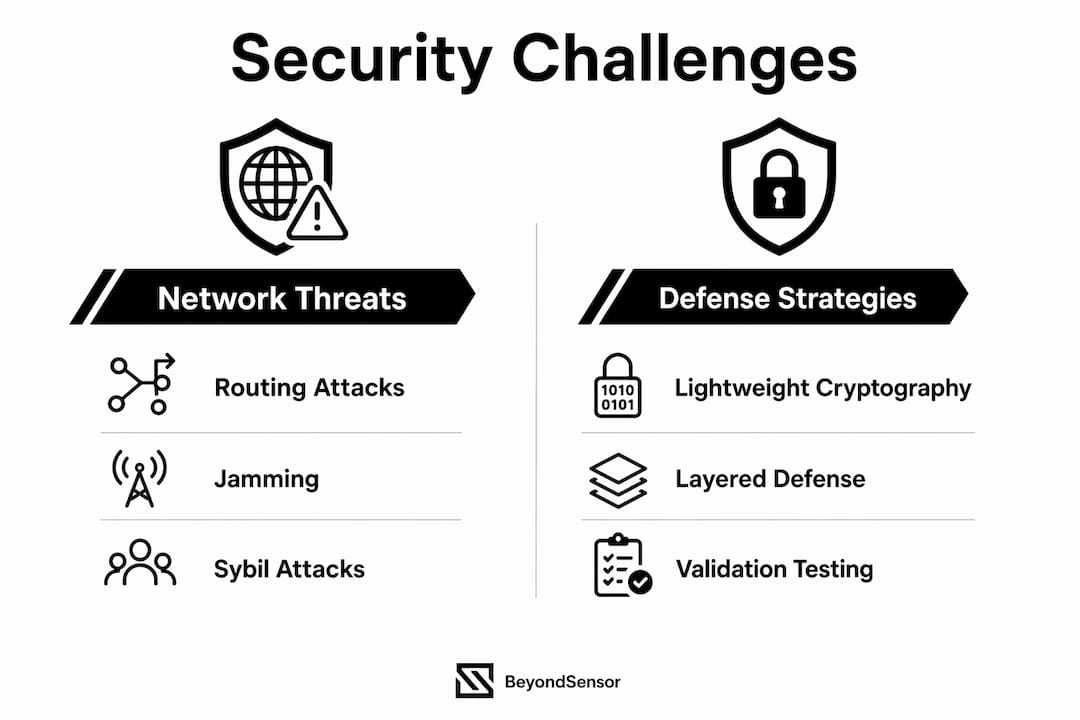
The role of cybersecurity in sensor networks is non-negotiable, yet it remains one of the most underengineered aspects of WSN deployments. WSNs are vulnerable to routing and denial-of-service attacks due to limited energy, computation, and bandwidth. The constrained nature of sensor nodes makes applying enterprise-grade security controls directly impossible.
Common attack vectors include:
- Routing attacks: Adversaries manipulate routing tables to redirect or drop data packets, corrupting the integrity of sensor readings.
- Jamming attacks: Radio frequency interference disrupts communication between nodes, creating blind spots in monitoring coverage.
- Sybil attacks: A malicious node assumes multiple false identities, undermining trust-based routing and consensus mechanisms.
- Denial-of-service (DoS) attacks: Flooding nodes with traffic exhausts their limited energy reserves, effectively killing them without physical access.
Addressing these threats requires a multi-layered defense strategy. Lightweight cryptography protects data in transit without draining node batteries. Trust management systems score node behavior over time and isolate anomalous actors. Intrusion detection systems (IDS) monitor traffic patterns for signatures of known attack types. For organizations seeking measurable protection, blockchain-enabled intrusion detection combined with federated learning achieves 97.4% detection accuracy and a 2.1% false positive rate while supporting low-power sensor nodes. That level of precision, at that energy cost, represents a genuine advance for production WSN environments.
The critical insight is that no single security control covers all threat scenarios. Effective WSN security requires layered defenses that balance protection strength against energy consumption and network longevity. Organizations that treat WSN security as an afterthought consistently face the same outcome: a technically functional network that becomes a liability the moment an adversary probes it.
Pro Tip: When evaluating WSN security vendors, request validation data from real network deployments, not just lab simulations. Attack behavior under real network variability differs significantly from controlled test conditions, and IDS performance gaps only appear under production constraints.
What are the key benefits of sensor networks in industry?
The importance of sensor networks in industrial and urban environments is best understood through concrete operational gains, not abstract capability claims. Here are the primary benefits decision-makers should evaluate:
- Reduced installation and maintenance costs: Wireless sensor networks eliminate the cabling infrastructure that traditional monitoring systems require. LoRaWAN-enabled industrial sensors can provide battery lifespans up to a decade and enable scalable monitoring and predictive maintenance via digital twins without costly cabling. That changes the total cost of ownership calculation for large facilities and remote sites.
- Predictive maintenance: Continuous vibration, temperature, and pressure monitoring on industrial equipment detects degradation patterns before failure occurs. Organizations shift from scheduled maintenance cycles to condition-based interventions, reducing downtime and parts waste.
- Enhanced physical security: Sensor-powered surveillance integrates motion detection, access control, and environmental monitoring into a unified threat picture. Anomaly detection algorithms flag deviations from baseline behavior, enabling security teams to respond to genuine threats rather than sift through false alarms.
- Smart city and environmental integration: Municipal governments deploy WSNs for air quality monitoring, traffic flow optimization, flood detection, and utility grid management. Sensor networks in daily life are already present in the infrastructure most urban residents depend on, even if invisibly.
The comparison below illustrates the operational difference between traditional monitoring and sensor network-enabled processes:
| Process | Traditional approach | Sensor network approach |
|---|---|---|
| Equipment maintenance | Scheduled, time-based inspections | Condition-based, real-time alerts |
| Security monitoring | Manual patrols and camera review | Automated anomaly detection |
| Environmental compliance | Periodic manual sampling | Continuous automated reporting |
| Energy management | Manual meter reading | Real-time consumption analytics |
Machine learning and deep learning integration into IoT-WSN enables efficient data processing and anomaly detection at the network edge, suited for resource-constrained devices. This means the intelligence does not have to live in the cloud. It can operate at the point of sensing, reducing latency and maintaining function even when connectivity is interrupted.
How should organizations deploy sensor networks for maximum value?
Why are sensor networks essential to get right from the start? Because a technically functional network that no one uses delivers no value and may impose ongoing costs. Technically functional but operationally unused networks deliver no value or may impose costs. That is the most expensive mistake in WSN deployment, and it is entirely avoidable.
Effective deployment follows five disciplines:
- Define operational objectives first. Identify the specific decisions the sensor network must support before selecting hardware or protocols. Vague goals produce vague architectures.
- Apply spatial deployment intelligence. Map coverage zones against operational blind spots. Redundant placement in critical areas prevents single-node failure from creating monitoring gaps. Consult sensor deployment in infrastructure guides to align placement with real-world performance requirements.
- Select communication protocols for the environment. LoRaWAN suits wide-area outdoor deployments. Zigbee suits dense indoor mesh scenarios. Choosing the wrong protocol for the physical environment creates range, interference, or power problems that no software fix can resolve.
- Build security into the architecture from day one. Retrofitting security onto a deployed WSN is expensive and often incomplete. Scalable, layered security architecture, including lightweight cryptography and trust management, must be specified at the design stage. Reviewing WSN security best practices before deployment prevents the most common vulnerabilities.
- Plan a realistic maintenance model. Sensor drift, battery depletion, and firmware updates are ongoing operational realities. Organizations that do not budget for maintenance see data accuracy degrade over time, eroding the value of the entire investment.
Pro Tip: Separate latency-sensitive edge computation from long-term cloud analytics in your architecture. Edge nodes handle real-time alerts and local automation. Cloud platforms handle trend analysis and reporting. Conflating the two creates systems that are slow at both tasks.
Key takeaways
Sensor networks deliver operational value only when purpose, architecture, security, and maintenance are engineered together from the start.
| Point | Details |
|---|---|
| WSNs are the IoT data layer | Sensor networks provide the real-time physical data that enables IoT analytics and automation. |
| Network design drives efficiency | Clustering and duty-cycling optimization extends network lifetime by up to 32% over standard protocols. |
| Security requires layered defense | No single control covers all WSN threats; combine cryptography, IDS, and trust management. |
| Wireless cuts industrial costs | LoRaWAN sensors with decade-long battery life eliminate cabling and reduce maintenance overhead. |
| Integration determines value | A sensor network that does not feed operational workflows delivers no business return. |
The insight most deployment teams miss
I have reviewed sensor network projects across industrial automation, smart city infrastructure, and physical security. The pattern that separates successful deployments from expensive failures is consistent: organizations that invest in sensor count without investing in data integration end up with dashboards nobody checks.
The technology itself is mature. WSNs using LoRaWAN, Zigbee, and ESP32-based nodes are proven at scale. The security frameworks, including blockchain-based IDS and federated learning models, now deliver production-grade accuracy at low power. What most teams underestimate is the workflow integration work that makes sensor data operationally meaningful.
I have also seen organizations treat security as a phase-two concern. It never stays in phase two. Routing attacks and Sybil exploits do not wait for a security retrofit. The projects that build layered defense into the initial architecture spend less on incident response and more on capability expansion.
The other observation worth sharing: edge AI is changing the calculus on latency. When anomaly detection runs at the node or gateway level, response times drop from minutes to seconds. That matters enormously in physical security scenarios where a 90-second delay in threat detection is the difference between intervention and incident. Organizations evaluating sensor networks in 2026 should treat edge analytics as a baseline requirement, not a premium add-on.
— Eumir
Build smarter with Beyondsensor's sensor network solutions

Beyondsensor designs and deploys sensor network solutions built for security, operational efficiency, and smart ecosystem integration across industrial, environmental, and infrastructure environments. Their AI-driven monitoring tools deliver real-time anomaly detection and threat response without the latency penalties of cloud-only architectures. For system integrators deploying WSNs across Singapore, Malaysia, the Philippines, and Southeast Asia, Beyondsensor provides localized expertise, validated hardware-software configurations, and scalable security architecture tailored to regional compliance requirements. Explore Beyondsensor's AI-powered tools to see how purpose-built sensing solutions translate into measurable operational outcomes for your organization.
FAQ
What is a wireless sensor network?
A Wireless Sensor Network (WSN) is a distributed system of sensor nodes that collect environmental data and transmit it via radio links to a central gateway or sink node for analysis. WSNs form the foundational data layer for IoT platforms, industrial automation, and smart security systems.
How do sensor networks improve physical security?
Sensor networks integrate motion detection, access control, and environmental monitoring into a unified system, enabling automated anomaly detection that flags genuine threats rather than requiring manual review. AI-driven edge analytics reduce response latency from minutes to seconds in production deployments.
What are the biggest security risks in sensor networks?
The primary threats are routing attacks, jamming, Sybil attacks, and denial-of-service exploits, all enabled by the limited energy and computation resources of sensor nodes. Multi-layered defenses combining lightweight cryptography, intrusion detection, and trust management are the recognized mitigation standard.
How long do wireless sensor network batteries last?
LoRaWAN-enabled industrial sensors can achieve battery lifespans of up to a decade, depending on transmission frequency and environmental conditions. Network-level optimizations such as duty-cycling extend operational life further without requiring hardware replacement.
Why do sensor network deployments fail to deliver value?
The most common cause is deploying sensors without integrating their data into operational workflows and decision-making processes. A technically functional network that feeds unused dashboards delivers no business return and may impose ongoing maintenance costs.
Recommended
- How sensor technology drives smarter industrial automation | News | BeyondSensor
- Essential sensing technology features for industrial security | News | BeyondSensor
- Must-Have Industrial Security Features for Facilities | News | BeyondSensor
- How to Secure Sensor Networks: 2026 IT Guide | News | BeyondSensor
Read More Articles
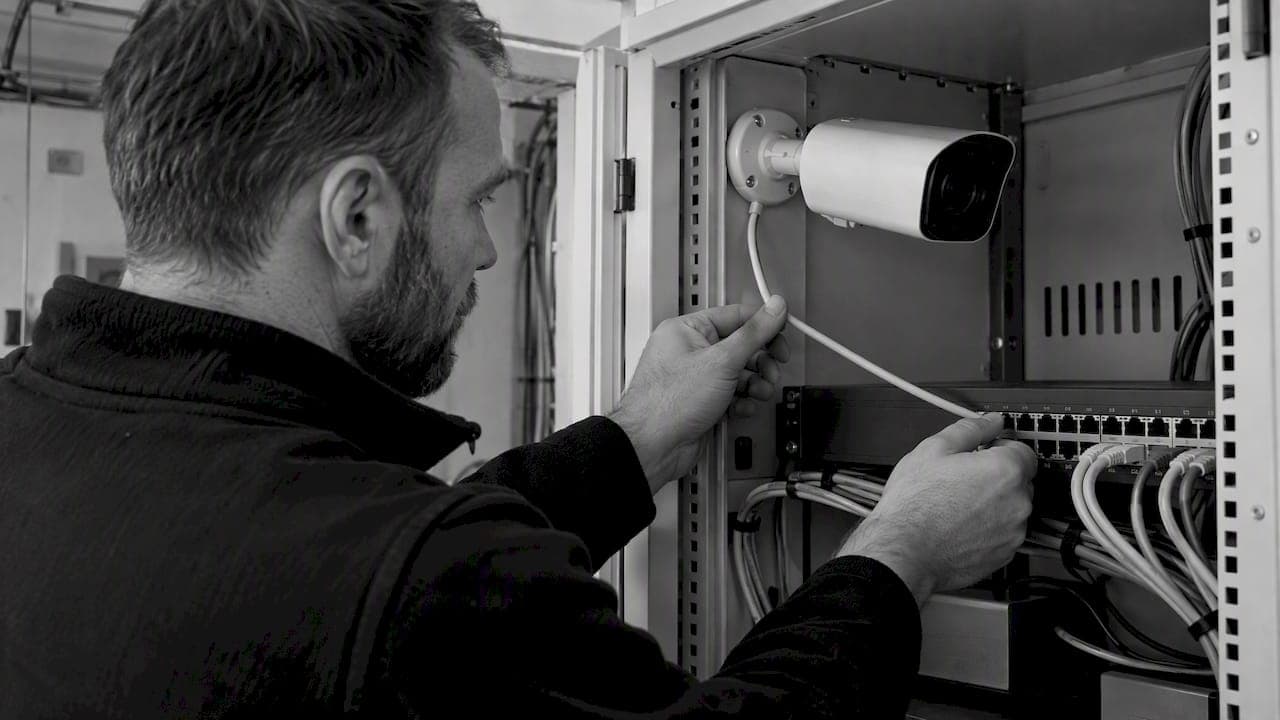
RTSP Security Risks: Integrators Must Block Exposed Ports 554 and 8554
See how integrators can reduce RTSP security risks: close exposed ports 554 and 8554, secure camera access, and verify each deployment with practical checks.

Require MAEpp and X Accuracy Before You Buy People Counting Systems
Verify people counting accuracy by demanding MAEpp, X Accuracy, and directional-bias reports. Validate on-site with at least 100 events per direction...
30–90 Day Pilot Validates Redundant Camera Networks for Engineers
Standards led, practical steps for engineers to deploy redundant camera networks: MRP, dual homing, and aggregation patterns, commissioning checks, and...

30 Day Pilot Proves Video Analytics Accuracy for Security Teams
Validate video analytics accuracy with scenario tests, camera tuning, transfer learning and a 30 day edge first pilot for security teams.
Let's Build YourSecurity Ecosystem.
Whether you're a System Integrator, Solution Provider, or an End-User looking for trusted advisory, our team is ready to help you navigate the BeyondSensor landscape.
Direct Advisory
Connect with our regional experts for tailored solutioning.