
Discover what is sensor integration architecture and how it builds a robust foundation for efficient data handling and smart systems.

Sensor Integration Architecture Explained for System Architects

TL;DR:
- Sensor integration architecture is the infrastructure layer that collects, normalizes, and routes data from multiple sensors without performing mathematical reconciliation. It enables unified data availability, serving as a foundational element for various analytics and control systems. Proper design of timing and semantic contracts is critical to prevent silent data corruption and ensure system reliability.
Most architects encounter the term "sensor integration architecture" and mentally file it alongside sensor fusion. That distinction matters enormously in practice. What is sensor integration architecture, exactly? It is the infrastructure layer that collects, normalizes, and routes data from multiple independent sensors into a unified environment, without performing mathematical reconciliation between modalities. Think of temperature readings from a building management system sitting alongside occupancy data from motion sensors, all accessible through a single platform. Get this layer wrong and every analytical process built above it inherits the error. Get it right and you have a foundation that scales across industrial automation, physical security, and smart infrastructure alike.
Table of Contents
- Key Takeaways
- What is sensor integration architecture: core definition and components
- Critical engineering challenges in sensor integration
- Sample-level synchronization and temporal alignment strategies
- Integration versus fusion: choosing the right approach
- Practical architecture for IoT and industrial deployments
- My take on where sensor integration architectures actually fail
- How Beyondsensor supports your integration architecture
- FAQ
Key Takeaways
| Point | Details |
|---|---|
| Integration precedes fusion | Sensor integration is foundational infrastructure; sensor fusion is the algorithmic layer built on top of it. |
| Four-layer pipeline model | Device ingestion, buffering, normalization, and time-series storage form the standard architecture pattern. |
| Timing is a first-class concern | Clock drift and message-arrival timestamps cause silent data corruption without explicit correction mechanisms. |
| Semantic contracts prevent failures | Standardized event schemas and cryptographic integrity checks stop incorrect data from entering downstream systems. |
| Security and scaling go together | TLS 1.2+, backpressure-aware channels, and modular component reuse are non-negotiable for production-grade systems. |
What is sensor integration architecture: core definition and components
Sensor integration systems aggregate outputs from multiple independent sensors into a unified environment without performing any mathematical reconciliation between modalities. That distinction is the foundation. Integration is about infrastructure availability. Fusion is about computational estimation. Conflating them leads architects to over-engineer ingestion pipelines with algorithmic complexity that belongs in a separate processing tier.
A well-designed sensor integration architecture follows a layered approach. Each layer has a distinct responsibility, and keeping those responsibilities separate is what makes the architecture maintainable at scale.
The four standard layers:
- Device ingestion. Protocol gateways translate raw sensor outputs, handling MQTT, Modbus, OPC-UA, and proprietary formats into a normalized stream. This is where physical diversity collapses into logical uniformity.
- Buffering and streaming. A message broker such as Apache Kafka absorbs traffic spikes and decouples producers from consumers. This layer is where backpressure handling lives.
- Processing and normalization. Stream processors apply unit conversions, timestamp normalization, and schema validation before data proceeds downstream.
- Time-series storage. Validated, normalized records land in a purpose-built time-series database with separate analytics queries isolated from ingestion paths.
A modular reference architecture ties sensor design to DSP, communication, AI, and validation using domain-independent signal representations. This allows preprocessing and feature extraction to be reused across time-series sensors, imaging arrays, and environmental monitors without duplicating engineering effort. The benefit is not just cleaner code. It is a meaningful reduction in integration lead time when you add a new sensor modality.
| Component | Function | Common Technologies |
|---|---|---|
| Protocol gateway | Translates heterogeneous sensor protocols | MQTT, Modbus, OPC-UA |
| Message broker | Buffers data and manages backpressure | Apache Kafka, RabbitMQ |
| Stream processor | Normalizes units, validates schemas | Apache Flink, Kafka Streams |
| Time-series database | Stores validated telemetry | InfluxDB, TimescaleDB |
| Semantic layer | Enforces event contracts and integrity | JSON Schema, SHA-256 |
Middleware and APIs sit across all four layers, providing the connective tissue that lets each component communicate without tight coupling. The goal is a system where swapping out the message broker does not require rewriting the normalization rules.
Critical engineering challenges in sensor integration
The problems that actually break sensor integration systems in production are not the obvious ones. Protocol mismatch gets all the attention. Timing and semantic interoperability are the silent killers.

Time normalization means more than attaching a timestamp at ingestion. Clock drift across devices accumulates. Without Network Time Protocol (NTP) correction applied before data enters the pipeline, two sensors reporting the "same moment" can be seconds apart. Temporal normalization and backpressure handling are non-negotiable for reliable ingestion. Skipping them leads to silent data corruption and query failures that are notoriously difficult to diagnose after the fact.
Backpressure-aware channels prevent data loss under traffic spikes. When a downstream consumer slows, an unbounded queue fills memory and eventually drops events. Backpressure propagation signals producers to slow down rather than overrun the buffer. Most architects know this conceptually but underestimate how often it needs tuning in production environments with heterogeneous sensor event rates.
Semantic interoperability is the integration tax nobody budgets for. Sensors from different vendors report the same physical quantity with different field names, different units, and different null representations. A minimal semantic core standardizes ingestion using machine-readable models, unified event formats, schema validation, and cryptographic integrity control. Correct events pass through; incorrect events are rejected without creating a misleading record. SHA-256 hashing supports reproducible verification of event integrity.
- Standardize event envelopes across all sensor types before writing normalization rules
- Maintain a metric and unit dictionary that maps vendor-specific field names to canonical identifiers
- Apply schema validation at the gateway layer, not downstream where bad data has already propagated
- Use cryptographic verification to confirm that stored records match what was ingested
Pro Tip: Build your semantic contract as a machine-readable artifact — JSON Schema or Avro — and version-control it alongside your pipeline code. When a vendor firmware update silently changes a field name, you will catch it at the gateway instead of discovering it in a corrupted time-series three weeks later.
Sample-level synchronization and temporal alignment strategies
Message-arrival timestamps are not sufficient for precise synchronization in multi-sensor systems. They capture when data reached the broker, not when the physical measurement occurred. For most analytics workloads this gap is tolerable. For any system where timing accuracy below one second matters, it is a structural flaw.
Sample-level temporal alignment surpasses message-level timestamping for tightly synchronized multi-sensor acquisition. The Temporal Sample Alignment (TSA) algorithm tracks per-sample timestamps relative to a common reference time, preventing cumulative synchronization errors from compounding over long acquisition windows. Here is how the approach works in practice:
- Assign a reference clock. One device or a dedicated time server acts as the ground truth. All other devices correct their local timestamps against this reference before emitting events.
- Track per-sample offsets. Rather than correcting the wall clock at the device level, TSA records the offset between each sample's local timestamp and the reference. This preserves the original measurement context.
- Apply edge-side correction. The Edge Control Protocol (ECP) in the Synchronized Data Acquisition System (SDAS) platform applies corrections at the edge node, reducing the synchronization burden on central processing.
- Validate alignment windows. Downstream consumers define acceptable alignment windows. Samples falling outside the window are flagged or discarded rather than silently misaligned.
Pro Tip: Do not wait until the fusion layer to discover synchronization errors. Instrument your pipeline to emit per-sensor alignment metrics in real time. A 500-millisecond drift between a thermal camera and a radar unit looks harmless in a log file. In a security detection workflow, it means the alerts from both sensors describe different physical moments.
Ignoring delay and jitter causes integration failures in production. Hardware Precision Time Protocol (PTP) and delay-aware state-space estimation using Kalman filtering are the standard mitigations for environments where millisecond accuracy is required. For less demanding applications, NTP with TSA-style per-sample tracking is sufficient and significantly lighter to deploy.
Integration versus fusion: choosing the right approach
Understanding sensor integration architecture requires knowing exactly where it ends and sensor fusion begins. They are not the same thing and they do not serve the same purpose.

Sensor integration is infrastructure enabling unified data availability. Sensor fusion is computational estimation and reconciliation. Integration makes data accessible. Fusion makes data meaningful through mathematical combination. A sensor integration system can operate without any fusion layer. A fusion system cannot operate without a solid integration layer beneath it.
| Dimension | Sensor integration | Sensor fusion |
|---|---|---|
| Primary function | Unified data availability | Computed estimates from multiple inputs |
| Computation level | Normalization and routing | Statistical, probabilistic, or ML-based |
| Typical output | Normalized event streams | Fused state estimates or classifications |
| Latency sensitivity | Medium | High |
| Failure mode | Data loss or corruption | Incorrect inference or false detection |
The decision to add a fusion layer depends on specific engineering parameters:
- Inference requirements. If your system needs to produce a single derived state from multiple modalities, for example a presence estimate combining radar and camera data, fusion is necessary.
- Modality complementarity. Fusion only adds value when sensor modalities cover different aspects of the same phenomenon. Fusing redundant sensors of the same type adds complexity without improving accuracy.
- Reliability thresholds. Safety-critical environments require explicit fusion architecture with validated models. Mis-specifying integration as sufficient when fusion is required is a design defect, not a corner case.
- Latency budgets. Fusion adds processing time. Systems with hard real-time constraints need to account for this in their architecture from the start.
For many physical security applications a clean integration layer is the correct stopping point. Unified access to camera feeds, access control events, and environmental sensors does not require fusion. Adding fusion without a clear inference goal creates maintenance debt with no operational payoff.
Practical architecture for IoT and industrial deployments
A production-grade sensor integration architecture for IoT and industrial contexts follows a well-established pattern. The specifics vary by industry, but the structural logic is consistent.
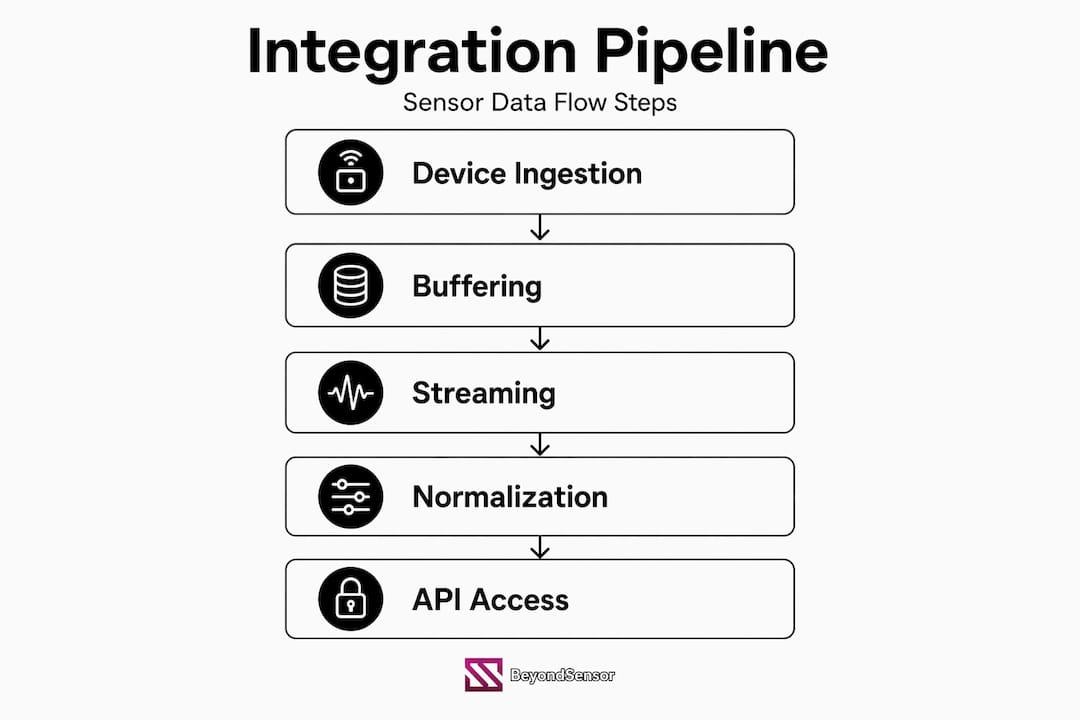
A representative layered pipeline looks like this: sensors publish over MQTT to a protocol gateway, which normalizes events and forwards them to a Kafka broker. A stream processor picks up events from Kafka, applies unit normalization and schema validation, then writes validated records to a time-series database. A separate analytics layer queries the database without touching the ingestion path.
Security practices that belong in the architecture, not added later:
- Enforce TLS 1.2 or higher on all sensor-to-gateway communications. Unencrypted sensor traffic is a known attack vector, particularly in sensor network environments that span physical infrastructure.
- Apply mutual TLS authentication between pipeline components to prevent unauthorized event injection.
- Use SHA-256 or equivalent integrity hashing on stored records so that tampering is detectable.
Scaling and fault tolerance considerations:
- Partition Kafka topics by sensor type or location to distribute load without cross-contaminating data streams.
- Deploy stream processors with exactly-once semantics where data loss has operational consequences.
- Design the normalization layer as a stateless service so it scales horizontally without coordination overhead.
Standards and interoperability: IEEE 1451 and OGC SensorThings API provide reference models for sensor data representation and discovery. For physical security compliance environments, alignment with these standards reduces integration friction when connecting to third-party platforms or government systems.
My take on where sensor integration architectures actually fail
I have reviewed and worked with enough sensor integration system designs to have developed strong opinions about where they consistently break down. The failures are almost never at the protocol layer. Protocol mapping is well-understood work with abundant tooling. The failures happen at timing and semantic contracts, and they are usually invisible until months into production operation.
The backpressure problem is routinely underestimated. Architects design the steady-state path carefully and leave the spike case as an afterthought. When a batch of sensors reconnects after a network interruption and floods the broker with catch-up traffic, systems without explicit backpressure propagation drop data silently. There is no error. There is no alert. There is just a gap in the time-series that shows up later when someone asks why occupancy data is missing for a twenty-minute window.
The semantic contract problem is even more insidious. I have seen integration projects spend months on protocol adapters and go live with no canonical unit dictionary. Every sensor calls its temperature reading something slightly different. The normalization rules are written per-vendor and never reconciled. The result is a system where queries work but comparisons mislead, and nobody realizes it until an alert fires on phantom data.
My recommendation: treat timing correction and semantic contract definition as critical-path deliverables, not cleanup tasks. Enforcing semantic integrity through stable contract definitions, schema validation, and cryptographic integrity enforcement is not overhead. It is the difference between a system that is reliable and one that merely appears to be.
— Eumir
How Beyondsensor supports your integration architecture
When you are designing or scaling a sensor integration system, the complexity compounds quickly. Protocol diversity, timing requirements, security compliance, and semantic normalization all demand simultaneous attention.
Beyondsensor brings direct engineering expertise in multi-sensor integration and AI-driven analytics across industrial, infrastructure, and physical security environments. The system integrators platform provides purpose-built tools for semantic layering, data normalization, and scalable pipeline design, along with compliance support for regional regulatory requirements across Southeast Asia. For security agencies deploying multi-sensor networks, Beyondsensor's validated integration frameworks reduce time-to-deployment while maintaining audit-ready data integrity. Explore the full toolkit at Beyondsensor Tools to see how semantic and synchronization utilities fit into your current architecture.
FAQ
What is sensor integration architecture?
Sensor integration architecture is the infrastructure layer that collects, normalizes, and routes data from multiple independent sensors into a unified platform. It does not perform mathematical reconciliation between sensor modalities. That is the role of sensor fusion.
How does sensor integration differ from sensor fusion?
Sensor integration enables unified data availability. Sensor fusion performs computational estimation by mathematically combining inputs from multiple modalities. Integration is the infrastructure prerequisite. Fusion is the analytical layer built on top.
What are the main layers in a sensor integration pipeline?
A standard sensor integration pipeline has four layers: device ingestion via protocol gateways, buffering and streaming through a message broker, stream processing with normalization and schema validation, and time-series storage with analytics isolation.
Why does timing matter so much in sensor integration systems?
Clock drift across devices causes silent data corruption when timestamps are not normalized before ingestion. NTP correction and per-sample alignment techniques like TSA prevent cumulative synchronization errors that would otherwise compromise downstream analysis.
What is semantic interoperability in sensor integration?
Semantic interoperability means that all sensors report data using standardized field names, units, and formats defined in a shared contract. Without it, normalization rules are written per-vendor and never reconciled, producing data that appears correct but supports misleading comparisons across sensor types.
Recommended
- Step-by-Step Security Integration: Advanced Sensor Guide | News | BeyondSensor
- Emerging sensing innovations guide for security leaders | News | BeyondSensor
- How sensor technology drives smarter industrial automation | News | BeyondSensor
- Sensor Data Management Process for IT Professionals | News | BeyondSensor
Read More Articles
97% Takeover Success Demoed: Sensor Fusion Security for Practitioners
For security teams and system integrators: harden sensor fusion security with ETSI hardware controls, documented attack evidence, and a practical...

Stop False Dispatches: 5 SOP Steps for Singapore Alarm Triage
SOP first, verification led alarm triage workflow for Singapore facilities. Five SOP steps aligned to PDPC, SGPolice and ABS guidance.
Singapore Procurement: Live Pilot for Intrusion Detection Analytics
Procurement-first checklist for Singapore teams: require live pilots, add PDPA checks to RFPs, and judge intrusion detection analytics by pilot results...

Avoid Outages: IMDA/JST Camera Firmware Management for Administrators
Practical operations-first guidance for security administrators to run staged, auditable firmware updates across multi-site camera fleets, aligned to IMDA...
Let's Build YourSecurity Ecosystem.
Whether you're a System Integrator, Solution Provider, or an End-User looking for trusted advisory, our team is ready to help you navigate the BeyondSensor landscape.
Direct Advisory
Connect with our regional experts for tailored solutioning.