
Map eight enterprise sensor categories to specs, integration paths, and commissioning tasks. Field proven advice from Beyondsensor and an Open-IoT...

Eight Enterprise Security Sensor Types Integrators Must Plan For

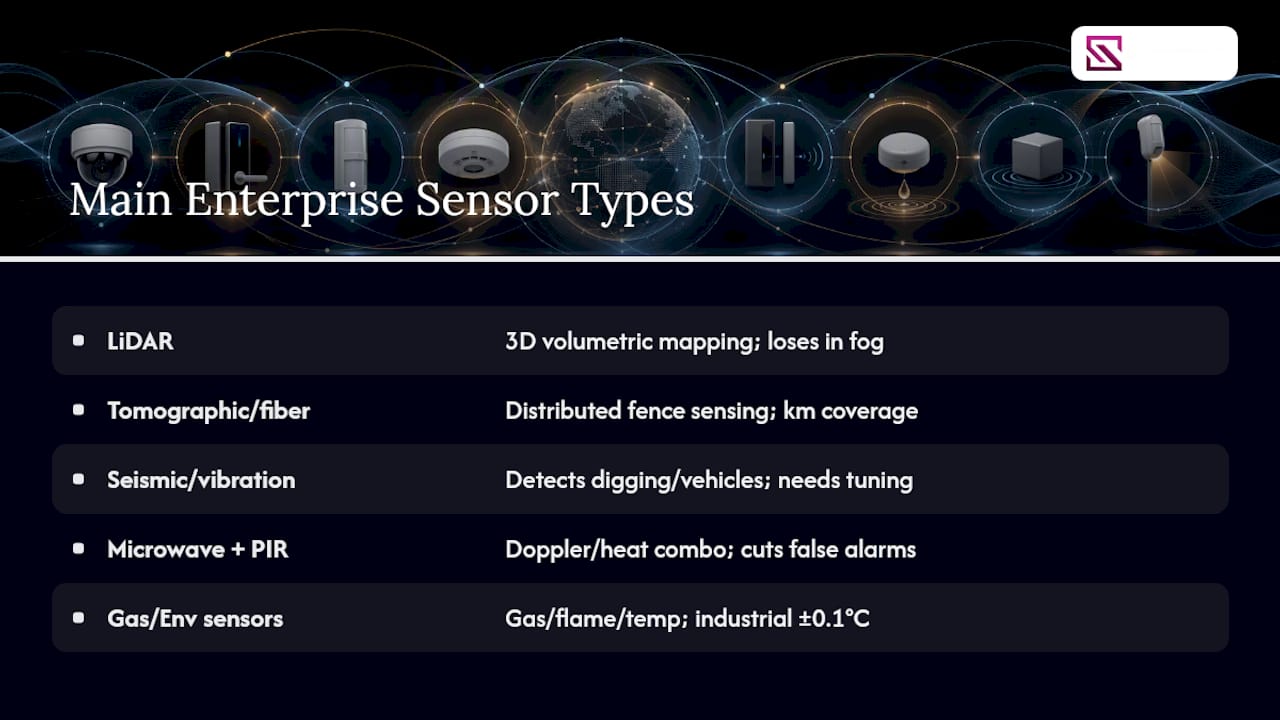
Enterprise-grade security sensing runs on eight core categories: LiDAR, tomographic/fiber, seismic, microwave/PIR, acoustic, gas/flame/smoke, temperature/humidity, and integrated IoT nodes. Consumer door contacts and glass-break detectors sit outside this scope entirely. Each category solves a distinct job: perimeter intrusion, volumetric detection inside a space, hazard detection in industrial environments, or continuous operational monitoring across a facility.
TL;DR:
- Combining sensor types like LiDAR and fiber-optic fences ensures reliable perimeter detection but requires layered fallback strategies for fog, rain, or dust conditions.
- Vendors must provide real detection metrics, including false alarm rates under outdoor conditions and verified field deployment data, to ensure sensor suitability.
- Secure communication protocols, standardized device identities, and proper edge-to-cloud rule placement are critical for maintaining an effective, cyber-secure security platform.
- Effective deployment depends on thorough site surveys, baseline ambient readings, deliberate sensitivity tuning, and scheduled maintenance routines.
- Multi-sensor architectures benefit from integrated planning and lifecycle support to prevent installation gaps, with vendors like Beyondsensor offering specialized services to streamline these processes.
Table of Contents
- What Are the Main Security Sensor Types for Enterprise Deployments?
- How Do You Choose the Right Security Sensor Specifications?
- How Should Sensors Integrate Into a Security Platform Architecture?
- Deployment and Maintenance: The Commissioning Checklist
- Comparing Security Sensor Technologies: Strengths and Trade-offs
- Emerging Sensor Technologies Worth Watching
- Integration Challenges When Combining Multiple Sensor Types
- Real-World Use Cases Across Security Scenarios
- Publisher Perspective: What Actually Separates a Working Deployment From a Failed One
- How Beyondsensor Supports Sensor Specification and Commissioning
- Sources
- FAQ
What Are the Main Security Sensor Types for Enterprise Deployments?
Choosing the right sensor category starts with matching the physics of detection to the problem you're actually trying to solve, not the marketing sheet. A perimeter fence needs something different than a warehouse floor, and a warehouse floor needs something different than a gas storage tank.
LiDAR uses pulsed laser ranging to build a live 3D map of a monitored zone, which makes it strong for volumetric detection and perimeter definition around irregular terrain. It handles darkness well but loses accuracy in heavy fog, rain, or dust, so outdoor deployments in tropical or industrial-particulate environments need a fallback sensor layered in.
Tomographic and fiber-optic sensors run continuous detection along the entire length of a fence line or wall, turning the barrier itself into a sensor. Because the detection element is distributed rather than point-based, tampering at any location along the run gets flagged, and coverage can extend for kilometers on a single fiber run with far fewer blind spots than discrete detectors.
Seismic and vibration sensors pick up ground-borne energy from vehicles, digging, or tunneling attempts. Sensitivity tuning matters enormously here. Set it too high near a road or rail line and you drown operators in nuisance alerts; set it too low and you miss the event you installed the sensor to catch.
Microwave and industrial PIR sensors detect motion through Doppler shift or heat signature change. Microwave units penetrate light barriers and cover long, narrow zones well, but they're prone to false triggers from moving foliage or reflective surfaces. Pairing microwave motion sensors with PIR in a dual-technology configuration is standard practice for cutting false alarm rates in outdoor perimeter zones.
Acoustic and shock sensors catch glass-break frequencies, impact events, and in specialized deployments, gunshot signatures. They're inexpensive to deploy densely but need frequency-discrimination tuning to avoid tripping on unrelated ambient noise.
Gas, flame, smoke, temperature, and humidity sensors cover environmental hazard detection. Industrial-grade units offer tighter accuracy bands, temperature precision around ±0.1°C and connectivity to plant control systems so a gas spike can trigger exhaust or suppression automatically rather than waiting on a human to see a dashboard alert.
Integrated multi-parameter sensor nodes fuse several of the above into one edge device, doing local pre-processing before data ever leaves the site. Specialist sensors — thermal imaging, radar, and license plate recognition (LPR) — round out the catalog for use cases like low-visibility perimeter watch or vehicle-access control at a gated facility.
How Do You Choose the Right Security Sensor Specifications?
Procurement decisions go wrong when buyers evaluate a sensor on a single spec sheet number instead of how it performs inside a full detection architecture. Work through these questions in order:
- Map the objective first. Perimeter intrusion, volumetric interior detection, and hazard monitoring call for different sensor families entirely — don't let a vendor's flagship product define your zoning plan.
- Demand real detection metrics. Ask for detection probability under stated environmental conditions, nuisance/false alarm rate per zone per month, range in meters, and ingress/impact ratings (IP66, IK08, and similar) rather than accepting marketing claims at face value.
- Confirm operating range tolerance. Temperature and humidity extremes vary by region, and a sensor rated for temperate climates may drift or fail in sustained tropical heat or monsoon humidity.
- Interrogate the integration path. Which protocols does it speak — MQTT, HTTP, Modbus? Does it support edge compute for local rule evaluation, or does every reading have to travel to the cloud before a decision gets made?
- Verify device identity and firmware update process. A sensor with no certificate-based authentication or no documented over-the-air update path is a liability the moment it's networked, because enterprise systems increasingly treat every sensor as an IT asset requiring VLAN segmentation and encrypted credential management.
- Check MTBF and spare-part availability. A sensor with a strong detection spec but a six-week lead time on replacement parts will create coverage gaps during the exact window you can least afford one.
- Ask for field validation, not lab results. Request deployment case data from a comparable climate and site type, not a controlled-lab detection rate.
Pro Tip: Ask every vendor for their false alarm rate under real outdoor conditions, not a lab-controlled figure. A sensor that looks flawless indoors can generate dozens of nuisance alerts a week once wind, wildlife, and temperature swings enter the picture.
Red flags worth walking away from: consumer-grade IP ratings on an outdoor perimeter product, no mention of cybersecurity controls anywhere in the technical documentation, and a vendor that can't produce a single documented field deployment.
How Should Sensors Integrate Into a Security Platform Architecture?
Detection hardware is only half the system. What happens to that signal between the sensor and the operator's screen determines whether your investment actually reduces risk or just generates noise.
- Split responsibilities between edge and cloud. Latency-sensitive rules, like triggering a local alarm the instant a fence-line sensor trips, belong at the edge. Audit trails, long-term analytics, and cross-site reporting belong in centralized cloud storage.
- Standardize on secure protocols. MQTT and HTTP dominate sensor-to-platform communication, and both need TLS encryption plus certificate-based device authentication running through it. A broker pattern that accepts unauthenticated device connections is an open door.
- Place your rules engine deliberately. Threshold logic that decides what counts as an "event" should sit close enough to the sensor to act fast, but every triggered rule needs to log to a central, auditable record for compliance review later.
- Build in redundancy. Mesh or dual-path communication prevents a single cut cable or dead access point from blinding an entire zone, and firmware lifecycle management needs a defined, tested update path rather than an ad hoc patch process.
The open-source Open-IoT-Industry-Security project is worth studying as a reference pattern here. It demonstrates a production-style ingestion-to-dashboard flow using FastAPI and React in a containerized stack, handling threshold-based alerts and even ML-driven anomaly detection across sensor types including flame, carbon monoxide, smoke, temperature, and humidity. It also supports simulated hardware ingestion, so integrators can validate rule logic before a single physical sensor ships to site. That kind of architecture, built for continuous operation and centralized auditability, is exactly what separates enterprise security platforms from consumer or light-commercial systems.
Deployment and Maintenance: The Commissioning Checklist
A sensor that performs perfectly on a bench can fail on site if commissioning skips the basics. Run through this sequence before calling any zone "live":
- Survey the site first. Check line of sight, vegetation growth patterns, mounting height, and nearby interference sources like motor equipment or RF-heavy machinery.
- Establish a baseline. Record ambient readings for at least one full day/night cycle before tuning thresholds, so you're calibrating against real conditions, not assumptions.
- Tune for false alarms deliberately. Adjust sensitivity in stages and log every adjustment; a rushed calibration pass is the single biggest cause of nuisance-alert fatigue among monitoring staff.
- Harden credentials at commissioning, not after. Replace every default password and certificate before the sensor goes live on the network.
- Run acceptance testing. Simulate the events the sensor is meant to catch and confirm the alert reaches the dashboard within the expected latency window.
- Set a maintenance cadence. Lens and housing cleaning, seal integrity checks, battery or service windows, and firmware updates all need a calendar, not a "when it breaks" policy.
- Report performance back to stakeholders. Periodic simulated-event testing and device-authentication checks give facility owners and integrators a documented record for audits.
Comparing Security Sensor Technologies: Strengths and Trade-offs
No single sensor family wins on every axis, which is exactly why enterprise deployments almost always layer two or more categories.
| Sensor Type | Strongest For | Main Trade-off |
|---|---|---|
| LiDAR | Volumetric mapping, perimeter definition | Degrades in fog, heavy rain, dust |
| Tomographic/fiber | Continuous fence-line coverage | Higher install complexity on curved terrain |
| Seismic/vibration | Underground/vehicle intrusion | Needs careful tuning near traffic or rail |
| Microwave | Long, narrow zone coverage | False triggers from foliage, reflective surfaces |
| Industrial PIR | Low-power interior/exterior motion | Shorter range than microwave |
| Acoustic/shock | Glass-break, impact events | Requires frequency discrimination tuning |
| Gas/flame/smoke | Hazard detection, plant safety | Needs calibration drift monitoring |
| Integrated IoT nodes | Multi-parameter fusion, edge filtering | Adds architecture and lifecycle complexity |
Microwave and PIR paired together solve each other's weaknesses, which is why dual-technology motion detection has become close to standard on outdoor perimeters. Fiber and tomographic sensors win on coverage length but demand more careful physical installation than a point sensor bolted to a post. Gas and flame sensors deliver the fastest life-safety payoff but only when tied into automated plant response, not just a dashboard alert someone might miss on a night shift.
Emerging Sensor Technologies Worth Watching
AI-powered sensing is moving detection logic out of the control room and onto the device itself. Rather than streaming raw readings for a human or a central server to interpret, modern environmental sensors now run pattern recognition locally, flagging a gas leak or thermal anomaly in under a second and generating an automated incident log for compliance review without waiting on manual triage.
Multispectral sensors extend detection beyond visible light and single-band thermal imaging, combining infrared, visible, and sometimes ultraviolet bands into one sensing element. That matters for scenarios where a single spectrum gets fooled, like camouflage that defeats visible cameras but not thermal, or smoke that obscures visible light but not certain infrared bands.
Sensor fusion at the edge is the broader trend underneath both developments. Instead of one sensor making one binary decision, an edge node now correlates readings from several sensor types before deciding whether an event is real. That correlation step is what actually cuts false alarm volume flowing upstream to central monitoring, rather than relying on any one detector's raw sensitivity setting.
Radar-camera fusion is also gaining ground in perimeter applications, since radar holds up in weather conditions that degrade optical and LiDAR performance, while cameras add the visual verification radar can't provide alone. None of these technologies replace fundamentals like proper zoning and commissioning. They add another layer of filtering on top of a foundation that still has to be built correctly first.
Integration Challenges When Combining Multiple Sensor Types
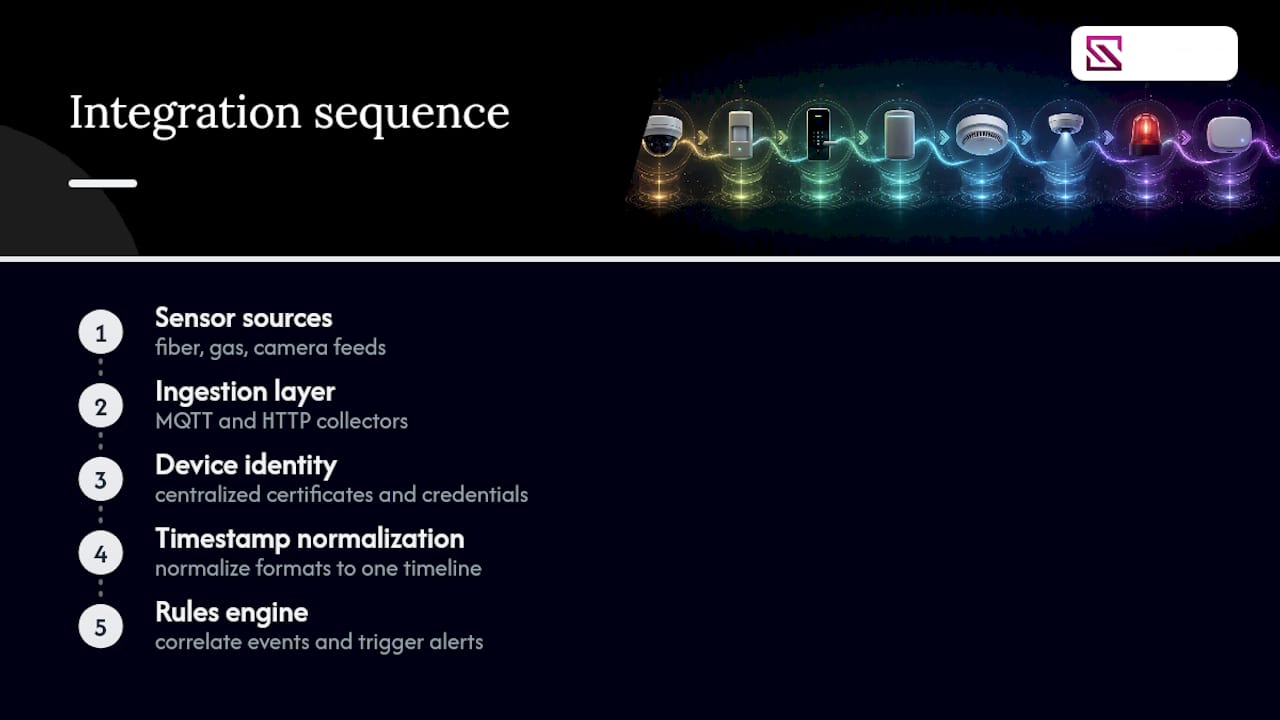
Layering sensor families creates a coverage advantage, but it also multiplies the number of things that can go wrong at the integration layer. The most common failure point is protocol mismatch: a fiber perimeter system speaking a proprietary format, a gas detection network on Modbus, and a camera system on ONVIF all need to land in one dashboard without someone hand-coding a translator for each pairing.
Device identity sprawl is the second recurring problem. Every additional sensor type brings its own authentication scheme, and without a centralized device-identity approach, integrators end up managing certificates and credentials across half a dozen disconnected systems. That's exactly the kind of fragmentation that turns a sensor network into a cybersecurity liability rather than an asset.
Timing and correlation issues show up next. If a seismic sensor and a fence-line fiber sensor both report activity but on slightly different clocks or with inconsistent timestamp formats, the rules engine can't reliably tell whether it's watching one event or two.
The practical mitigation is standardizing on a small number of ingestion protocols (MQTT and HTTP cover most modern hardware), centralizing device identity management from day one, and choosing a platform architecture, like the ingestion-and-rules pattern in Open-IoT-Industry-Security, that's built to normalize multiple sensor feeds into one timeline before rules ever get applied. Ecosystem matchmaking between vendors before purchase, rather than after installation, resolves most of these conflicts before they become field problems.
Real-World Use Cases Across Security Scenarios
A critical infrastructure perimeter, like a substation or water treatment facility, typically layers tomographic fiber along the fence line with microwave motion sensors covering open approach lanes and thermal cameras for low-light verification. The fiber catches tampering at the barrier itself; microwave catches anyone crossing open ground; thermal confirms whether it's a person or a stray animal before dispatch gets called.
A chemical storage or manufacturing site leans on gas and flame detection as the primary layer, with multi-parameter environmental nodes reporting continuously to a centralized platform and automatically triggering ventilation or suppression systems the moment a threshold is crossed, no operator decision required.
A logistics warehouse typically combines industrial PIR for interior motion, LPR at vehicle gates, and vibration sensors on high-value storage racking to catch tampering attempts that visual coverage alone would miss.
A government or defense facility commonly requires the deepest layering: seismic detection for underground approach, radar-camera fusion for all-weather perimeter watch, and acoustic sensors tuned for specific threat signatures, all feeding one rules engine with strict audit logging for compliance reporting.
Publisher Perspective: What Actually Separates a Working Deployment From a Failed One
Most procurement conversations start with sensor specs and end there too, which is backward. Field experience across industrial and physical security deployments points to a different priority order: integration architecture and lifecycle support matter more than any single sensor's detection range. A fiber sensor with a flawless spec sheet is worthless if it can't authenticate securely onto your network or if nobody's mapped out who updates its firmware in year three. Multi-vendor ecosystems, evaluated through structured matchmaking rather than one vendor's catalog, consistently reduce procurement risk because they force buyers to confront integration gaps before signing a contract, not after a failed commissioning test.
— Eumir
How Beyondsensor Supports Sensor Specification and Commissioning
Building a multi-sensor architecture that actually holds up under field conditions takes more than a hardware catalog. It takes someone who's already solved the integration puzzle across fiber, microwave, acoustic, and gas detection layers on real sites.

Beyondsensor's Solution Integration service exists for exactly the procurement and commissioning gaps outlined above, mapping detection objectives to sensor families, verifying protocol compatibility, and hardening device identity before anything goes live. For buyers weighing several vendors against each other, Ecosystem Matchmaking shortens that evaluation cycle by connecting integrators with validated hardware and platform partners instead of running blind vendor comparisons. Once sensors are in place, BeyondWatch and BeyondPatrol turn raw detection events into monitored, actionable operations rather than a dashboard nobody watches at 3 a.m. If your next deployment needs a partner who handles specification through commissioning, start with a conversation about your site's sensor architecture at Beyondsensor's solution integration page.
Sources
For a deeper technical look at ingestion and rules-engine design, review the Open-IoT-Industry-Security reference architecture. Beyondsensor's own guides on sensor integration architecture and essential sensing technology features go further into edge device design and industrial monitoring patterns covered throughout this guide.
- Open-IoT-Industry-Security (GitHub README)
- How Enterprise Security Systems Differ From Commercial Security | Prime Secured
- Commercial vs Residential Security Cameras — Connextivity
- Industrial Environmental Safety Monitoring Solution | NiuBoL
FAQ
What's the Difference Between Enterprise and Consumer Security Sensors?
Enterprise sensors are built for continuous operation, network integration through VLANs and PoE, and audit-grade logging, while consumer devices prioritize simple installation over integration depth.
Which Sensor Type Works Best for Perimeter Detection?
Tomographic/fiber sensors and microwave motion sensors are the two most common perimeter choices, often deployed together since fiber catches fence-line tampering and microwave covers open approach lanes.
How Do I Reduce False Alarms Across Multiple Sensor Types?
Layer complementary technologies (like microwave and PIR), tune thresholds against a real baseline recorded on-site, and push correlation logic to the edge so single-sensor noise doesn't trigger unnecessary alerts.
What Protocols Should an Enterprise Sensor Platform Support?
MQTT and HTTP cover most modern sensor integrations, with Modbus still common in industrial environmental monitoring; any platform should also support certificate-based device authentication over these protocols.
Does Beyondsensor Offer Sensor Integration Services?
Yes. Beyondsensor's Solution Integration and Ecosystem Matchmaking services support sensor specification, vendor evaluation, and commissioning; pricing details are available directly on the site.
Recommended
Read More Articles
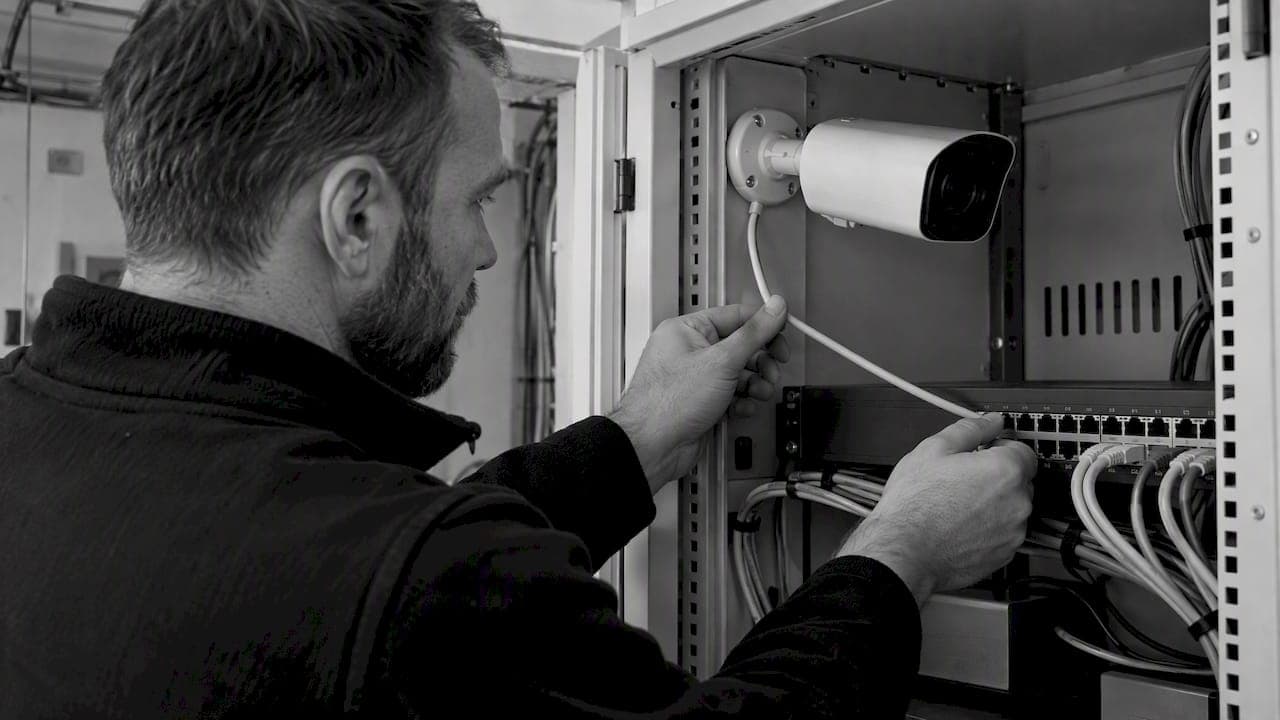
RTSP Security Risks: Integrators Must Block Exposed Ports 554 and 8554
See how integrators can reduce RTSP security risks: close exposed ports 554 and 8554, secure camera access, and verify each deployment with practical checks.

Require MAEpp and X Accuracy Before You Buy People Counting Systems
Verify people counting accuracy by demanding MAEpp, X Accuracy, and directional-bias reports. Validate on-site with at least 100 events per direction...
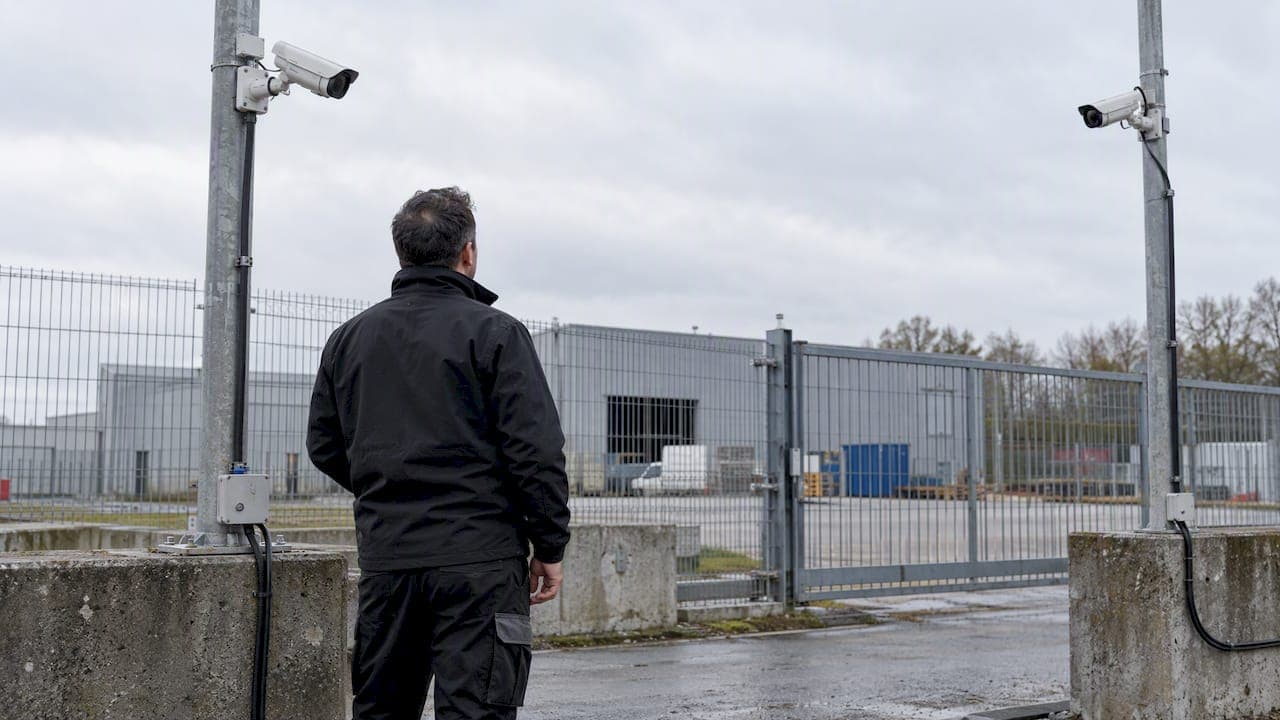
30–90 Day Pilot Validates Redundant Camera Networks for Engineers
Standards led, practical steps for engineers to deploy redundant camera networks: MRP, dual homing, and aggregation patterns, commissioning checks, and...

30 Day Pilot Proves Video Analytics Accuracy for Security Teams
Validate video analytics accuracy with scenario tests, camera tuning, transfer learning and a 30 day edge first pilot for security teams.
Let's Build YourSecurity Ecosystem.
Whether you're a System Integrator, Solution Provider, or an End-User looking for trusted advisory, our team is ready to help you navigate the BeyondSensor landscape.
Direct Advisory
Connect with our regional experts for tailored solutioning.