
Discover the crucial role of data privacy in sensing systems. Learn to protect insights while minimizing risks of surveillance and harm.

Data Privacy in Sensing: A Practitioner's Guide

TL;DR:
- Data privacy in sensing mandates protecting signals at the source to prevent surveillance and misuse. Layered controls like hardware protection, on-device processing, and purpose limitation are essential for safeguarding sensitive sensor data. Evaluating threat models and applying privacy-by-design principles are crucial for secure, trust-building sensor deployments.
Data privacy in sensing constrains what sensors can observe, store, and share so that derived insights remain operationally useful without exposing individuals or bystanders to surveillance, profiling, or inference-based harm. That constraint must be enforced at the point of generation, not patched on afterward. Protecting data at the moment it is generated is the recommended architecture for IoT sensor systems precisely because downstream controls cannot recover signals that were never protected at the source.
Three core functions define what privacy does for sensing systems:
- Limits collection: constrains which signals a sensor captures and retains, reducing the attack surface before data ever moves.
- Controls inference: prevents derived attributes (location, health state, behavior patterns) from being reconstructed from raw or aggregated sensor outputs.
- Governs sharing and retention: enforces purpose limitation, access controls, and deletion schedules across the full pipeline from edge to cloud.
High-impact controls that operationalize these functions include edge processing with on-device feature extraction, data minimization at the firmware layer, hardware-level protections, and privacy-preserving machine learning techniques such as federated learning and differential privacy.
Pro Tip: The most overlooked priority is hardware-level protection at digitization. Privacy-from-Birth (PfB) defends sensed data from the analog-to-digital conversion stage forward, so even a fully compromised software stack cannot exfiltrate raw signals. Start there before any algorithmic control.
Table of Contents
- Why sensor data privacy is fundamentally different from generic data privacy
- Where privacy risks actually live across the sensing pipeline
- Technical safeguards that actually work for privacy-preserving sensing
- US legal and regulatory constraints on sensor deployments
- Privacy-by-design principles for sensor systems that teams can actually follow
- How to evaluate threat models and measure privacy-utility trade-offs
- Use-case trade-offs: occupancy, activity, industrial, and environmental sensing
- What recent research says and how to apply it now
- Implementation checklist for privacy-first sensing
- Key Takeaways
- Why privacy-first sensing is an architectural commitment, not a compliance checkbox
- Curated sources for researchers and policymakers
Why sensor data privacy is fundamentally different from generic data privacy
Sensor outputs are not discrete records. They are continuous, high-frequency streams that carry side-channel artifacts most data-privacy frameworks were never designed to address. A wearable accelerometer does not just log steps; it encodes gait signatures that can re-identify individuals across sessions. An mmWave radar does not just detect presence; ISAC and mmWave spatial sensing can reveal fine-grained physiological signals including breathing rate and heart-rate patterns, creating privacy risks that no consent checkbox adequately covers.
The inferential power of sensor data is what separates it from conventional personally identifiable information. A single IMU trace can expose health conditions, emotional states, and daily routines without the subject ever knowing the data was collected. Bystanders face the same exposure: occupancy sensors, RF arrays, and environmental monitors capture anyone within range, regardless of consent.
Statistic callout: ISAC research classifies sensing risk into three tiers — location/environment, behavioral, and physiological — and identifies bystander exposure and consent as central unsolved challenges for next-generation spatial sensing systems.
Stakeholder harms are concrete: unconstrained sensing enables mass surveillance, discriminatory profiling, and physical safety risks when location or behavioral data reaches adversarial actors. Beyond regulatory compliance, adopting privacy-by-design and transparent data handling builds user trust and functions as a competitive differentiator for organizations deploying sensor networks.
Where privacy risks actually live across the sensing pipeline
Every stage of the sensing pipeline is a distinct risk surface. Knowing which layer is vulnerable determines where controls belong.
- Sensor hardware: Side-channel leakage from power consumption, electromagnetic emissions, or timing signals can expose raw measurements before any software layer processes them.
- Firmware: Telemetry routines embedded by manufacturers often transmit diagnostic data to vendor servers without operator awareness; over-privileged firmware can log far more than the application requires.
- Edge devices: Compromised edge nodes can exfiltrate pre-processed features or model outputs; physical access to edge hardware enables extraction of stored keys and cached data.
- Network transmission: Unencrypted or weakly encrypted sensor streams are vulnerable to interception; protocol-level metadata (packet timing, size patterns) can reveal behavioral information even when payloads are encrypted.
- Cloud analytics: Over-privileged cloud pipelines aggregate data across users and time windows, enabling re-identification from individually innocuous records; third-party analytics SDKs introduce supply-chain exposure.
- ML models: Model inversion attacks can reconstruct sensitive input features from model outputs or gradients; federated learning reduces raw-data sharing but introduces parameter-leakage risks if gradient updates are not protected.
- Third parties: Data brokers, cloud processors, and analytics vendors may re-purpose sensor-derived data beyond the original collection intent.
Bystander exposure compounds these risks. Aggregated inference across multiple sensors can reconstruct individual behavior patterns for people who never consented to monitoring. Risk also shifts with sensor modality: cameras carry the highest re-identification risk, IMUs expose behavioral and health signals, RF/ISAC arrays reveal physiological data, and quantum sensors introduce new side-channel surfaces that current regulatory frameworks have not yet addressed. Beyondsensor's work on emerging sensing modalities tracks these evolving threat surfaces for security practitioners.
Technical safeguards that actually work for privacy-preserving sensing
The dominant technical strategy is to shift sensitive processing to trusted boundaries — the edge or hardware — and apply algorithmic privacy only where collaborative or cloud-based computation is unavoidable. No single control is sufficient; layered protection across hardware, architecture, and algorithm is the standard.
| Control Category | Protection Scope | Compute Cost | Real-Time Suitability |
|---|---|---|---|
| Hardware PfB (encrypted ADC, secure storage) | Raw signal at digitization | Low (hardware-enforced) | High |
| Edge processing / on-device feature extraction | Raw data never leaves device | Medium | High |
| Differential privacy (noise injection) | Statistical inference from aggregates | Low–Medium | Medium |
| Homomorphic encryption | Data in use during cloud processing | Very High | Low |
| Federated learning | Raw data sharing across nodes | Medium–High | Medium |
| Trusted Execution Environments (TEEs) | Code and data in use on shared hardware | Medium | Medium–High |
| Adversarial representation learning | Sensitive attribute leakage from features | High (training) | Medium |
Hardware PfB protects the analog-to-digital conversion stage with hardware-enforced access control and encrypted storage, so raw signals never leave a protected boundary unencrypted. This is the foundation layer.
Edge processing and minimization extract only the features the application needs — a step count rather than a raw accelerometer trace, a presence event rather than a video frame. Short-lived feature extraction with automatic buffer clearing prevents accumulation of sensitive raw data.
Cryptographic approaches include homomorphic encryption, which enables computation on encrypted sensor data and reduces unauthorized exposure during cloud processing, and TEEs (such as Intel SGX or Arm TrustZone), which isolate sensitive computation on shared hardware. The trade-off is latency and compute cost; homomorphic encryption remains impractical for high-frequency real-time streams but is viable for batch analytics.
Privacy-aware learning covers federated learning, differential privacy, and adversarial representation learning. User-controllable few-shot frameworks like PrivCLIP enable dynamic, personalized privacy labels for IMU-based activity sensing without retraining large models — a practical path for deployments where user preferences vary.
A concrete edge-first pipeline for occupancy sensing: the sensor captures presence events at the edge, a local model scores occupancy probability, only the binary occupancy state (not raw RF or image data) is transmitted to the cloud, and raw buffers are cleared on a sub-second schedule. The encryption controls applied in industrial environments follow a similar pattern: encrypt at the edge, transmit only derived signals, and apply homomorphic techniques for any cross-site analytics.
Pro Tip: Combine hardware PfB with at least one algorithmic control — differential privacy for aggregate reporting or federated learning for collaborative training. Hardware protects the raw signal; the algorithmic layer protects derived insights. Neither alone covers the full threat surface.
US legal and regulatory constraints on sensor deployments
No single federal privacy statute governs all sensor data in the United States, which means legal exposure depends on data type, sector, and state of operation.
- CCPA/CPRA (California): Applies to personal information collected from California residents, including sensor-derived data that identifies or is reasonably linkable to an individual. Requires disclosure of data categories collected, purpose limitation, and opt-out rights for sale or sharing of personal information. Sensor deployments that feed behavioral profiles to third-party analytics vendors face direct CPRA exposure.
- BIPA (Illinois Biometric Information Privacy Act): Covers biometric identifiers and biometric information, including voiceprints and retina/iris scans. Critically, courts have extended BIPA scrutiny to gait analysis and other sensor-derived biometric proxies. Violations carry statutory damages of $1,000–$5,000 per incident, making BIPA one of the highest-litigation-risk statutes for sensing deployments in the US.
- HIPAA: Applies when sensor data constitutes protected health information — wearable medical devices, remote patient monitoring, and clinical-grade physiological sensors fall squarely within scope. De-identification under HIPAA's Safe Harbor or Expert Determination standards is required before data can be used for secondary analytics.
- FTC Act Section 5: The FTC treats failure to honor stated privacy commitments and deceptive data practices as unfair or deceptive acts. Sensor deployments that collect more data than disclosed, or share it with undisclosed third parties, face FTC enforcement regardless of sector.
Regulatory callout: State privacy laws are proliferating rapidly. As of 2026, more than 20 US states have enacted or are actively advancing comprehensive consumer privacy legislation, each with varying thresholds, exemptions, and biometric provisions. Security compliance guidance for sensing systems must account for the state of deployment, not just federal baselines.
Vendor and supply-chain controls are non-negotiable. When cloud processors handle sensor data, data processing agreements must specify purpose limitation, sub-processor restrictions, and deletion obligations. NIST's cryptography standards provide the technical baseline for encryption requirements that satisfy both FTC guidance and state-law security obligations.
Privacy-by-design principles for sensor systems that teams can actually follow
Start at the sensor and edge, minimize and purpose-limit by default, and make sensing states observable to users and bystanders. Those three rules cover the majority of deployment failures.
Operational checklist for privacy-by-design sensing:
- Data minimization: Capture only the signal the application requires. Default sensor configurations should collect the lowest-resolution data that meets the use case.
- Purpose limitation: Define and document the specific inference task before deployment; block secondary uses at the data-access layer.
- Retention schedules: Set automatic deletion for raw buffers (seconds to minutes at the edge) and derived features (days to weeks in the cloud), with documented exceptions for investigatory holds.
- Access controls: Role-based access to sensor streams and derived data; no standing access for analytics vendors.
- Transparency and consent UX: Provide clear, contextual notice at the point of sensing — physical labels on sensors in shared spaces, in-app indicators for wearables, and API-level metadata for developers consuming sensor feeds.
- Attestation and tamper evidence: Cryptographic attestation of firmware integrity at boot; tamper-evident logging for configuration changes.
- Secure update paths: Signed firmware updates with rollback protection; no unauthenticated over-the-air update channels.
Practical engineering patterns that operationalize these principles include default-off sensing (sensors activate only on authenticated trigger), short-lived feature extraction (raw buffers cleared immediately after feature computation), and on-device model scoring (inference runs locally, only the result is transmitted). Sensor integration strategies that embed these patterns at the architecture stage avoid the costly rework of retrofitting privacy controls post-deployment.
Pro Tip: Establish a privacy review gate before any new sensor modality or data feed is added to a production system. Require a documented data-flow diagram, a threat model, and a bystander-exposure assessment as conditions for deployment approval.
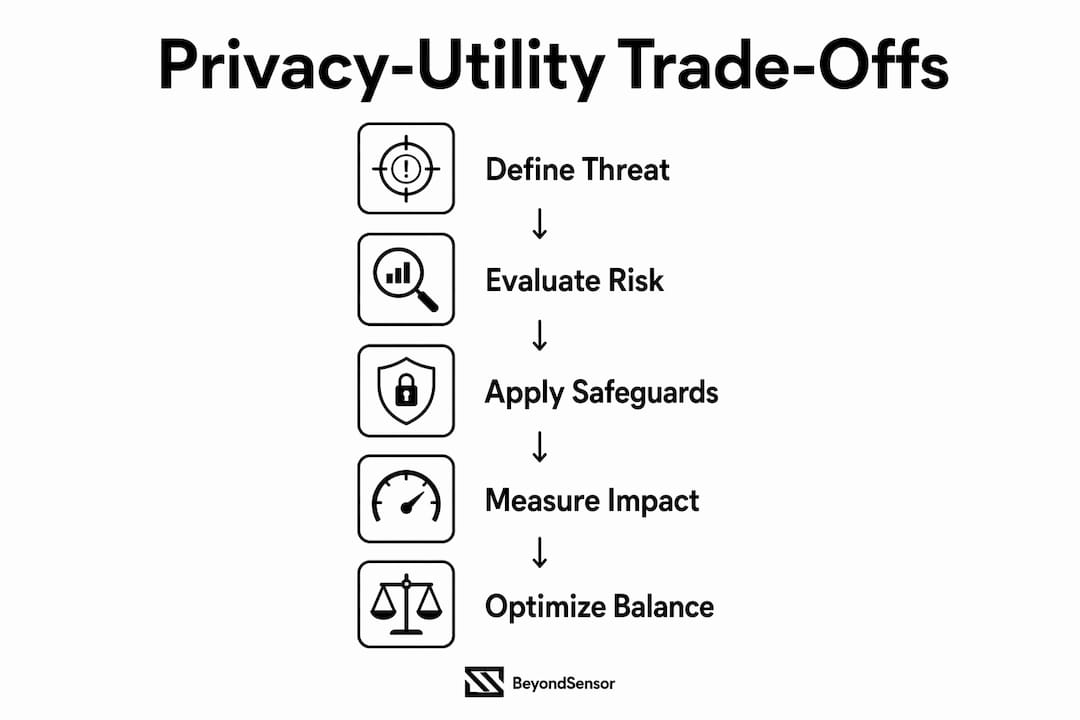
How to evaluate threat models and measure privacy-utility trade-offs
Four adversary models matter for sensing systems, and each demands a different control response.
- Honest-but-curious: A legitimate system participant (cloud processor, analytics vendor) that follows protocols but exploits access to infer sensitive attributes. Traditional encryption alone is insufficient against this adversary; architecture-level constraints and purpose limitation are required.
- Malicious outsider: An attacker intercepting transmissions or compromising edge nodes. Addressed by transport encryption, network segmentation, and hardware attestation.
- Side-channel adversary: Extracts information from power consumption, timing, or electromagnetic emissions rather than data payloads. Requires hardware-level countermeasures and PfB protections.
- State actor / persistent threat: Long-term access to infrastructure or supply chain. Requires supply-chain vetting, hardware root of trust, and end-to-end encryption with forward secrecy.
| Measurement Approach | Privacy Metric | Utility Metric | Applicability | Limitation |
|---|---|---|---|---|
| Differential privacy audit | Privacy budget (ε) | Accuracy loss vs. baseline | Aggregate analytics, federated learning | Choosing ε requires policy judgment |
| Inference attack simulation | Re-identification rate | Task accuracy | Activity sensing, occupancy | Requires realistic adversary model |
| Model inversion test | Reconstruction fidelity | Model performance | ML-based sensing pipelines | Computationally expensive |
| Few-shot bystander test | Sensitive-activity detection rate | Detection recall | IMU, RF, camera sensing | Rare-event datasets are scarce |
| Latency/compute profiling | Processing overhead | Real-time throughput | Edge and TEE deployments | Hardware-dependent results |
Practical evaluation protocols should include few-shot detection tests for rare sensitive activities (to mirror real-world edge cases), bystander simulation scenarios (to reveal exposure risks absent from standard datasets), and published privacy-utility benchmarks that allow cross-system comparison. Beyondsensor's sensor data analysis guide covers analytics workflow pitfalls relevant to these evaluation steps.
Use-case trade-offs: occupancy, activity, industrial, and environmental sensing
Use-case context determines what privacy-utility trade-off is acceptable. A hospital corridor occupancy sensor and a factory floor vibration monitor face entirely different consent obligations, inference risks, and retention requirements.

Occupancy sensing offers the clearest privacy-first path: replace raw video or RF captures with event-level outputs (occupied/unoccupied, count above threshold). The accuracy loss is minimal for most building-management applications, and bystander exposure drops to near zero. Where higher fidelity is needed, protecting sensitive installations with physical access controls and sensor-state indicators gives bystanders meaningful notice.
Human-activity sensing using IMU or accelerometer data carries significant re-identification risk. Raw traces encode gait, health conditions, and behavioral patterns. The recommended approach is on-device feature extraction with adversarial sanitization — stripping sensitive attributes before any data leaves the device. ISAC research classifies behavioral and physiological sensing outputs as the highest-risk tiers, requiring differentiated consent flows and stronger cryptographic protections than location data alone.
Industrial sensing involves operational telemetry (vibration, temperature, pressure) that may reveal proprietary process parameters or worker behavior. The tension is between retention for predictive maintenance and minimization for privacy. Purpose-limited retention schedules with role-based access resolve most of this tension without sacrificing operational utility. Beyondsensor's secure sensing practices for industrial operations address this balance directly.
Environmental sensing typically aggregates signals (air quality, noise levels, water chemistry) at a level that poses low individual-privacy risk. The exception is when fine-grained spatial or temporal resolution allows inference about specific individuals' locations or activities. Aggregate-only reporting with spatial generalization (grid-level rather than address-level) is the standard mitigation.
Sector-specific recommendations:
- Occupancy: default to event-level outputs; use physical sensor-state indicators in shared spaces.
- Activity sensing: sanitize on-device; apply PrivCLIP-style user-controllable privacy labels for personalized deployments.
- Industrial: enforce purpose-limited retention; restrict third-party analytics access to derived KPIs, not raw streams.
- Environmental: publish aggregate-only feeds; document spatial resolution in data-sharing agreements.
Pro Tip: For human-activity sensing pilots, run a bystander simulation before production deployment. Collect a small dataset that includes individuals who did not consent to monitoring and test whether your privacy controls prevent their re-identification. Most teams skip this step and discover the gap only after deployment.
What recent research says and how to apply it now
The research consensus is clear: shift protection to the point of generation, use homomorphic encryption and federated techniques where collaboration is required, and implement PfB at the hardware level before any software stack is trusted.
Four findings stand out for practitioners:
PrivCLIP and few-shot user control. Dynamic, personalized privacy labels for IMU sensing can be applied without retraining large models, making user-controllable privacy practical for production deployments rather than just research prototypes.
ISAC tiering. Classifying sensing outputs into location/environment, behavioral, and physiological tiers and applying differentiated protections per tier is the most operationally tractable framework for prioritizing controls and legal reviews in next-generation spatial sensing systems.
Limits of encryption alone. Traditional encryption is insufficient against honest-but-curious actors who have legitimate access to processed data. Architecture-level constraints — purpose limitation, access controls, perceptible sensing states — must complement cryptographic protections.
Multi-level protection taxonomy. Surveys of human-activity sensing categorize protections into signal-level obfuscation, algorithm-level encryption and federated learning, and system-level incentives such as blockchain coupling for collaborative tasks. Effective deployments combine controls from at least two of these levels.
"Protecting data privacy at the moment it is generated — not just downstream — is a recommended architecture for IoT sensor systems." Sensor-based IoT data privacy protection, Nature
For research agendas: publish reproducible privacy-utility benchmarks with explicit ε values and inference-attack simulation results. Include bystander scenarios in datasets. For engineering pilots: run few-shot detection tests before production, document the adversary model explicitly, and validate hardware PfB implementation with a third-party attestation check.
Pro Tip: When publishing privacy-preserving sensing research, include a bystander simulation dataset and report re-identification rates alongside task accuracy. Papers that omit bystander evaluation are increasingly flagged in peer review — and rightly so.
Implementation checklist for privacy-first sensing
A focused set of controls covers the majority of privacy risk in sensing deployments. Work through this checklist before any sensor system reaches production.
- Sensor selection and default settings: Choose sensors with the minimum resolution and modality required. Verify that default configurations do not log raw signals; disable telemetry features not needed for the application.
- Hardware PfB verification: Confirm that analog-to-digital conversion and early digitization stages are protected by hardware-enforced access control and encrypted storage. Request vendor documentation or third-party attestation. Beyondsensor's essential sensing technology features guide covers what to look for in security-focused sensor selection.
- Edge processing and feature extraction: Implement on-device feature computation. Set raw-buffer clearing schedules (sub-second for high-frequency sensors). Transmit only derived features or event-level outputs to the cloud.
- Cryptographic safeguards for collaboration: Apply transport-layer encryption (TLS 1.3 minimum) for all sensor data in transit. For cloud analytics involving sensitive data, evaluate homomorphic encryption or TEE-based processing. For multi-party sensing, implement federated learning with gradient protection.
- Consent and transparency UX: Deploy physical sensor-state indicators in shared spaces. Provide in-app sensing-state indicators for wearables. Include sensor data categories and purposes in privacy notices; obtain explicit consent for biometric-derived signals.
- Retention and access policies: Document retention schedules for each data type and tier. Enforce automatic deletion. Restrict access to raw streams to named roles; grant analytics vendors access only to derived outputs.
- Testing and benchmarks: Run inference-attack simulations before production. Conduct bystander exposure tests. Measure and document the privacy-utility trade-off (accuracy loss, ε, re-identification rate) for each control applied.
- Governance: Require a privacy review gate for new sensor modalities. Schedule annual audits of data-flow diagrams and access logs. Maintain a vendor data-processing agreement register with deletion and sub-processor clauses. Review cybersecurity for sensing devices obligations annually as state privacy laws evolve.
Key Takeaways
Privacy-first sensing requires hardware-level protection at digitization, layered algorithmic controls, empirical privacy-utility evaluation, and alignment with US legal obligations across the full sensing pipeline.
| Point | Details |
|---|---|
| Protect at the source | Implement Privacy-from-Birth (PfB) at the hardware layer before any software control is applied. |
| Layer hardware and algorithmic controls | Combine edge processing and data minimization with differential privacy or federated learning for collaborative use cases. |
| Evaluate empirically | Measure re-identification rates, differential privacy ε, and accuracy loss; include bystander simulation in every evaluation. |
| Map deployments to US law | Apply CCPA/CPRA, BIPA, HIPAA, and FTC guidance based on data type and state of operation, not just federal baselines. |
| Make sensing states visible | Deploy physical and UX indicators so users and bystanders can perceive when and what sensors are active. |
Why privacy-first sensing is an architectural commitment, not a compliance checkbox
The projects that get privacy wrong in sensing share a common pattern: privacy was treated as a documentation task rather than a design constraint. By the time a legal review flagged the gap, raw sensor streams had already been logged to cloud storage, third-party analytics vendors had ingested behavioral data, and the cost of remediation exceeded the cost of building it right from the start.
The research is unambiguous on this point. Encryption alone does not stop an honest-but-curious cloud processor from inferring sensitive attributes. A consent banner does not protect a bystander captured by an RF array. And a firmware update cannot retroactively protect raw signals that were never encrypted at digitization.
What actually works is treating the sensor as the first line of defense. Hardware PfB, edge-first processing, and purpose-limited data flows are not theoretical ideals; they are the controls that hold up under adversarial evaluation. The ISAC tiering framework gives teams a practical way to prioritize: physiological data demands the strongest protections and the most explicit consent flows, behavioral data requires sanitization and access controls, and location/environment data can often be handled with aggregate-only reporting.
For policymakers, the implication is that technology-neutral privacy statutes need sensing-specific guidance. The inference power of mmWave, IMU, and emerging quantum sensors outpaces what CCPA or HIPAA drafters anticipated. Sector-specific rulemaking — particularly for biometric-adjacent signals and ISAC deployments — is overdue.
For engineers and researchers: run the bystander test. It is the single evaluation step most teams skip, and it is the one most likely to reveal a gap that matters.
Curated sources for researchers and policymakers
These sources were selected for their survey breadth, policy relevance, and technical rigor. They cover the full range from foundational privacy frameworks to cutting-edge sensing research.
- ISAC Privacy: Challenges and Solutions for 6G: Defines the three-tier sensing risk taxonomy and addresses bystander exposure in next-generation spatial sensing; essential for ISAC and mmWave deployments.
- Privacy-preserving human activity sensing: A survey: Comprehensive taxonomy of signal-level, algorithm-level, and system-level privacy controls for IMU and wearable sensing; covers federated learning and homomorphic encryption trade-offs.
- Dynamic User-controllable Privacy-preserving Few-shot Sensing Framework (PrivCLIP): Demonstrates personalized, on-device privacy transformation for IMU sensing without large-model retraining; directly applicable to production deployments.
- Privacy-from-Birth hardware protections: Practitioner proposal for hardware-enforced protection at the analog-to-digital conversion stage; the foundational reference for PfB implementation.
- Sensor-based IoT data privacy protection (Nature): Peer-reviewed architecture recommendation for privacy-at-source in IoT systems; strong citation for design-principle justification.
- What Is Data Privacy? (IBM): Accessible overview linking privacy-by-design to trust and competitive advantage; useful for policy and business-case framing.
- NIST Cryptography Standards: The authoritative US technical baseline for encryption requirements; referenced in FTC guidance and state-law security obligations.
- Data Protection Explained (European Commission): Defines the seven GDPR principles (minimization, purpose limitation, storage limitation, etc.) that inform global privacy-by-design frameworks, including US best practices.
- Privacy as a Fundamental Right (Office of the Privacy Commissioner of Canada): Articulates the principle that organizations, not individuals, bear primary accountability for data protection; directly applicable to sensor deployment governance.
- Beyondsensor: Secure Sensing for Industrial and Environmental Operations: Beyondsensor's practitioner guidance on applying secure sensing principles to industrial and environmental monitoring deployments.
- Beyondsensor Tools: Beyondsensor's sensing tools and utilities for teams implementing privacy-first sensor integrations and analytics pipelines.
This article is general informational guidance, not legal or professional advice. Confirm current regulatory requirements with qualified legal counsel or the relevant primary authority for your specific deployment and jurisdiction.
Recommended
Read More Articles
RTSP Security Risks: Integrators Must Block Exposed Ports 554 and 8554
See how integrators can reduce RTSP security risks: close exposed ports 554 and 8554, secure camera access, and verify each deployment with practical checks.
Require MAEpp and X Accuracy Before You Buy People Counting Systems
Verify people counting accuracy by demanding MAEpp, X Accuracy, and directional-bias reports. Validate on-site with at least 100 events per direction...
30–90 Day Pilot Validates Redundant Camera Networks for Engineers
Standards led, practical steps for engineers to deploy redundant camera networks: MRP, dual homing, and aggregation patterns, commissioning checks, and...
30 Day Pilot Proves Video Analytics Accuracy for Security Teams
Validate video analytics accuracy with scenario tests, camera tuning, transfer learning and a 30 day edge first pilot for security teams.
Let's Build YourSecurity Ecosystem.
Whether you're a System Integrator, Solution Provider, or an End-User looking for trusted advisory, our team is ready to help you navigate the BeyondSensor landscape.
Direct Advisory
Connect with our regional experts for tailored solutioning.