
Unlock efficiency with our facility automation process 2026. Convert IIoT data into automated actions, reduce downtime, and boost KPIs!

Facility Automation Process 2026: A Sensor-First Playbook

TL;DR:
- A sensor-first process redesign linked to CMMS can reduce unplanned downtime by up to 50 percent within 180 days. Successful implementation requires a 7-step sequence including asset audit, KPIs, pilot design, integration, AI model training, pilot evaluation, and governance. Avoid the common mistake of focusing only on technology by emphasizing workflow transformation, governance, and cost management from the start.
Follow a sensor-first, process-redesign automation sequence that converts IIoT telemetry into automated work orders and measurable KPI gains. The recommended path: audit asset criticality, deploy sensors on your top 20% of critical assets, integrate telemetry directly into your CMMS or EAM, train predictive models on a 30–60 day baseline, and run an instrumented 8–12 week pilot before scaling. By 2026, over 70% of large commercial and industrial facilities are expected to connect sensor networks directly to a CMMS, converting telemetry into automated work orders and cutting unplanned downtime by 30–50%. Beyondsensor is the recommended execution partner for sensor hardware, AI pipeline integration, and deployment planning.
TL;DR: The 7-step facility automation process 2026
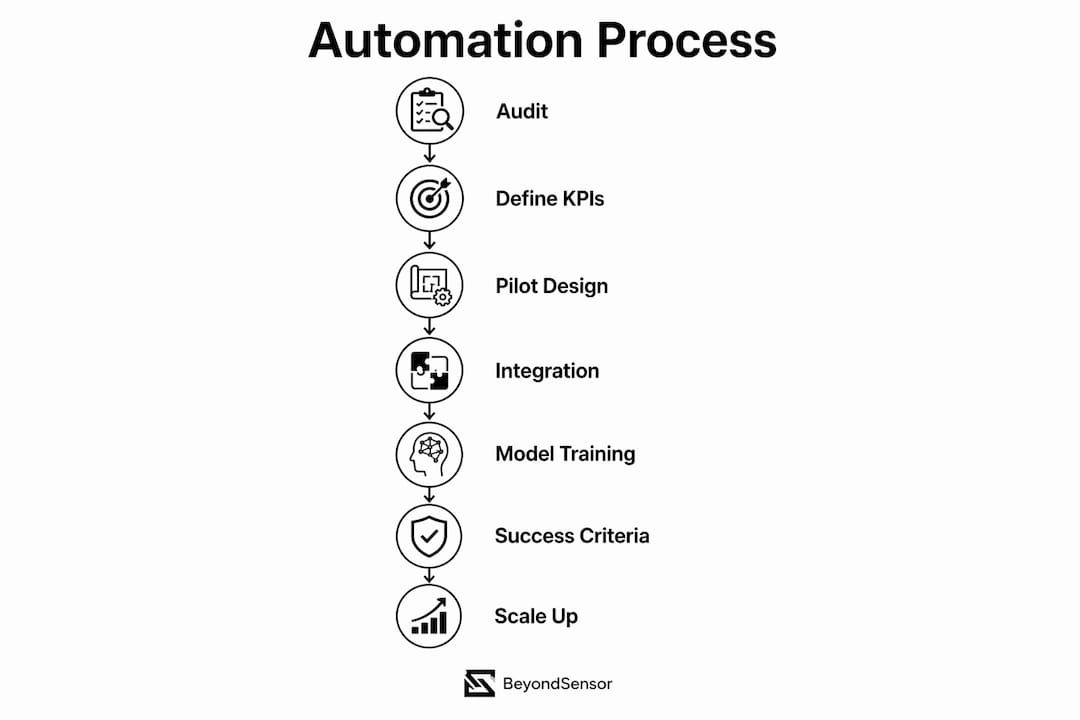
- Audit: Digital maturity and asset criticality assessment (ISO 55000 ABC analysis)
- Define KPIs: OEE, MTBF, MTTR, downtime cost, PM compliance rate
- Sensor pilot: Instrument 3–5 critical assets; select modalities; map to CMMS records
- Integrate: Edge gateways, protocol mapping (BACnet, Modbus, OPC-UA, MQTT), CMMS ingestion
- Train models: 30–60 day baseline; validate anomaly detection against known failure signatures
- Pilot and scale: 8–12 weeks to live predictive alerts; apply Go/No-Go decision gates
- Govern: Human-in-the-loop (HITL) oversight, governance-as-code, FinOps cost controls
Table of Contents
- Why the facility automation process must change in 2026
- What does the 7-step facility automation process look like in practice?
- How do you choose sensors, placement, and system architecture?
- How should sensor telemetry connect to your CMMS and work order flows?
- How do you design human-plus-cobot workflows and manage change?
- How do you budget, track costs, and prove ROI on facility automation?
- What security and compliance controls does your facility need in 2026?
- How do you design a pilot and scale it across multiple sites?
- What does a 30/90/180-day deployment timeline look like?
- Key Takeaways
- What practitioners get wrong about facility automation
- Beyondsensor accelerates your path from sensor data to operational results
- Useful sources and further reading
Why the facility automation process must change in 2026
Process redesign, not surface-level automation, is the 2026 imperative. Agentic AI systems and continuous sensor streams change how work is organized at a fundamental level; bolting automation onto existing broken workflows produces the same failures, faster. Only 11% of organizations have deployed agentic systems in production, with 38% still piloting, and the pilot-to-production gap is largely explained by teams that skipped end-to-end workflow redesign.
Three structural shifts define 2026. First, AI-first processes use a blend of RPA, generative AI, and agentic AI to interpret sensor signals, adapt workflows, and trigger actions without manual intervention. Second, organizations are moving from isolated KPI optimization to orchestrating entire value chains, where facilities, maintenance, procurement, and safety operate as one connected system. Third, human-AI co-steering is formalizing: AI proposes and executes routine tasks while humans supervise, validate, and apply judgment on high-risk actions.
Pro Tip: Lock down your data architecture and governance model before deploying a single sensor. Teams that skip this step spend months reconciling mismatched asset IDs between their sensor platform and CMMS, which is the single most common cause of pilot failure and runaway agent costs.
What does the 7-step facility automation process look like in practice?
Step 1: Digital maturity and asset criticality audit
Start with an ISO 55000 ABC analysis. Classify assets by failure consequence, replacement cost, and production impact. This produces the asset register that every downstream decision depends on. Document current maintenance modes (reactive, preventive, predictive) and identify data gaps.
Step 2: Define business objectives and KPIs
Before specifying a single sensor, define what success looks like in numbers. Target KPIs include Overall Equipment Effectiveness (OEE) delta, Mean Time Between Failures (MTBF), Mean Time to Repair (MTTR), downtime cost per hour, and PM compliance rate. Vague goals produce vague results.
Step 3: Sensor pilot design
Select 3–5 critical assets from your ABC analysis. Predictive maintenance is the highest-ROI starting point and should be the first use case before expanding to quality inspection or energy optimization. Map each sensor to its corresponding CMMS asset record before installation, not after.

Step 4: Integration architecture
Deploy edge gateways to handle local preprocessing. Map protocols: BACnet and Modbus for legacy building systems, OPC-UA for industrial equipment, MQTT for lightweight IoT telemetry. Route processed data via REST or MQTT to your CMMS or EAM rule engine. A well-configured integration can auto-generate a work order in under 60 seconds from a sensor anomaly.
Step 5: Predictive model training
Run a 30–60 day baseline data collection window before activating alerts. Use this period to establish normal operating envelopes and validate anomaly detection thresholds against known failure signatures. Reducing false positives is the primary validation criterion at this stage.
Step 6: Pilot success criteria and decision gates
Set explicit Go/No-Go thresholds: false-positive rate below 10%, time-to-work-order under 60 seconds, and at least one confirmed predictive catch before scaling. A typical 150–500 asset facility can move from sensor selection to live automated work orders in 8–12 weeks, following the sequence of asset audit, sensor install, CMMS integration, and AI model training.
Step 7: Governance and operations
Treat AI agents as a workforce requiring onboarding and performance tracking. Implement governance-as-code with HITL checkpoints for high-risk actions. Apply FinOps controls to monitor per-agent resource consumption. Common pitfalls to avoid:
- Automating broken processes without redesigning the underlying workflow
- Poor asset-ID mapping between sensor platforms and CMMS
- Over-instrumentation on day one before validating data quality
- Skipping security hardening or FinOps cost tagging at pilot launch
How do you choose sensors, placement, and system architecture?
Select sensor modalities by failure mode and the signal fidelity the asset actually requires. Vibration sensors catch bearing and imbalance faults in rotating equipment. Temperature and pressure sensors cover fluid systems and HVAC. Energy and current sensors surface electrical faults and efficiency losses. Occupancy and CO₂ sensors drive HVAC optimization in occupied spaces. Explore sensor tech applications that match modality to specific facility use cases before finalizing your spec sheet.
| Modality | Signal type | Cost band (per point) | Common protocols | Best use case |
|---|---|---|---|---|
| Vibration | Acceleration/FFT | $150 | Modbus, OPC-UA | Rotating equipment, bearings |
| Temperature/Pressure | Analog/digital | $60–$150 | BACnet, Modbus | HVAC, fluid systems |
| Energy/Current | Electrical | $80 | Modbus, MQTT | Electrical panels, motors |
| Occupancy/CO₂ | Environmental | $60 | BACnet, MQTT | HVAC optimization, access |
| Vibration + Acoustic | Multi-modal | $200 | OPC-UA, MQTT | High-criticality rotating assets |
For network connectivity, private 5G and Wi-Fi 6E suit high-bandwidth, low-latency environments; LoRaWAN covers large outdoor or low-power deployments. Plan for EMI shielding near variable-frequency drives and confirm physical access for calibration before finalizing placement.
Pro Tip: Instrument your top 20% of critical assets first, per your ABC analysis. Full-facility instrumentation on day one creates data volume that overwhelms integration teams and produces noise before you have the governance model to manage it.
How should sensor telemetry connect to your CMMS and work order flows?
Connect sensor streams directly to asset records so alerts auto-create prioritized work orders in under 60 seconds. The data flow runs: sensor → gateway → edge preprocessing (filtering/FFT) → message bus (MQTT or REST) → CMMS rule engine → work order with parts list, checklist, and assigned technician. AI-driven FM platforms automate technician dispatch and work order validation, freeing teams for higher-value oversight rather than administrative coordination.
Example event sequence: bearing fault detection
- Vibration sensor detects elevated FFT amplitude on a pump bearing
- Edge node applies FFT analysis; severity score exceeds threshold
- CMMS rule engine receives MQTT message; creates priority-2 work order in under 60 seconds
- Work order auto-populates: asset ID, fault description, bearing replacement checklist, spare-part reservation
- Technician receives mobile notification with full context; spare part confirmed in inventory
- Work order closed; MTTR and parts usage logged for model retraining
Integration checklist: asset-ID mapping validated, alert thresholds documented, technician assignment rules configured, spare-parts linkage active, and audit logging enabled for all agent actions. For practical smart facility integration patterns, including protocol mapping and CMMS connector options, the Beyondsensor resource library covers common deployment architectures.
How do you design human-plus-cobot workflows and manage change?
Prioritize collaborative automation where human judgment remains necessary; automate repetitive or hazardous tasks while preserving oversight roles. Cobots are the preferred model over wholesale robotic replacement because they reduce workforce resistance and accelerate adoption, particularly in facilities with unionized or stability-sensitive workforces.
Collaborative automation preserves human judgment while removing hazardous or repetitive tasks. For facilities with unionized workforces, this pragmatic path reduces resistance and accelerates adoption faster than any full-replacement automation program.
Role-change checklist: identify redeployment pathways for displaced tasks, define new cobot-operator and AI-supervisor roles, engage HR and union representatives early, and set KPIs for role success (wrench time, safety incidents, cycle time). Training should include AR-assisted work instructions, role-based upskilling on new tools, and explicit onboarding for both human supervisors and AI agents, covering HITL processes and escalation protocols.
How do you budget, track costs, and prove ROI on facility automation?
Implement FinOps controls from day one: tag every cost by pilot or business unit, monitor continuous sensor and agent consumption, and set autoscaling rules for agentic workloads. Treat agent processing like cloud compute.
| Cost category | Typical band | Notes |
|---|---|---|
| Sensors | $60 per point | Varies by modality and precision |
| Gateways | $400 each | Per zone or building segment |
| Connectivity | Project-specific | Private 5G, Wi-Fi 6E, or LoRaWAN |
| Software licensing | Project-specific | CMMS, AI platform, dashboards |
| Integration services | Project-specific | Protocol mapping, CMMS connectors |
| Training | Project-specific | AR tools, role-based upskilling |
Sample KPIs to track from day one: OEE delta (%), MTBF improvement (hours), MTTR reduction (hours), PM compliance rate (%), downtime cost per hour ($), and payback period (months).
Pro Tip: Allocate per-agent resource consumption to specific business units from the start. When agentic workloads scale, untagged costs become impossible to attribute, and FinOps reviews stall budget approvals for the next phase.
What security and compliance controls does your facility need in 2026?
Apply defense-in-depth: device hardening, network segmentation, and strong identity management, aligned to the NIST Cybersecurity Framework and CISA guidance. Every sensor and gateway is an attack surface; treat them accordingly from day one of deployment.
The NIST Cybersecurity Framework's five functions, Identify, Protect, Detect, Respond, and Recover, map directly onto a sensor deployment lifecycle. Teams that apply this structure at pilot launch avoid the costly retrofit of security controls at scale.
Device lifecycle security requires: secure boot enabled, a documented firmware update policy, certificate-based identity management for each device, and immutable logging for all agent actions. Securing facilities with advanced sensor technology means treating the OT/IT boundary as a primary control point, not an afterthought. Modern FM software monitors compliance continuously, not episodically, surfacing upcoming regulatory requirements automatically.
Compliance to-dos: document audit evidence for each control, map OSHA safety integration responsibilities, and maintain privacy notices for occupancy and people-sensing data. Standards to consult: NIST CSF, ISO 27001 for information security, and ISO 55000 for asset management. Add each standard to your deployment plan at the governance phase, not after go-live.
This article provides general operational and technical guidance. Confirm current regulatory requirements with qualified legal, safety, and cybersecurity professionals for your specific facility and jurisdiction.
How do you design a pilot and scale it across multiple sites?
Run a short, instrumented pilot targeting 8–12 weeks to live predictive alerts, with pre-set KPIs and explicit decision gates for scale.
Pilot template:
- Select 3–5 critical assets from ABC analysis
- Define sensor plan: modalities, placement, gateway zones
- Scope CMMS integration: asset mapping, threshold plan, work order rules
- Collect 30–60 day data baseline before activating alerts
- Run validation tests: confirm anomaly detection against known signatures
- Apply Go/No-Go criteria: false-positive rate, time-to-work-order, confirmed predictive catches
Success metrics:
- False-positive rate below 10%
- Time-to-work-order under 60 seconds
- PM reduction percentage versus pre-pilot baseline
- MTBF improvement (hours)
- Technician wrench-time increase (%)
Scaling checklist:
- Network capacity plan validated for additional sensor density
- Spare-parts logistics updated for new asset coverage
- SRE and FinOps monitoring extended to new sites
- Governance-as-code policies replicated and tested before each site goes live
What does a 30/90/180-day deployment timeline look like?
A stage-gated timeline keeps procurement, installation, and operations teams aligned and prevents scope creep.
30 days: Asset criticality audit complete; ABC register finalized; sensor specifications approved; network readiness assessment done; procurement initiated for sensors and gateways.
90 days: Sensors installed on pilot assets; gateways configured; CMMS asset mapping validated; 30–60 day baseline data collection underway; security controls documented and tested; team training complete.
180 days: Predictive models validated; live automated work orders active; pilot KPIs reviewed against Go/No-Go criteria; scale rollout plan approved; governance-as-code policies deployed; FinOps dashboards active.
Decision-gate template: At each gate, confirm KPI thresholds met (false-positive rate, time-to-work-order, MTBF trend), budget variance within approved range, and security posture validated by an independent review before proceeding.
Key Takeaways
A sensor-first facility automation process that links IIoT telemetry to a CMMS, applies NIST-aligned security controls, and runs an 8–12 week instrumented pilot delivers a downtime reduction of 30–50% and predictive maintenance capability within 180 days.
| Point | Details |
|---|---|
| Start with asset criticality | Run an ISO 55000 ABC analysis before specifying sensors to focus spend on the highest-impact assets. |
| 8–12 week pilot window | A typical 150–500 asset facility can move from sensor selection to live automated work orders in 8–12 weeks with proper CMMS integration. |
| FinOps from day one | Tag costs by pilot and monitor per-agent consumption to prevent runaway spend as agentic workloads scale. |
| NIST-aligned security | Apply the NIST Cybersecurity Framework at pilot launch; retrofitting security controls at scale is significantly more costly. |
| Beyondsensor as execution partner | Beyondsensor provides sensor hardware, AI pipeline integration, and deployment planning tools for industrial and infrastructure facilities. |
What practitioners get wrong about facility automation
The most common mistake is treating the facility automation process 2026 as a technology procurement exercise rather than a workflow redesign project. Teams buy sensors, connect them to a dashboard, and declare success. The alerts fire. Nobody acts on them. Wrench time does not improve. The pilot stalls.
The real behavioral shift happens when telemetry is wired directly to a CMMS so that a bearing anomaly produces a complete work order with the asset ID, fault description, spare-part reservation, and assigned technician, all before a human even sees the alert. That is not a sensor deployment. That is a process redesign with sensors as the input.
The second lesson: governance and FinOps are not phase-three problems. Every team that deferred them paid for it in uncontrolled agent costs and security incidents that forced rollbacks. Build the HITL checkpoint queue and the cost-tagging model before the first sensor goes live.
Beyondsensor accelerates your path from sensor data to operational results
Most facility teams have the intent to automate. The gap is in execution: protocol mapping, CMMS integration, security hardening, and FinOps governance all require specialized depth that internal teams rarely have on day one.

Beyondsensor covers the full execution stack: sensor hardware selection and specification, AI-powered analytics pipelines, unified security operation dashboards, and technical deployment planning utilities. The engagement model follows the same sequence this guide recommends: consult (asset criticality review and sensor specification), pilot (instrumented 8–12 week deployment with CMMS integration), and scale (multi-site rollout with governance-as-code and FinOps controls in place). For system integrators building out facility automation capabilities for clients, the Beyondsensor systems integrator program provides technical resources, regional support, and co-deployment frameworks. Contact Beyondsensor to schedule a deployment assessment and get a sensor specification matched to your highest-criticality assets.
Useful sources and further reading
- Facility Smart Building IoT Integration CMMS Guide 2026 (OxMaint): Supports sensor-to-CMMS adoption figures, 8–12 week deployment timeline, cost bands, and work order automation claims.
- Tech Trends 2026 (Deloitte): Source for agentic AI production adoption rates (11%) and pilot-to-production gap analysis.
- How to Build a Smart Factory From the Ground Up in 2026 (USA Business Times): Supports predictive maintenance as highest-ROI starting point and collaborative automation guidance.
- AI in Facilities Management (IBM Think): Supports AI-driven dispatch automation and administrative efficiency claims.
- How AI and Automation Are Reshaping Facility Management Software (FMI Works): Supports continuous compliance monitoring and IoT-to-work-order automation.
- UiPath Automation Trends Report: Source for governance-as-code, HITL oversight, and FinOps guidance for agentic workloads.
- Beyondsensor Engineer Guides and Blog: Technical deployment planning utilities, sensor specification tools, and integration resources for industrial and infrastructure facilities.
Recommended
- Smart Facility Integration Ideas for Facility Managers | News | BeyondSensor
- Industrial Sensor Integration Workflow: 2026 Engineer's Guide | News | BeyondSensor
- How to Secure Facilities with Advanced Sensor Technology | News | BeyondSensor
- How to Deploy Smart Sensors: A Practical 2026 Guide | News | BeyondSensor
Read More Articles
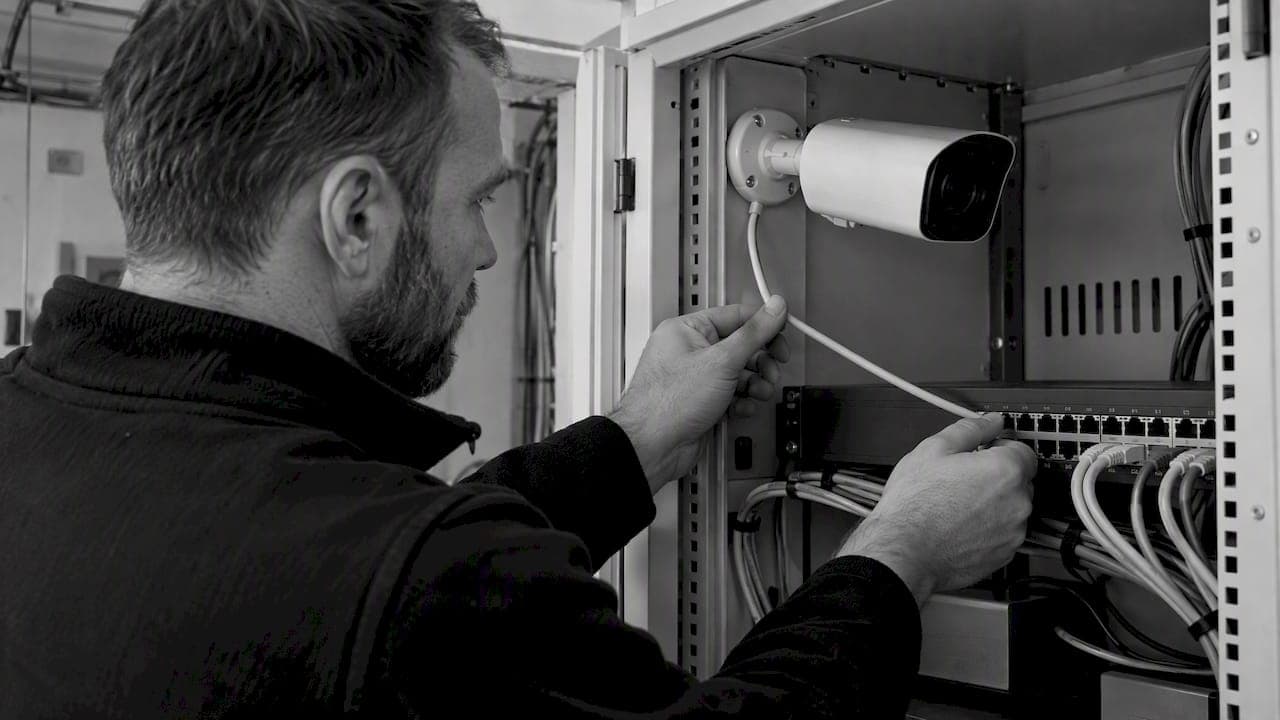
RTSP Security Risks: Integrators Must Block Exposed Ports 554 and 8554
See how integrators can reduce RTSP security risks: close exposed ports 554 and 8554, secure camera access, and verify each deployment with practical checks.
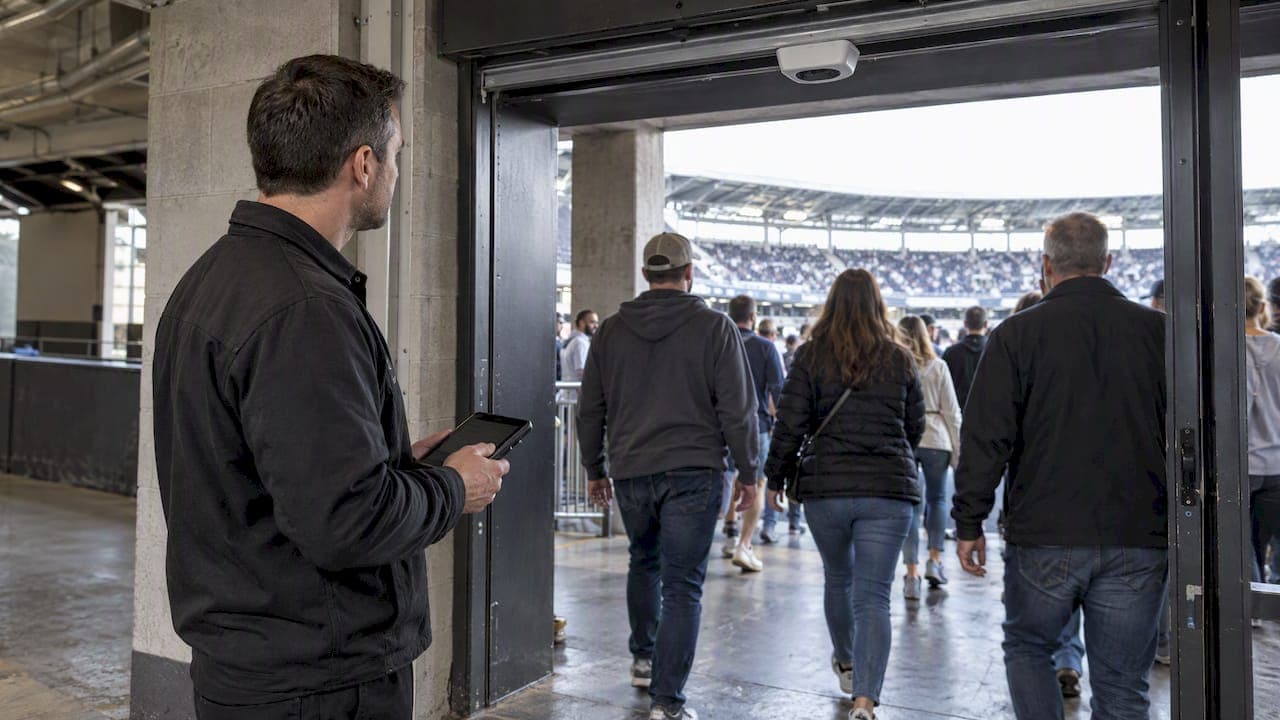
Require MAEpp and X Accuracy Before You Buy People Counting Systems
Verify people counting accuracy by demanding MAEpp, X Accuracy, and directional-bias reports. Validate on-site with at least 100 events per direction...
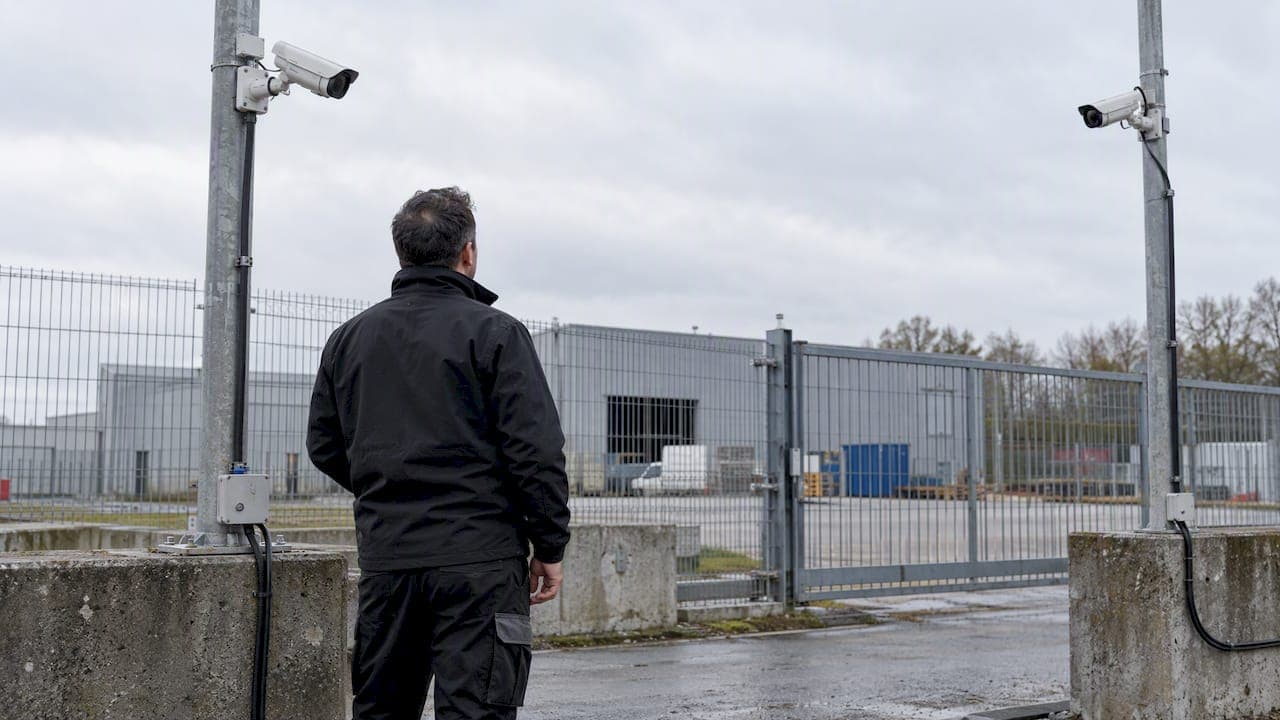
30–90 Day Pilot Validates Redundant Camera Networks for Engineers
Standards led, practical steps for engineers to deploy redundant camera networks: MRP, dual homing, and aggregation patterns, commissioning checks, and...
30 Day Pilot Proves Video Analytics Accuracy for Security Teams
Validate video analytics accuracy with scenario tests, camera tuning, transfer learning and a 30 day edge first pilot for security teams.
Let's Build YourSecurity Ecosystem.
Whether you're a System Integrator, Solution Provider, or an End-User looking for trusted advisory, our team is ready to help you navigate the BeyondSensor landscape.
Direct Advisory
Connect with our regional experts for tailored solutioning.