
Discover why digital transformation in security is crucial now. Learn how integrating cybersecurity protects your organization and supports growth.

Why Digital Transformation in Security Matters Now

TL;DR:
- Digital transformation in security integrates cybersecurity into every modernization effort to protect assets and enable growth. Embedding security early reduces breach risks, operational costs, and provides competitive advantages by building resilience.
Digital transformation in security is the strategic integration of cybersecurity into every digital modernization effort, from cloud migration to AI deployment, to protect data, systems, and operations while enabling business growth. Organizations that treat security as an afterthought during digital change pay a steep price. In 2025, 21.5% of organizations reported cybersecurity incidents causing significant operational disruption tied directly to transformation projects. The frameworks endorsed by NIST, CISA, and ISO all point to the same conclusion: security must be embedded from day one, not bolted on after the fact.
Why digital transformation in security changes your risk profile
Every digital initiative expands the attack surface. Cloud migration, IoT adoption, remote work, and AI integration each introduce new entry points that traditional perimeter defenses cannot cover. Legacy perimeter security was built for a world where data lived inside a defined network boundary. That world no longer exists.

The MGM Resorts ransomware attack is the clearest recent example of what happens when transformation outpaces security. Attackers used social engineering to bypass identity controls, then moved laterally across a digitally connected infrastructure. The result was days of operational shutdown and hundreds of millions in losses. The attack did not exploit exotic vulnerabilities. It exploited the gap between a modernized digital environment and an outdated security model.
The role of IoT in security compounds this problem. Each connected sensor, camera, or access control device is a potential entry point. Organizations deploying IoT at scale without embedding security into device management create sprawling, difficult-to-monitor networks.
"Traditional perimeter-based defenses are ineffective in modern expanded attack surfaces. Zero Trust and continuous verification are necessary responses to the risks introduced by cloud, IoT, and remote work."
AI adds another layer of complexity. AI both enhances detection and introduces new vulnerabilities. Adversarial attacks on machine learning models, prompt injection in AI-driven workflows, and automated phishing at scale are all direct products of AI adoption. Security teams must account for both sides of that equation.
What are the foundational security principles for digital transformation?
The security principles that underpin successful digital transformation are not theoretical. They are operational frameworks that organizations deploy today to manage real risk.
-
Zero Trust architecture. Zero Trust operates on the principle that no user, device, or network segment is trusted by default. Every access request requires continuous verification. This model is the direct response to the failure of perimeter security in cloud and mobile environments.
-
Identity-first security with phishing-resistant MFA. Identity is the new perimeter. FIDO2-based authentication and hardware security keys represent the current standard for phishing-resistant multi-factor authentication (MFA). Organizations that still rely on SMS-based MFA carry a known, documented risk.
-
Platform consolidation. Adding security tools without consolidation increases alert noise and overwhelms smaller security teams. A unified platform with correlated visibility reduces operational fatigue and increases the speed of incident response.
-
AI-augmented security operations. Extended detection and response (XDR) platforms unify telemetry across endpoints, networks, and cloud environments, enabling faster threat identification. AI never blinks, which means it catches patterns that human analysts miss at 3:00 AM.
-
Security integration in CI/CD pipelines. Embedding security checks into continuous integration and continuous delivery pipelines, a practice known as DevSecOps, catches vulnerabilities before code reaches production. This is the technical implementation of "shift left" security.
Pro Tip: Run a platform audit before adding any new security tool. If your team manages more than eight separate security consoles, consolidation will deliver more risk reduction than any single new product.
| Security Principle | Core Benefit | Key Standard or Framework |
|---|---|---|
| Zero Trust architecture | Eliminates implicit trust across all network segments | NIST SP 800-207 |
| Phishing-resistant MFA | Blocks credential-based attacks at the identity layer | FIDO2 / WebAuthn |
| XDR platform consolidation | Reduces alert fatigue and speeds incident response | ISO/IEC 27001 |
| DevSecOps integration | Catches vulnerabilities before production deployment | OWASP SAMM |
How do traditional and modern security approaches compare?
The contrast between legacy and modern security architecture is not subtle. Legacy hub-and-spoke models route all traffic through a central data center for inspection. That design made sense when applications lived on-premises. It creates serious problems when your workforce is distributed and your applications run in AWS, Azure, or Google Cloud.
Moving from hub-and-spoke to Zero Trust Network Access (ZTNA) removes the latency penalty of backhauling traffic through a central inspection point. Users connect directly to the applications they need, with access granted based on verified identity and device posture. The result is lower latency, reduced packet loss, and a smaller attack surface.
| Dimension | Legacy perimeter model | Modern Zero Trust model |
|---|---|---|
| Trust model | Implicit trust inside the network | Continuous verification for every request |
| Remote access | VPN with broad network access | ZTNA with application-level access only |
| Latency | High due to traffic backhauling | Low with direct-to-app connections |
| Breach containment | Flat networks allow lateral movement | Segmentation limits blast radius |
| Visibility | Limited to network perimeter | Full telemetry across users, devices, and apps |
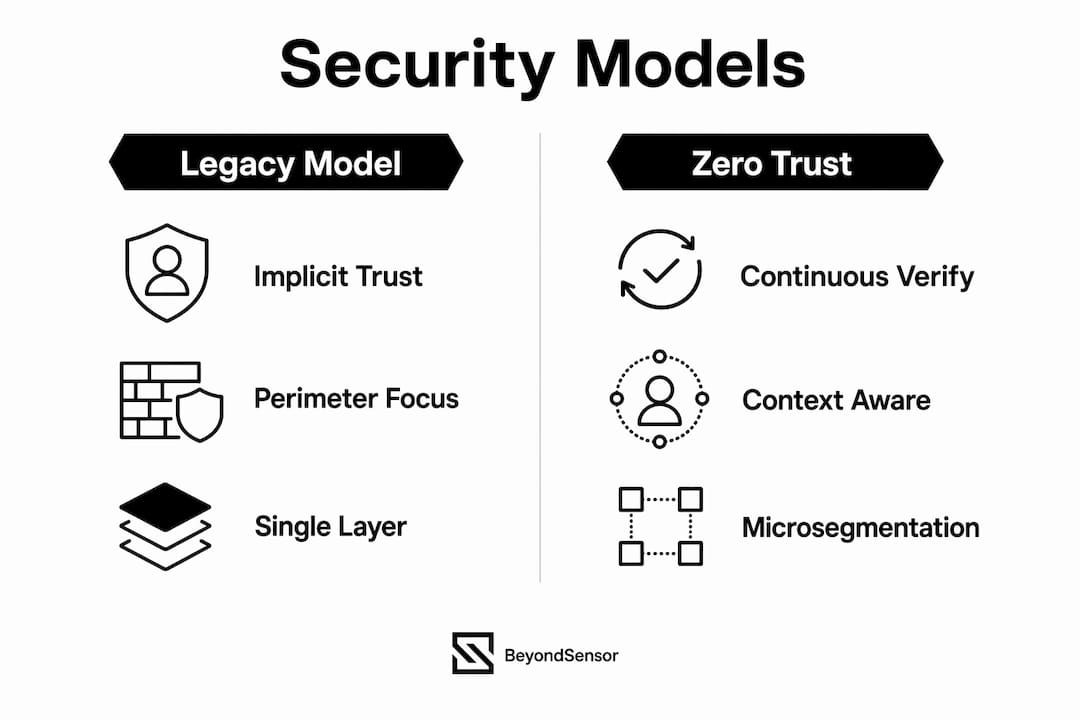
Context-aware security is the practical expression of this shift. Rather than asking "is this user inside the network?", modern systems ask "is this user, on this device, in this location, accessing this application, behaving normally?" That question produces far better security outcomes. Continuous monitoring and behavioral analytics, as security operations now require, detect anomalies that static rules miss entirely.
What are practical strategies for implementing security in digital transformation?
Successful security integration during digital transformation follows a clear pattern. Organizations that get it right share five consistent practices.
-
Involve security teams at project inception. Security succeeds when embedded early as a parallel engineering track. When security reviews happen at the end of a project, the cost of remediation multiplies. When they happen at the start, security becomes a design constraint rather than a blocker.
-
Apply risk-based prioritization. Not every asset carries equal risk. Threat modeling, using frameworks like STRIDE or PASTA, helps security teams focus effort on the systems where a breach would cause the most damage. This is how you get maximum impact from a finite security budget.
-
Upskill product owners and developers. Training product owners to handle routine security tasks prevents security specialists from becoming a bottleneck. The global shortage of cybersecurity professionals makes this approach not just efficient but necessary. Scalable security solutions depend on distributed security competence across teams, not just centralized expertise.
-
Consolidate tools before adding new ones. Alert fatigue is a real operational risk. A security team drowning in uncoordinated alerts from a dozen tools will miss the signal that matters. Platform consolidation, with correlated detection and automated triage, is the fix.
-
Test and validate continuously. Penetration testing, red team exercises, and automated vulnerability scanning should run on a regular cadence, not just before a compliance audit. Security audits are the feedback loop that keeps security controls aligned with an evolving threat environment.
Pro Tip: Map your digital transformation roadmap against a threat model before the first sprint begins. Every new capability you plan to build has a corresponding attack surface. Knowing that surface in advance is the difference between proactive and reactive security.
The economic case for this approach is direct. A one standard deviation increase in cybersecurity preparedness associates with 1–2 percentage points of higher annualized growth in digitally exposed sectors. Security investment is not a cost center. It is a growth driver.
Key Takeaways
Organizations that embed security into digital transformation from the start reduce breach risk, cut operational costs, and gain measurable competitive advantage over those that treat security as a compliance checkbox.
| Point | Details |
|---|---|
| Security belongs at project start | Embedding security early prevents costly remediation and keeps transformation on schedule. |
| Zero Trust replaces perimeter models | ZTNA reduces latency, limits lateral movement, and scales with cloud and mobile environments. |
| Platform consolidation cuts alert fatigue | Unified detection platforms reduce noise and help smaller teams respond faster to real threats. |
| Staff upskilling distributes security capacity | Training product owners on routine security tasks prevents specialist bottlenecks at scale. |
| Security preparedness drives growth | Higher cybersecurity readiness correlates with 1–2 percentage points of additional annualized growth. |
Security is the enabler, not the obstacle
I have watched organizations treat security as the department that says no. That framing is the single most expensive mistake a leadership team can make during a digital transformation program.
The organizations I have seen succeed treat security as a parallel engineering track, not a gate at the end of the process. Their security teams sit in sprint planning meetings. Their developers understand threat modeling. Their product owners own routine security tasks. The result is not slower delivery. It is faster delivery with fewer costly rollbacks.
The cybersecurity talent shortage makes this distributed model essential, not optional. You cannot hire your way out of a skills gap when the global pool of qualified professionals is structurally insufficient. You build security competence into every role that touches digital systems. Embedding resilience throughout your innovation roadmap is how forward-looking organizations turn security from a cost into a competitive signal.
The organizations that will define their sectors in the next decade are not the ones that moved fastest. They are the ones that moved fast and built security into every step. That combination is what organizations that embed security from the start consistently demonstrate: resilience and competitive advantage are the same thing.
— Eumir
Beyondsensor's AI-powered tools for secure digital transformation
Beyondsensor builds the sensing infrastructure that makes continuous monitoring and threat detection real in physical and digital environments. Their AI-powered solutions support system integrators and security teams deploying sensor-based security across industrial, infrastructure, and smart facility environments.

For organizations running digital transformation programs that include physical security, IoT integration, or edge analytics, Beyondsensor provides the hardware-software foundation that keeps those environments visible and verifiable. Their AI solutions for system integrators connect sensing data to automated detection workflows, reducing the manual oversight burden that slows most security operations. Explore Beyondsensor's full range of security tools to see how sensor-based intelligence fits your transformation program.
FAQ
What is digital transformation in security?
Digital transformation in security is the integration of cybersecurity frameworks, such as Zero Trust, continuous monitoring, and AI-driven detection, into every phase of an organization's digital modernization program. It treats security as a design requirement, not an afterthought.
Why does digital transformation increase security risk?
Cloud migration, IoT adoption, and remote work each expand the attack surface beyond what traditional perimeter defenses can cover. In 2025, 21.5% of organizations reported cybersecurity incidents directly linked to transformation-related vulnerabilities.
What is Zero Trust and why does it matter for digital transformation?
Zero Trust is a security model that requires continuous verification of every user, device, and connection, regardless of network location. It replaces the legacy assumption that anything inside the network perimeter is safe, which fails in cloud and mobile environments.
How does platform consolidation improve security operations?
Adding security tools without consolidation increases alert noise and overwhelms security teams. A unified platform with correlated telemetry reduces operational fatigue and speeds up the identification of real threats.
What is the business case for investing in security during digital transformation?
Higher cybersecurity preparedness associates with 1–2 percentage points of additional annualized growth in digitally exposed sectors. Organizations that embed security from the start also avoid the remediation costs and reputational damage that follow a major breach.
Recommended
Read More Articles

RTSP Security Risks: Integrators Must Block Exposed Ports 554 and 8554
See how integrators can reduce RTSP security risks: close exposed ports 554 and 8554, secure camera access, and verify each deployment with practical checks.

Require MAEpp and X Accuracy Before You Buy People Counting Systems
Verify people counting accuracy by demanding MAEpp, X Accuracy, and directional-bias reports. Validate on-site with at least 100 events per direction...

30–90 Day Pilot Validates Redundant Camera Networks for Engineers
Standards led, practical steps for engineers to deploy redundant camera networks: MRP, dual homing, and aggregation patterns, commissioning checks, and...

30 Day Pilot Proves Video Analytics Accuracy for Security Teams
Validate video analytics accuracy with scenario tests, camera tuning, transfer learning and a 30 day edge first pilot for security teams.
Let's Build YourSecurity Ecosystem.
Whether you're a System Integrator, Solution Provider, or an End-User looking for trusted advisory, our team is ready to help you navigate the BeyondSensor landscape.
Direct Advisory
Connect with our regional experts for tailored solutioning.